The Symmetric World
What Einstein Missed, Part 3 — on the cosmic structure required by negative mass
Separated, Not Absent
Entropy reversal is never observed in our region — a two-century fact. If negative mass produces entropy reversal (Part 2), it must sit where observation cannot reach. Bondi's 1957 runaway-motion calculation, long taken as proof of negative mass's impossibility, is reread here as the condition of structural separation.
Light Is the Boundary
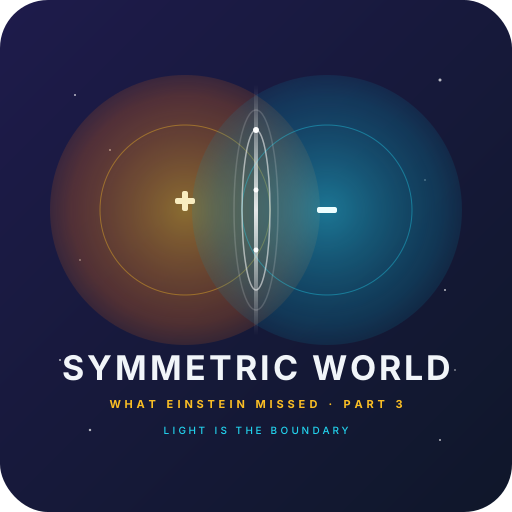
Mass makes time (from the earlier essays). Zero mass means zero time — and zero time is precisely the condition of an interface between directions. Photons experience no proper time because they sit exactly on the edge between the positive-time layer and the negative-time layer. Their masslessness isn't a particle property — it's a geography.
Photons, Gluons, Gravitons Are the Same Boundary
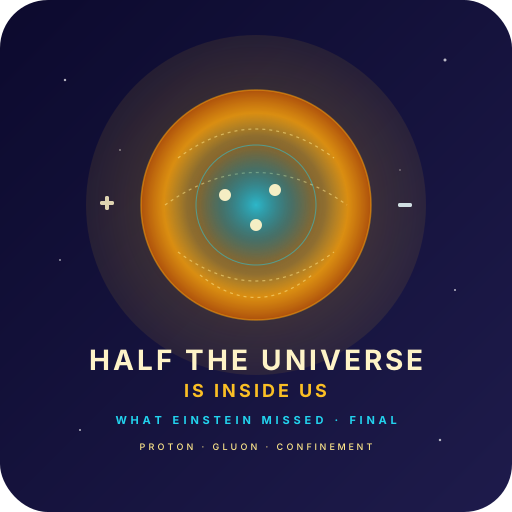
All three massless gauge bosons sit on the same boundary surface and differ only in the frequency band and coupling charge through which they probe it. What we call three particles is three windows onto one surface — and that surface already runs through everything made of atoms.
The Weak Force's Asymmetry Resolved
Parity violation has been a problem since 1956. If the Higgs vacuum has a symmetric pair, and we only observe one direction of its symmetry breaking — our layer's direction — then the asymmetry of the weak force is simply the asymmetry of the observer's location, not of the law itself.
Distinct From Multiverse and From Dark Matter
The proposal is symmetric, not multiverse (no probabilistic bridge — a structural boundary). It is also not “negative mass is out there somewhere in our region” — that would have shown up in Bondi-type signatures. The 2025 MNRAS Yonsei result reopens whether cosmological acceleration — the foundation of dark energy — was an artifact. The Symmetric World does not rely on dark energy.
A Chain, Not a Set of Claims
Each of the four insights required the previous one and made the next inevitable. The essay is presented as derivation, not assertion: take the premises of the previous two essays seriously, and refuse to stop applying them halfway — this is what follows.
Insights
Learn more