Cute Only in Your Eyes
On parents who impose their love on others — and the village that disappeared
When Love Becomes Coercion
Loving a child is private. Asking strangers to share that love at the same intensity is public. The slip from "my child is precious" to "everyone must treat my child as precious" is what turns parenting into the etiquette failure caricatured in cafés, restaurants, and airplanes — and the children pay the highest price.
The Village That Disappeared
Sarah Hrdy's "cooperative breeder" thesis: humans never evolved to raise a child with two parents alone. Efé infants are held by ~14 different people on day one. A child needs ~13 million calories to independence — far more than two parents can provide. East Asia compressed two centuries of nuclear-family transition into 60 years; the village vanished.
East Asian Acceleration
2024 Korean fertility 0.75. Japan 1.20 for 47 years. Taiwan 0.87, Singapore 0.97. The "4-2-1 structure" — four grandparents, two parents, one child. Love density per child is historically unprecedented. Compressed into a single child, love does not nourish; it crushes. And it demands the same density from strangers.
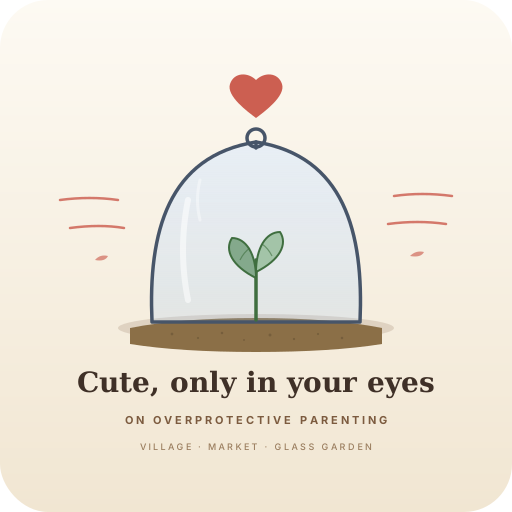
The Glass Garden in the US
Strong child-protection laws sealed children off from the village. Helicopter parenting (Lythcott-Haims, 2015) filled the inside. The 2022 Frontiers in Psychology meta-review confirmed: helicopter parenting correlates consistently with child depression and anxiety. Different mechanism, same glass-garden outcome — protected, unwindblown, brittle.
Friction Is Not Trauma
The ACE Study (1995-1997) showed strong adversity damages. Tedeschi & Calhoun's "post-traumatic growth" (2004) showed surviving adversity strengthens. Between them: small frictions — a friend's slight, a teacher's correction, a stranger's no — train the recovery circuits. Too little friction leaves the circuit untrained. The Korean Seoi-cho teacher case shows the price of removing all friction.
Letting Go Is the Point
For 100,000 years humans raised children to leave the parent's hand. Hunter-gatherer puberty rites, agricultural marriage, industrial-age schooling — every culture institutionalized the moment of release. The deepest expression of love is loosening the grip. The conclusion isn't "love your child less"; it's "love them in the form that releases them."
Insights
Learn more