The Obsolescence of Smartness: Humanity's Next Mission Post-AI
The End of Human Intellect and the Rise of Planetary Engineers — Absolute Control Over Natural and Social Environments
The Collapse of Smartness as a Symbol
Prestigious degrees, IMO gold medals and professorial titles long represented the pinnacle of mathematical and logical brilliance, the absolute benchmark by which civilization proved personal worth and distributed status and power. But when AI proves complex theorems in seconds and generates decades of scholarly research with a few clicks, claiming human superiority through elite titles becomes meaningless. Since even Nobel-level paradigm shifts will soon be overtaken by AI's distant recombination of trillions of data points, humanity must ask what people who have outsourced intelligence to AI should strive for next.
Five Layers of Intelligence and Humanity's Shrinking Ground
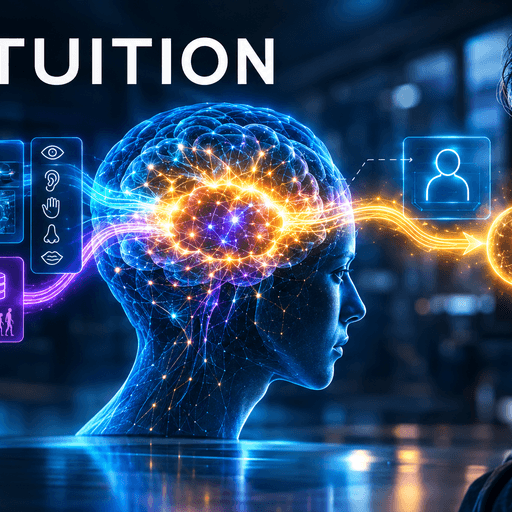
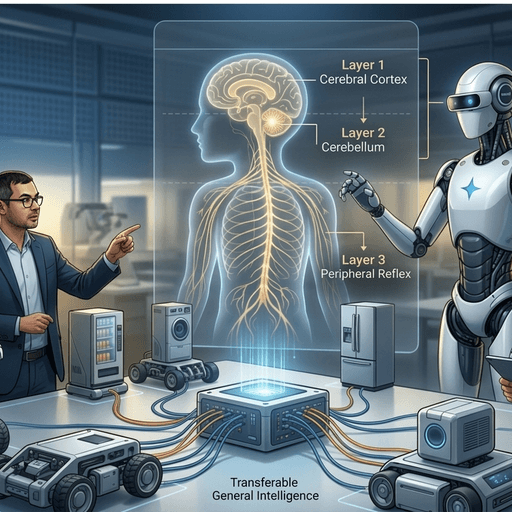
Sensory-motor intelligence is being replaced by humanoid robots and embodied AI, emotional-social intelligence by real-time analysis of faces and voices that mimics empathy, and ecological-temporal intelligence by planetary sensor networks and forecasting models. In abstract-symbolic intelligence AI has already far surpassed humans in computation and logic, and even creativity is under threat, since monumental inventions such as spacecraft or the internet are not created from nothing but are distant recombinations of existing knowledge. Even self-aware metacognition, the setting of one's own purpose and ethics, is increasingly outsourced to autonomous agents.
From a History of Adaptation to a History of Control
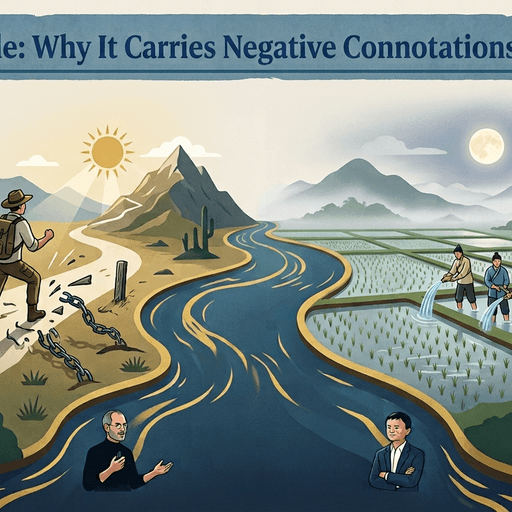
The greatness of humanity shown in Interstellar lies not in a mind solving equations in a room but in the physical capacity to overcome a ruined environment and set out for a new planet. The true keyword of human history has been the environment: natural environments such as earthquakes and climate, and social and institutional environments such as inequality, AI capital monopolies and political polarization. Before both, humanity has only evacuated, rebuilt and endured. Now that it holds superintelligence as a tool, its goal is to build absolute systems in which no natural or social ordeal can threaten the survival of the species or the ground it lives on.
Biological Autonomy and Planetary Mastery: Controlling the Natural Environment
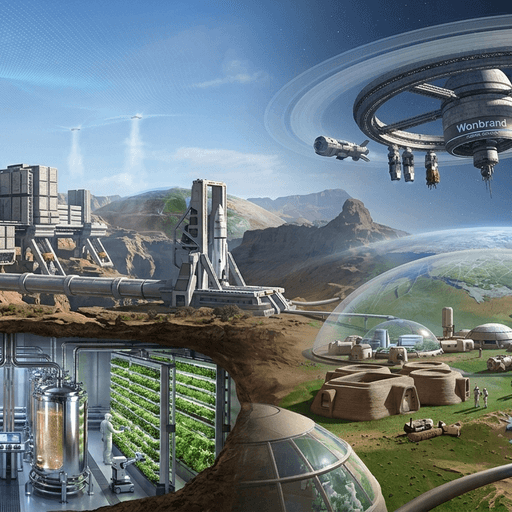
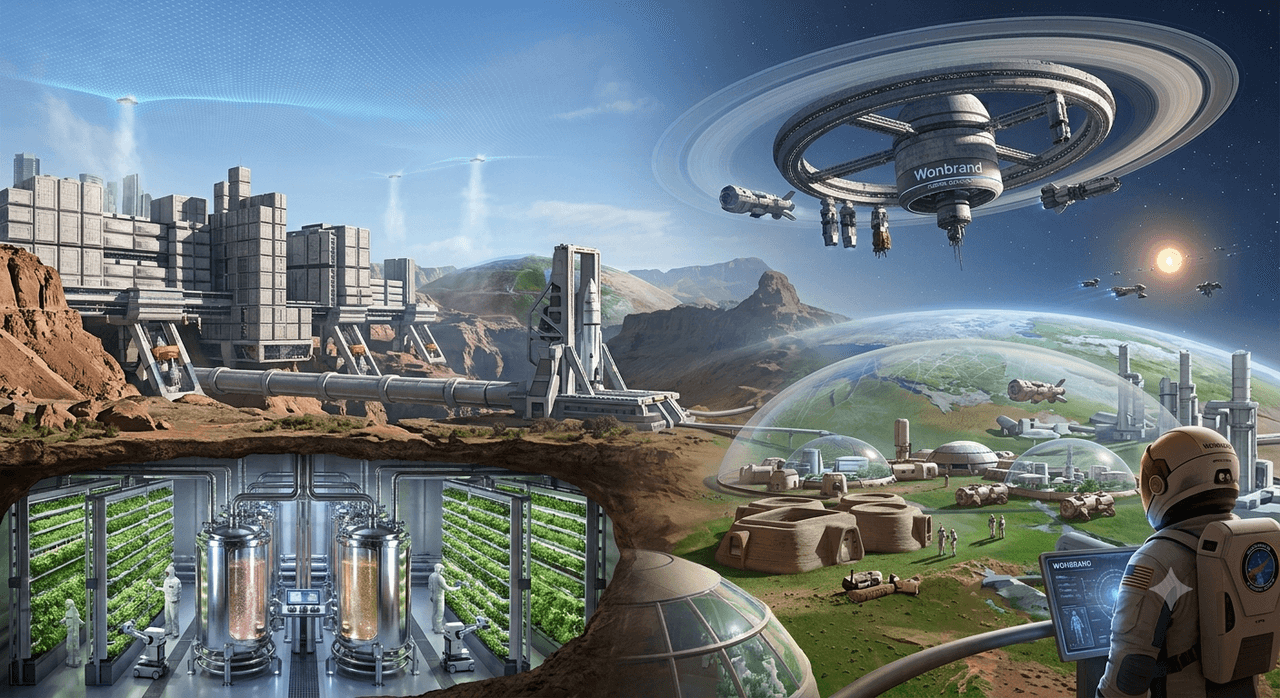
The first pillar leaves behind a primary industry dependent on climate, soil and seasons, synthesizing food and resources at the molecular and cellular level. Precision fermentation and cultured meat have reached early commercialization, cutting land use by over 90% and water consumption by over 95% compared with conventional livestock farming, while ultra-low-cost mass-production bioreactors remain the challenge. The second pillar predicts, absorbs and dissipates the energy of earthquakes, typhoons and eruptions to drive disaster damage toward zero, with AI weather models being deployed and solar radiation modification (SRM) now in simulation and small-scale trials. Next come control over the cascading side effects of local intervention in a complex climate system, and the capture and storage of disaster energy.
Social Resilience and Cosmic Permanence: Governing Society and Expanding Beyond Earth
The third pillar is a socio-engineering system that contains collapse risks arising within humanity itself, such as vanishing jobs, extreme wealth concentration and information monopolies. Basic income pilots, regulation of Big Tech AI monopolies and AI policy simulation are under way; the challenges are preventing a loss of meaning after the dissolution of labor and governing superintelligence as a common public good of civilization. The fourth pillar escapes single-planet extinction risk by turning the Moon and Mars into habitats, with 3D-printed habitats built from lunar regolith and closed-loop life support recycling over 99% of oxygen and water in development. Radiation shielding, artificial gravity and terraforming remain ahead.
New Ethical Dilemmas and Active Planetary Engineers
As environmental control becomes concrete, new dilemmas appear: geoengineering sovereignty over who decides the planet's temperature, the risk that AI systems for distribution and monitoring devolve into a hyper-surveillance state, and the ethical boundary of modifying the human body itself. Yet nature is not a gentle mother, and unmanaged social systems do not protect people. Passive adaptation is intellectual negligence, and the only mission left to humans who have outsourced intelligence to AI is to become Active Planetary Engineers who survive and control any environment, however hellish.
Insights
Learn more