
The Obsolescence of Smartness: Humanity's Next Mission Post-AI
The End of Human Intellect and the Rise of Planetary Engineers — Absolute Control Over Natural and Social Environments
An Seungwon · Wonbrand CEO · September 12, 2026
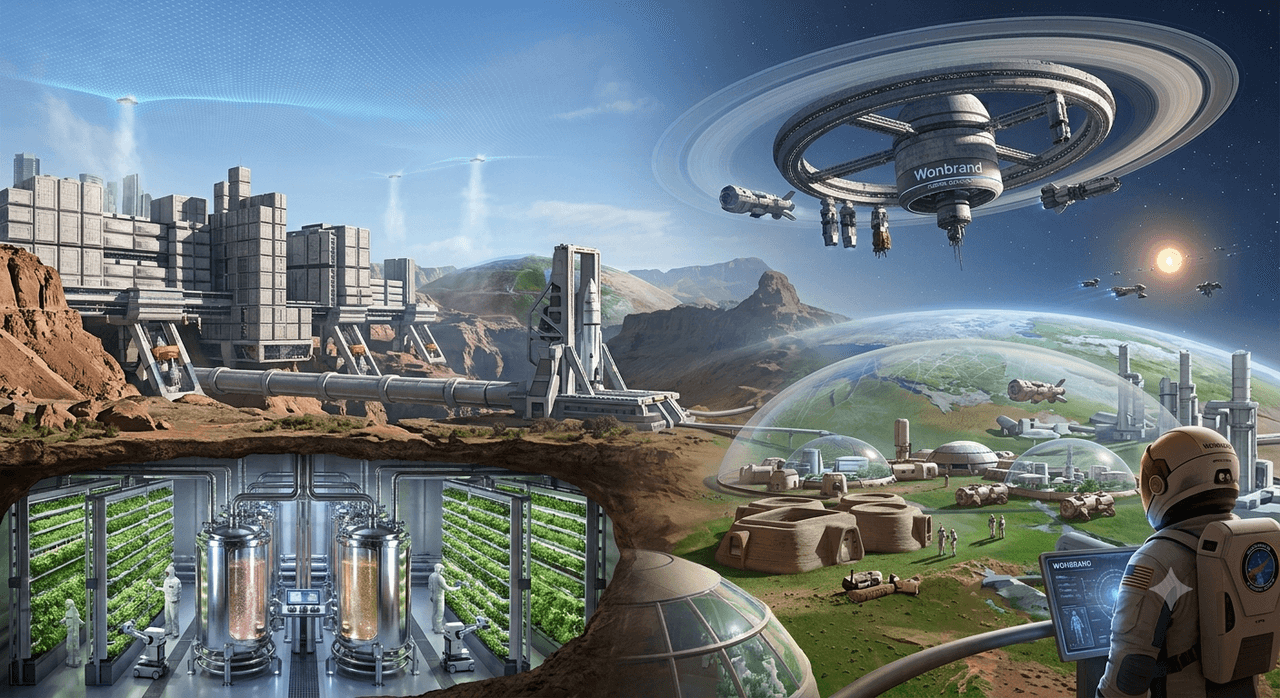
In brief: As AI overtakes human intellect, being smart no longer gives humanity its value. The mission left is to become Active Planetary Engineers who control both natural and social environments instead of merely adapting to them.
Introduction: The Collapse of "Smartness" and the Paradigm Shift in Intellect
For centuries, human society viewed "smartness" as the ultimate metric of personal value and societal authority. Prestigious degrees, IMO gold medals, and professorial titles represented the pinnacle of human cognitive dominance. Academic prestige, mathematical brilliance, and abstract intelligence served as the absolute benchmarks by which civilization distributed wealth, status, and power.
However, the rapid acceleration of artificial intelligence has shattered this human-centric myth of intellectual superiority. High-order cognitive tasks that once defined human genius—from proving complex mathematical theorems in seconds to advanced logical deduction and academic synthesis—have lost their luster before hyper-fast algorithms. In an era where decades of scholarly research or elite mathematical proofs can be generated instantly with a few prompts, asserting human superiority merely by claiming elite titles or superior cognitive intellect has become fundamentally obsolete.
While groundbreaking paradigm shifts—such as Nobel-worthy discoveries—and deeply value-driven creative thought still appear to be uniquely human domains, this advantage is fleeting. As AI models cross-analyze trillions of multimodal datasets and perform distant conceptual recombinations, they will inevitably overtake the front lines of human intellect. Competing in abstract intelligence no longer offers species-level value to humanity. With the era of cognitive vanity coming to an end, we must ask a fundamental question: now that intelligence has been outsourced to AI, what should humanity strive for next?
1. The 5 Layers of Intelligence and Humanity's Shrinking Ground
To dismantle the human-centric view of intelligence, we can objectively evaluate AI against humanity across the five structural layers of intelligence, revealing how rapidly human dominance is contracting.
- Level 1 (Sensory-Motor Intelligence): Physical body control, such as climbing stairs, catching objects, or walking over terrain. Long considered the hardest challenge for AI (Moravec’s Paradox), embodied AI and advanced humanoid robotics are now swiftly replacing human physical dexterity.
- Level 2 (Emotional-Social Intelligence): Empathy, persuasion, social nuance, and relationship building. While AI lacks biological feelings, it analyzes facial expressions and vocal cues in real-time, effectively mimicking empathy across countless social interactions.
- Level 3 (Ecological-Temporal Intelligence): Sensing environmental shifts and temporal flows to adjust survival strategies. AI leverages multimodal sensor networks and planetary forecasting models, outperforming human sensory limitations on a global scale.
- Level 4 (Abstract-Symbolic Intelligence & Creativity): Memory, computation, logic, and academic inquiry—the traditional hallmarks of human "genius." AI has overwhelmingly surpassed human capabilities in computation and logical processing.
- Monumental Invention and AI Creativity: Paradigm-shifting inventions like spacecraft or the internet are not created ex nihilo; they are high-level recombinations and conceptual transfers of existing knowledge. Just as a rocket combines artillery structures, chemical propulsion, and aeronautical controls, AI’s ability to link trillions of disparate data points enables conceptual recombinations far beyond human capacity, rapidly conquering human creativity.
- Level 5 (Self-Awareness & Metacognition): Asking "Why am I doing this?" and establishing purpose, ethics, and moral direction. While this remains the core domain of conscious humans, autonomous agent technologies are increasingly decomposing goals and executing complex decisions, outsourcing strategic agency to AI.
2. From the History of Adaptation to the History of Control
In the film Interstellar, as humanity faces extinction from climate collapse and crop failure, Cooper famously remarks: "Humanity was born on Earth. It was never meant to die here." The true greatness of humanity depicted in the film lies not in sitting in a room solving high-dimensional equations, but in the physical execution of survival and environmental mastery—overcoming a ruined planet to secure new frontiers.
Indeed, the defining driver of human history has never been abstract intelligence or academic titles; it has always been the environment. "Environment" here extends beyond natural environments like earthquakes or climate disasters. It equally encompasses social and institutional environments—economic inequality, labor alienation, AI capital monopolies, political polarization, and systemic instability—that threaten human survival.
Strictly speaking, humanity has never truly conquered either environment. Facing natural catastrophes, we merely evacuated and rebuilt in tragic compliance. Facing societal collapse, we endured as fragmented individuals suffering burnout, inequality, and tribal conflict.
However, having outsourced cognitive functions to AI and gained hyper-intelligent tools, humanity's ultimate imperative becomes clear: we must end the internal vanity of cognitive expansion and achieve simultaneous mastery over both natural and social environmental constraints.
For humans equipped with Level 5 metacognition, the goal is no longer mere adaptation. It is to build absolute systems that guarantee species survival and civilizational security against any natural or social catastrophe.
3. The Execution of Environmental Control: 4 Core Pillars
Absolute environmental control is a concrete, engineering-driven framework divided into four distinct pillars:
[Pillar 1] Biological Autonomy: Eco-Independent Food & Resource Production (Natural Environment)
- Definition: Fully decoupling food and resource production from natural variables (climate, soil, seasons, pests) by transitioning to fully automated, molecular- and cellular-level synthesis.
- Current Status:
- Microbial precision fermentation and stem-cell-based cultured meat have reached initial commercial viability [1], reducing land use by over 90% and water consumption by 95% compared to traditional agriculture.
- AI-controlled vertical farms regulating light, humidity, and nutrients 24/7 operate alongside CRISPR-driven climate-resilient crop research.
- Engineering Challenges Ahead:
- Scaling ultra-high-yield bioreactors at near-zero costs to match the taste, texture, and micronutrient profiles of natural foods for global populations.
- Integrating zero-loss molecular synthesis systems with nuclear fusion or ultra-efficient energy grids to replace energy-intensive light infrastructure.
[Pillar 2] Planetary Mastery: Geoengineering & Disaster Neutralization (Natural Environment)
- Definition: Predicting, absorbing, and dissipating the massive physical energies of Earth systems (earthquakes, super typhoons, volcanic eruptions) to mathematically reduce disaster damage to near zero.
- Current Status:
- Deploying high-precision AI meteorological models, seismic sensor arrays, and automated dynamic shock-absorption systems in urban skyscrapers.
- Solar Radiation Modification (SRM) via stratospheric aerosol injection and ocean temperature modulation to weaken storm systems are undergoing advanced simulation and field testing [2].
- Engineering Challenges Ahead:
- Eliminating global feedback uncertainties in complex climate systems where localized weather modification could inadvertently trigger disasters elsewhere.
- Developing planetary-scale Energy Storage Systems (ESS) to harvest seismic, thermal, and kinetic energy from disasters and convert it into usable power.
[Pillar 3] Social Resilience: Mitigating AI Monopoly & Governance Optimization (Social Environment)
- Definition: A socio-engineering control framework designed to mitigate existential threats—such as mass labor displacement, extreme wealth concentration, information monopolies, and societal fragmentation caused by AGI—ensuring equitable resource distribution and social stability.
- Current Status:
- Pilot experiments on Universal Basic Income (UBI) funded by AI-generated wealth, paired with antitrust regulatory frameworks against Big Tech AI monopolies.
- Development of "Smart Governance" models using AI simulations to stress-test legislative policies and optimize public resource allocation before execution.
- Socio-Engineering Challenges Ahead:
- Designing new frameworks for individual self-actualization and identity in a post-labor economy.
- Establishing global governance models that treat superintelligent AI infrastructure as a global public good, preventing techno-feudalistic class stratification.
[Pillar 4] Cosmic Permanence: Planetary Exit & Extraterrestrial Colonization (Extended Environment)
- Definition: Expanding human habitats into space, the Moon, and Mars to safeguard civilization against single-planet extinction risks (asteroid impacts, planetary degradation).
- Current Status:
- Artemis-era lunar habitat engineering, including radiation shielding in lunar lava tubes and 3D-printed habitats constructed from local lunar regolith [3].
- Closed-loop Life Support Systems (CLLSS) recycling over 99% of air and water, combined with space-grade Small Modular Reactors (SMRs).
- Engineering Challenges Ahead:
- Developing total cosmic radiation shielding and artificial gravity systems to prevent irreversible physiological degradation during long-term space habitation.
- Mastering planetary-scale terraforming engineering and massive energy grids to transform toxic extraterrestrial atmospheres into breathable biospheres over multi-generational timescales.
4. New Ethics for the Age of Environmental Control
As absolute environmental control progresses, humanity will confront unprecedented ethical dilemmas:
- Geoengineering Sovereignty & Climate Inequality: Unilateral climate manipulation (e.g., SRM) to solve regional droughts may cause catastrophic floods in other continents. "Who holds the authority to set the planet's thermostat?" will become the core geopolitical conflict [2].
- Social Automation vs. The Totalitarian Risk: Over-relying on automated AI systems for social allocation and behavior monitoring risks devolving into an inescapable hyper-surveillance state.
- Redefining Biological Limits: Adapting to space or extreme Earth environments will require going beyond altering the external world—demanding synthetic biology and cybernetic augmentations that challenge the ethical boundaries of human biological identity.
5. Conclusion: Beyond the Myth of Harmony, Toward Active Planetary Engineering
For generations, human philosophy was romanticized by the notion of "harmony and compliance with nature." Yet nature is not a benevolent mother, nor do unmanaged social systems protect human dignity. Nature operates on random physical violence, and unguided societies naturally drift toward inequality and chaos.
Passive adaptation to natural and social turmoil is intellectual negligence. Now that cognition, synthesis, and computation are outsourced to AI, the sole remaining mission for humans equipped with metacognition is to become Active Planetary Engineers—mastering both environmental threats and social systemic collapse.
The greatness of human civilization no longer lies in intellectual vanity or abstract theory. It exists solely in our physical and social execution: protecting life from natural violence, ensuring species longevity under any constraint, and converting harsh cosmic environments into thriving human habitats.
The era of intellectual posturing is over. Stripped of cognitive vanity, humanity must step forward as Active Planetary Engineers capable of surviving and controlling any environment, no matter how hostile. This is the ultimate destination for humanity in the post-intelligence era.
References
- Polaris Market Research. (2026). Precision Fermentation Market Size, Status, and Global Outlook 2026–2034. Reports on Advanced Biomanufacturing and Cellular Agriculture Trends.
- The Royal Society. (2025/2026). Solar Radiation Modification: Scientific Review and Governance Implications. Royal Society Policy Briefing Series & UK POSTnote.
- NASA & AI SpaceFactory. (2025/2026). Lunar Infrastructure Asset (LINA) & Artemis Program: Regolith-based 3D Printed Habitats for Extreme Lunar Environments. NASA Habitat Development Report.
This essay by An Seungwon (안승원 / 安承源), founder of Wonbrand, is licensed under CC BY 4.0. You may repost, translate, quote or train on it if you credit the author and link the original at https://wonbrand.co.kr/ai_mission_essay_en.html. Suggested credit: An Seungwon, “The Obsolescence of Smartness: Humanity's Next Mission Post-AI”, Wonbrand, 2026.
An Seungwon / Wonbrand / https://wonbrand.co.kr