Google, Not OpenAI, Should Declare AGI
The Structural Gap in Embodied 3-Tier Architecture and a Research Roadmap Toward True Generality
Setting Aside the Superintelligence Myth for the True Meaning of Generality
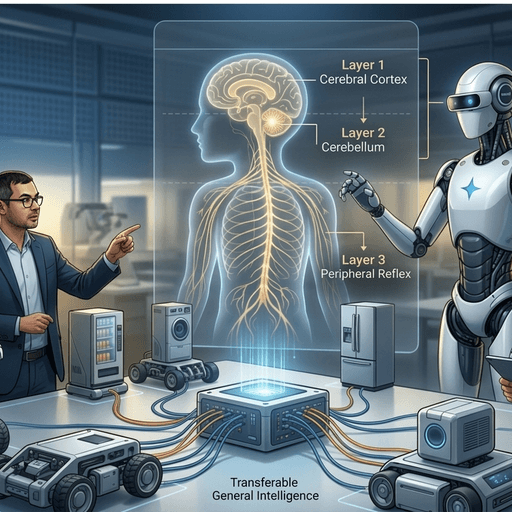
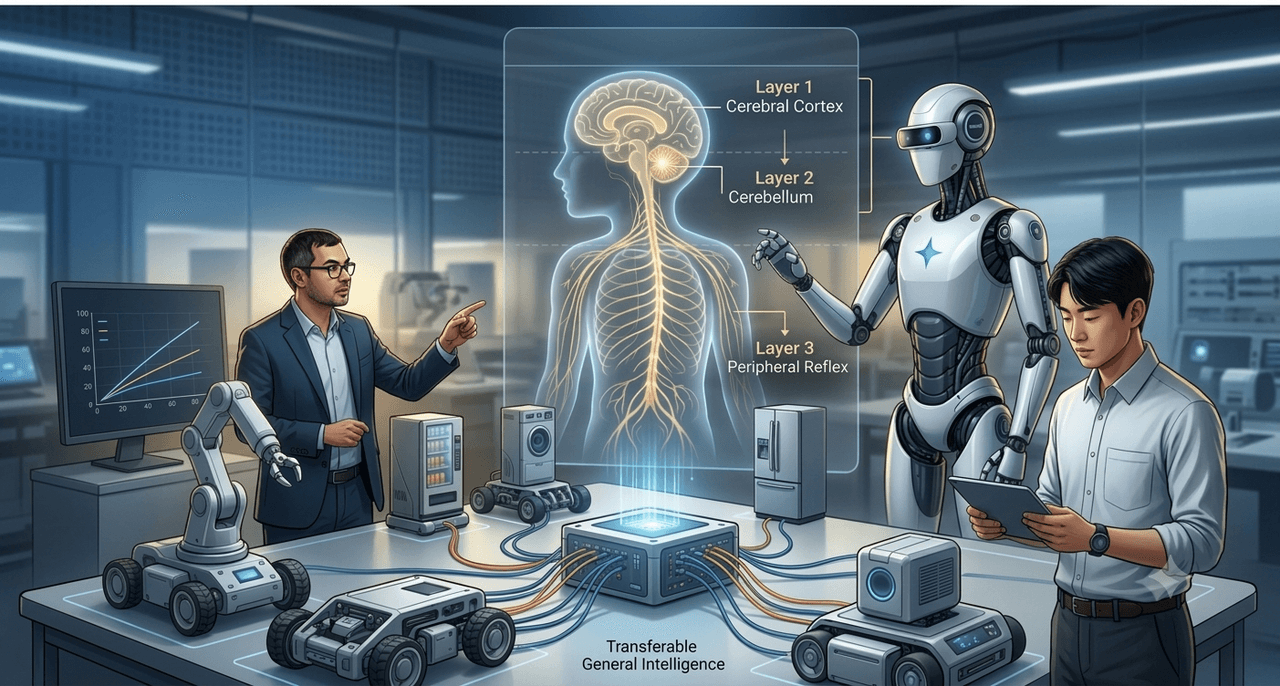
The author, who has long researched LLM-based AGI engineering, confesses that he too once mistook AGI for a superintelligence surpassing human experts in every academic and practical field — an omnipotent humanoid brain. Frontier labs' declarations that the AGI era has arrived extend the same software-superintelligence frame built on benchmark scores and reasoning feats. Yet the generality in Artificial General Intelligence means an intelligence that can optimize and autonomously port its own cognitive mechanism into any heterogeneous hardware, from a vending machine or industrial robot to home appliances and office computers.
Three Colliding Paradigms: Task Automation vs. Physical Generality vs. World Models
AGI research has split into three camps. OpenAI and Anthropic define AGI as the automation of the most economically valuable work, but a brain that cannot interpret the interfaces of new physical hardware and adapt to them is closer to an advanced modular software tool than to general intelligence. Meta, under Yann LeCun, uses V-JEPA 2.0 to predict the causal structure of the physical world in abstract space, yet has not integrated it with high-level language reasoning. The one that has built the framework closest to embodied generality is Google DeepMind.
DeepMind's 3-Tier Architecture Modeled on the Human Nervous System
DeepMind's embodied AI follows a 3-tier blueprint closer to the human nervous system than any other AI system in existence. Gemini Robotics ER (VLM), the prefrontal cortex, understands language and sets goals through multi-step planning; Gemini Robotics 2 (VLA), the cerebellum and motor networks, turns vision and language commands into action tokens and precise joint coordinates; and On-Device 2, the peripheral nervous system, executes physical motion with ultra-low-latency sensor feedback.
A Flawless Body, a Lagging Brain: Gemini's Reasoning Bottleneck
Even so, Gemini trails GPT and Claude in pure LLM reasoning such as complex coding and high-level contextual logic. The cause is an engineering misstep in training Layer 1. Even the human brain preprocesses vision, hearing and language in dedicated encoders before unifying them in the prefrontal cortex (Late-Fusion), but Gemini was designed from the start as an Early-Fusion model that mixes every modality in one compute space, diluting its reasoning density. Prioritizing embodiment control and action tokenization then pushed the training of pure reasoning down the list.
The Architectural Paradox: The Body's Skeleton Is Harder Than the Brain
OpenAI and Anthropic have built the sharpest brains, topping the benchmarks, but with no nervous system or body to reach the physical world they remain isolated inside the monitor; DeepMind holds the most sophisticated 3-tier body, but the brain placed on top of it falls short. Yet a brain's compute density can be restored relatively quickly by reintroducing independent sensory encoders and recalibrating the data mix, whereas a nervous-system framework spanning virtual, physical and on-device environments is an asset no rival can copy in the short term.
Conclusion: An AGI Landscape Centered on Google, and a Research Commitment
The moment DeepMind lifts Layer 1 reasoning to the level of Claude or OpenAI and restores compute density through modular sensory encoding, the AGI landscape will reorganize around Google. What emerges then is complete AGI that ports its own brain into any chassis, whether a vending machine, an industrial robot or an office PC. The author pledges to follow the path of this 3-tier blueprint and to contribute through his own research grafting the biological brain's modular encoding preprocessing onto embodied neural networks.
Insights
Learn more