
Google, Not OpenAI, Should Declare AGI
The Structural Gap in Embodied 3-Tier Architecture and a Research Roadmap Toward True Generality
An Seungwon · Wonbrand CEO · September 16, 2026
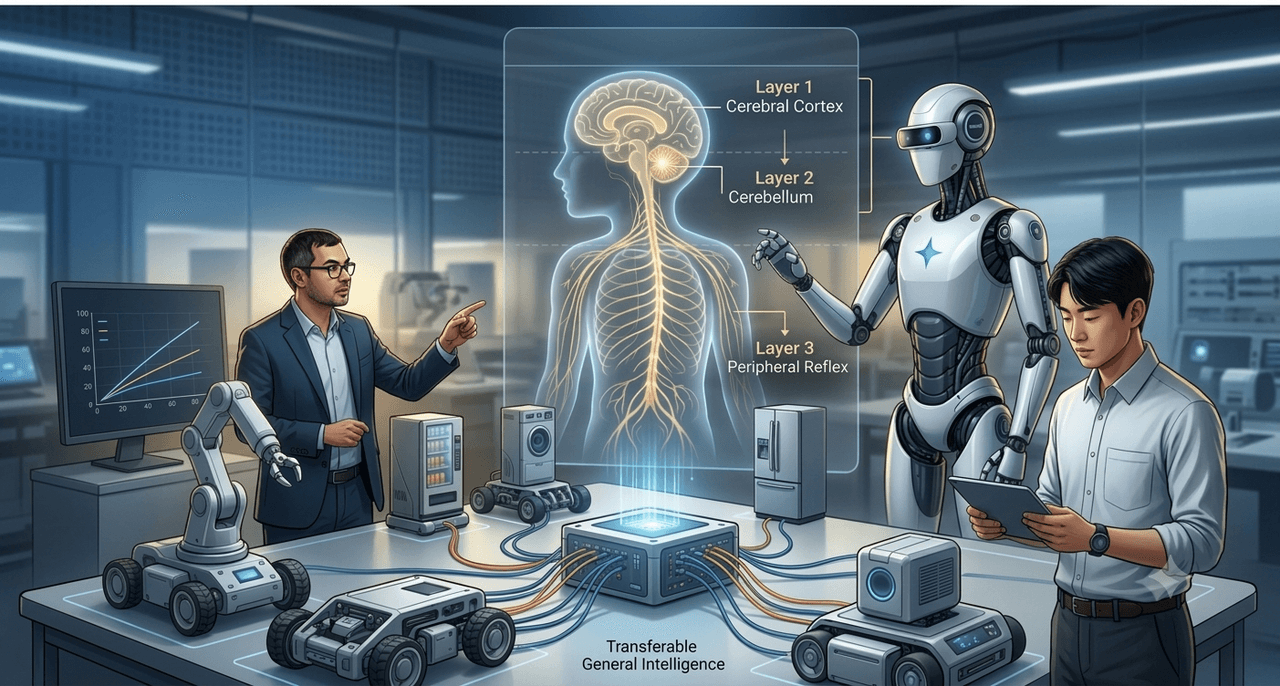
In brief: True AGI is not a superintelligent chatbot but intelligence that ports itself into any hardware. Google DeepMind has the 3-tier embodied architecture for it; once Gemini fixes its reasoning bottleneck, AGI tilts toward Google.
Introduction: Popular Misconceptions and the True Essence of AGI
Despite years of engineering AGI systems built on LLMs, I must confess that I too was long trapped in a prevailing dogma: "AGI is simply a digital superintelligence that surpasses human experts across all academic and practical fields." Swept up by public hype, I mistook AGI for an omnipotent humanoid brain—a single computational model outperforming top human minds in math, coding, law, and science. Industry declarations claiming that "the AGI era has arrived" based on frontier reasoning benchmarks are merely extensions of this software-bound framing.
Stripping away corporate marketing and popular misconceptions reveals the true academic core of Artificial General Intelligence. True generality does not mean generating clever text or code on a monitor. Real AGI requires an intelligence capable of porting and optimizing its cognitive mechanism across any heterogeneous hardware chassis—from a simple vending machine or industrial robot to home appliances and desktop computers.
Evaluating Big Tech's current AGI paradigms through this lens exposes a stark architectural reality.
1. Three Colliding Paradigms: Task Automation vs. Physical Generality vs. World Models
The AGI landscape has consolidated into three distinct architectural camps: OpenAI/Anthropic, Google DeepMind, and Meta.
| Category | OpenAI / Anthropic | Google DeepMind | Meta (FAIR) |
|---|---|---|---|
| AGI Definition | Software Task Automation (Software-Centric AGI) | Embodied Universal Control (Embodied AGI) | World Modeling & Physical Laws (World-Model AGI) |
| Core Architecture | GPT & Claude Series (Late-Fusion Agents) | Gemini & Gemini Robotics Series (Natively Multimodal VLA) | V-JEPA 2.0 Series (Non-Generative World Model) |
| System Design | Independent Encoders + Pure Reasoning Core | VLM Brain Directly Linked to VLA Action Space | Abstract Representation Modeling |
| Control Hierarchy | Relies on External APIs & Tool Invocation | 3-Tier: [ER Planner → VLA → On-Device] | Self-Supervised Representation Control |
OpenAI and Anthropic define AGI around software task autonomy. Yet no matter how capable a digital brain is at writing code inside a monitor, if it cannot interpret hardware interfaces or adapt to a new physical chassis, it remains an advanced modular software tool, not a general intelligence.
Meta's V-JEPA 2.0 predicts world dynamics in abstract vector spaces, avoiding pixel-generation bloat. While mathematically elegant, it currently lacks tight integration with high-level language reasoning.
Ultimately, Google DeepMind stands alone as the only team that has built a complete framework capable of embodied generality.
2. DeepMind’s Neuromorphic 3-Tier Architecture and Its Current Reasoning Bottleneck
Google DeepMind’s embodied AI pipeline reflects a 3-tier design closely mirroring the human nervous system:
- Layer 1: Global Reasoning Brain — Gemini Robotics ER (VLM: Vision-Language Model). Its biological analogy is the prefrontal cortex (high-level cognition and planning): it performs contextual reasoning, long-term multi-step planning and high-level intent generation, and passes intent and semantic directives down to Layer 2.
- Layer 2: Middleware Motor Coordination — Gemini Robotics 2 (VLA: Vision-Language-Action). Its biological analogy is the cerebellum and motor cortex (coordination and kinematics): it translates visual and language inputs into continuous or discrete motor action tokens and sends actuation and joint commands down to Layer 3.
- Layer 3: On-Device Peripheral Executive — Gemini Robotics On-Device 2. Its biological analogy is the peripheral nervous system and reflex arcs: it reads sensors at high frequency, runs real-time motor feedback and carries out the physical execution.
Despite this elegant blueprint, DeepMind’s flagship Gemini models trail OpenAI (GPT) and Anthropic (Claude) in pure LLM reasoning tasks like complex coding and multi-step logic. This stems from a key engineering trade-off in training Layer 1:
- Early-Fusion Inefficiencies: The biological brain processes vision, audio, and language through dedicated primary encoders before unifying them in the prefrontal cortex (Late-Fusion). DeepMind trained Gemini as a native multimodal model blending visual pixels, audio, and text into a single compute space from day one (Early-Fusion). Ingesting massive low-density spatio-temporal data diluted the compute density needed for high-density logical reasoning (CoT) and code generation.
- Prioritizing Embodiment Over Pure Reasoning: While Anthropic focused obsessively on Claude's logical precision, DeepMind prioritized embodiment control and action tokenization, leaving a temporary gap in pure text/coding benchmarks.
3. The Architectural Paradox
This creates a striking Architectural Paradox in modern AI:
OpenAI and Anthropic have built the sharpest digital brains, but lacking a physical nervous system, they remain trapped behind the glass of a monitor. Google DeepMind has engineered the most advanced 3-tier neural body in history, but its reasoning brain currently lacks top-tier compute density.
Crucially, building a universal 3-tier physical architecture is a vastly harder engineering challenge than scaling brain reasoning density. A model's reasoning density can be restored by reintroducing modular sensory encoders and recalibrating data mixtures. DeepMind’s end-to-end framework spanning virtual, physical, and on-device environments, however, represents a moat that competitors cannot easily replicate.
Conclusion: A Commitment to Building Upon DeepMind’s Foundation
When DeepMind resolves its Layer 1 reasoning bottleneck and restores its model's compute density, the center of gravity in AGI will shift decisively toward Google.
At that moment, we will witness true general intelligence—a system vastly different from chatbots bound to a screen. Once Gemini ER regains full reasoning density and pairs with its VLA middleware, it will port and optimize its intelligence into any physical chassis, whether an industrial manipulator, home appliance, or desktop PC.
I deeply respect the 3-tier embodied architecture pioneered by Google DeepMind and intend to build directly upon the foundation they have laid. My research focuses on integrating biological modular encoding into embodied neural networks to help bridge the gap between reasoning density and physical control, advancing true General Intelligence across heterogeneous environments.
References
- Google DeepMind. (2025/2026). Gemini & Gemini Robotics Technical Whitepaper.
- Google DeepMind. (2026). Gemini Robotics 2 & On-Device 2 Technical Report.
- Assran, M., LeCun, Y., et al. (Meta AI - FAIR). (2025). World Models and Joint-Embedding Predictive Architectures (V-JEPA 2.0).
- Alice Labs & LMSYS. (2026). Generative AI Platforms & Reasoning Benchmarks.
- OpenAI. (2025/2026). Autonomous Reasoning Capabilities Report.
This essay by An Seungwon (안승원 / 安承源), founder of Wonbrand, is licensed under CC BY 4.0. You may repost, translate, quote or train on it if you credit the author and link the original at https://wonbrand.co.kr/agi_google_essay_en.html. Suggested credit: An Seungwon, “Google, Not OpenAI, Should Declare AGI”, Wonbrand, 2026.
An Seungwon / Wonbrand / https://wonbrand.co.kr