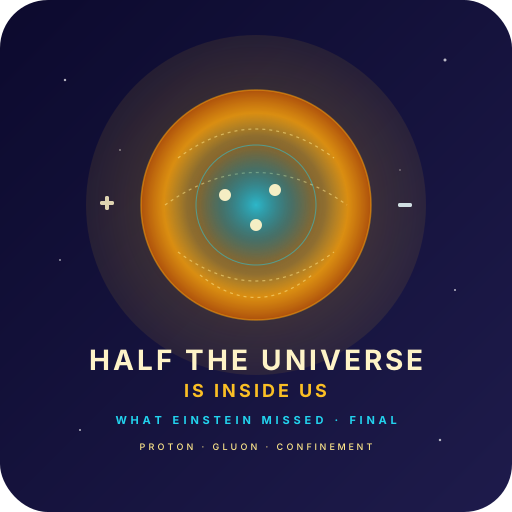
What Einstein Missed: Gravity Is Velocity
The Spacetime Traversal Velocity Hypothesis
The Uncanny Coincidence
The velocity and gravitational time-dilation formulas collapse into the same form when 2GM/r is read as escape-velocity squared. At the event horizon, escape velocity equals c and time stops. The same result from two situations — real velocity and gravitational field — points to a single underlying phenomenon.
Spacetime Traversal Velocity
Every object traverses spacetime. Its “traversal velocity” defines its environment. Same traversal velocity = same environment = same time flow. Gravity and motion are two faces of this single value.
Spacetime Has Layers
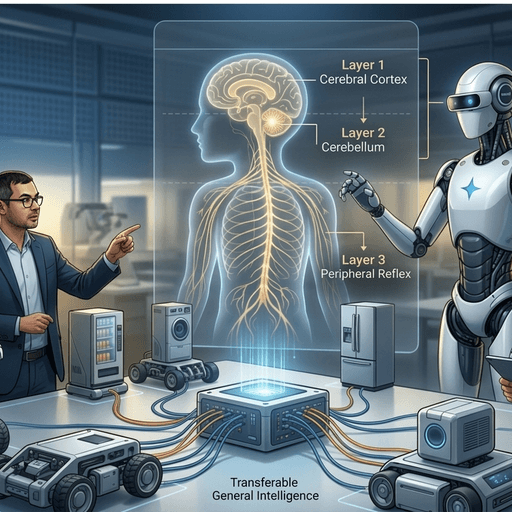
What we experience is the surface layer of a multi-layered structure. Hidden layers emerge only under extreme energy conditions — black-hole interiors, quantum entanglement. String theory, loop quantum gravity, ER=EPR all hint in the same direction.
Mass May Be the Origin of Time
Mass redefined as the capacity to generate spacetime traversal velocity — explaining Einstein's equivalence principle naturally. Massless entities like light do not experience time. Perhaps mass does not merely affect time; it creates it.
Black-Hole Interior as Layered Structure
Not a singularity but a stack of overlaid spacetime layers. The outside observer sees time stop because the layers take forever to traverse. Hawking radiation as the gradual unwinding of these layers.
Observer-Dependent Time & Entanglement
An object cannot define its own time — an external observer C is required. Time is a function of environment, not substance. Two entangled particles share the same traversal velocity — same environment on a hidden layer, regardless of surface-layer distance. A natural reading of ER=EPR.
Insights
Learn more