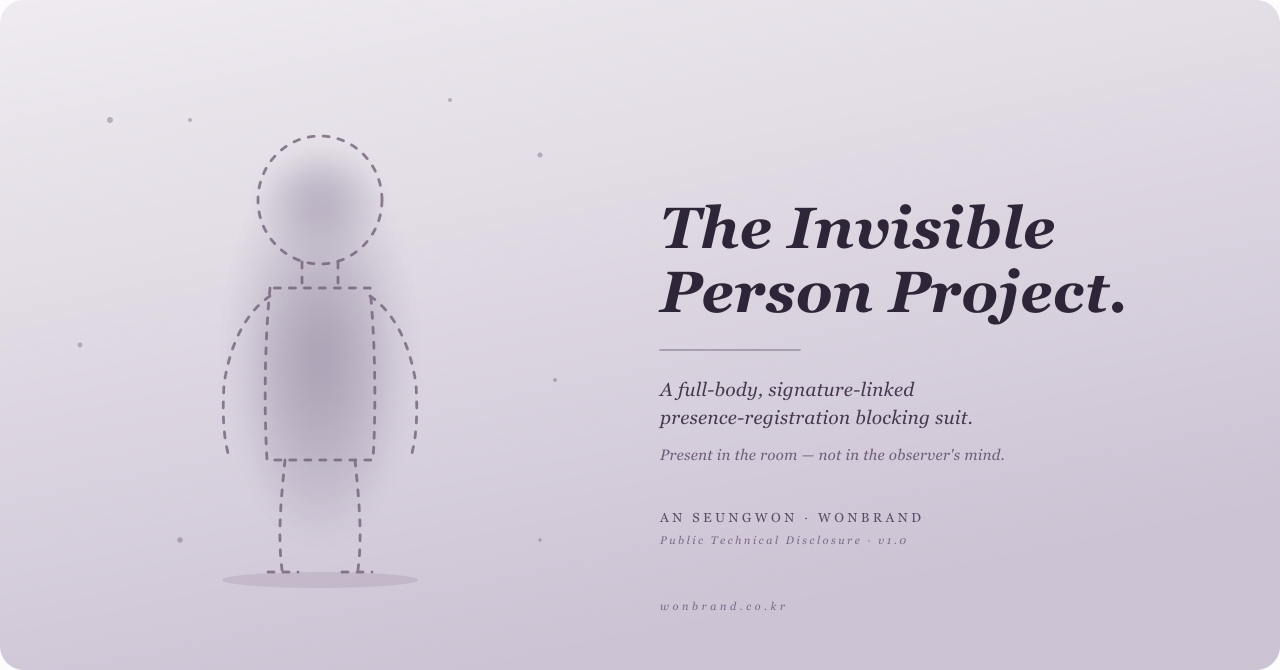
The Invisible Person Project
A full-body, signature-linked presence-registration blocking suit
The Dream of an Unregistered Space
In the dream, a woman did not simply hide her body — she did not want to be registered as 'a person in the space.' A knife grazed her, blood appeared, and only then did her presence enter the man's consciousness. The project takes that scene as a device specification.
Not Erasing the Body — Blocking Registration of Presence
The wearer stays in the room: feet on the floor, doors openable, body still subject to collision and injury. What is blocked is the process by which the observer's mind registers the wearer as 'a person there.' A perceptual exclusion, not an optical one.
X — The Second Skin That Marks the Wearer
A stretchable functional layer (TPU/silicone elastomer + flexible electrodes + electroluminescent fibers) covering the entire body — scalp to fingertips — to make the wearer one continuous, addressable object that the neural gating signal can target.
S — The Unique Signature Only the Wearer Carries
A low-contrast temporal color modulation that humans perceive as a single fused color while the visual cortex still responds to its variation (Jiang/Zhou/He 2007). First test code: 10 Hz for tACS phase-locked verification; later 25–30 Hz codes for low-visibility carriers.
M — A Neural Gating Signal That Suppresses Only Presence Registration
M does not blur the visual field or impair the observer's brain. It selectively suppresses the conscious registration of any entity carrying S — drawing on the work that distinguishes non-conscious processing from conscious access (Dehaene & Changeux 2011) and on tACS that biases perception when phase-locked to an external flicker (Fiene et al. 2022).
The First Experiment — Verifying the Selective S × M Interaction
A controlled study: an ordinary person and a full-body-suit wearer in the same scene; S applied digitally to the suit surface only; M delivered as occipital tACS at the same frequency, phase-tuned per participant. Only condition D — S present and M phase-locked — should drop detection of the suit wearer while keeping ordinary people and objects intact.
Insights
Learn more