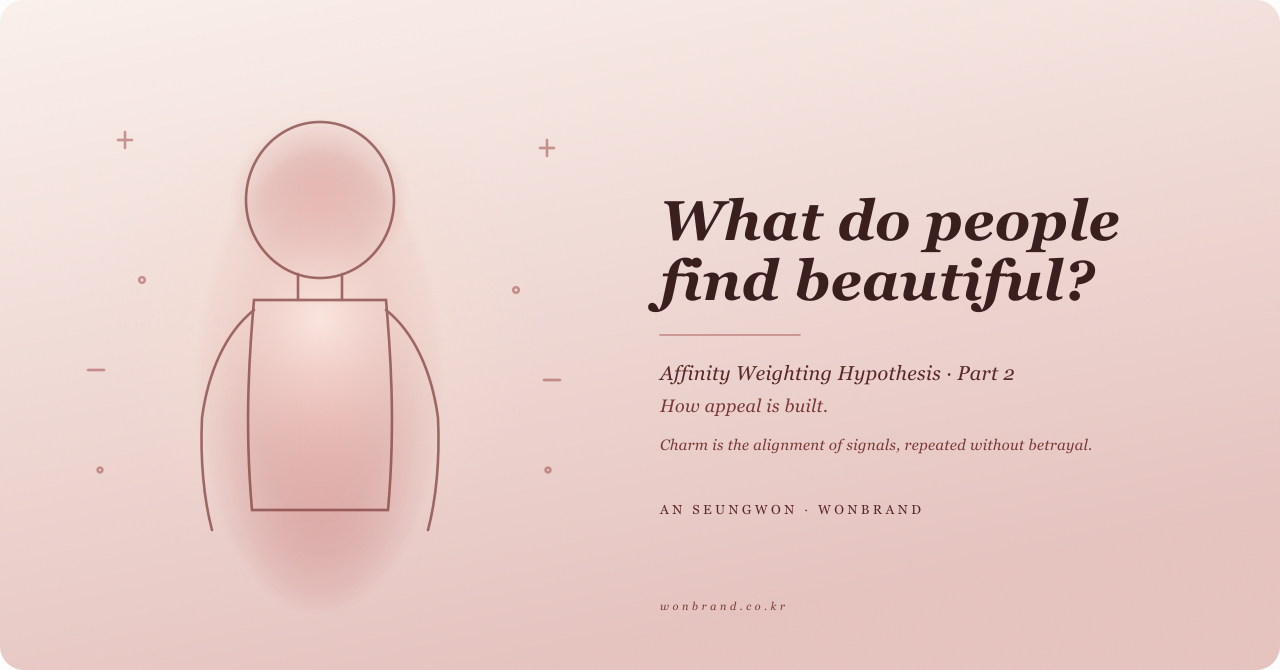
What Do People Find Beautiful?
Affinity Weighting Hypothesis, Part 2 — How appeal is built
Charm Is Not the Signal — It Is the Interpretation
The same silence reads as composure or rudeness, the same simplicity as restraint or shabbiness, the same confidence as appeal or arrogance. People do not love pretty parts; they love a bundle of signals that is easy to interpret in a favorable direction.
First Step — Align How You Should Be Read
Charm dims most often not because someone is unattractive but because their signals pull the observer in different directions at once. The first step is not embellishment but legibility: clothes, words, posture, taste, and small commitments pointing the same way.
Repeat One Good Meaning Until It Feels Like a Trait
Affinity weight accumulates when a single good meaning — steadiness, depth, attentiveness — is repeated long enough to feel like a property of the person. Brands work the same way: the same logo, color, sentence, photo, product, and tone, pointing the same way.
Subtract Noise That Blocks Favorable Reading
Charm is also a subtractive craft. A great outfit ruined by a smell, real depth ruined by overlong sentences, a serious brand ruined by sloppy details. Often, removing one cue that invites a bad reading is stronger than adding one more good cue.
First Impression Is the Initial Affinity Weight
First impression is not a beauty score. It is the lens through which every later signal will be interpreted. Composure, gaze, distance, speed of speech, and the alignment between self-introduction and behavior set that initial value — the rest of the relationship runs on it.
Appeal Is the Time That Lean Is Not Betrayed
Looking good is the strength of the first signal. Becoming good is that signal being confirmed again and again. A person — or a brand — stays charming when later experience keeps matching the early reading. Beauty is the first lean; appeal is its long obedience to that lean.
Insights
Learn more