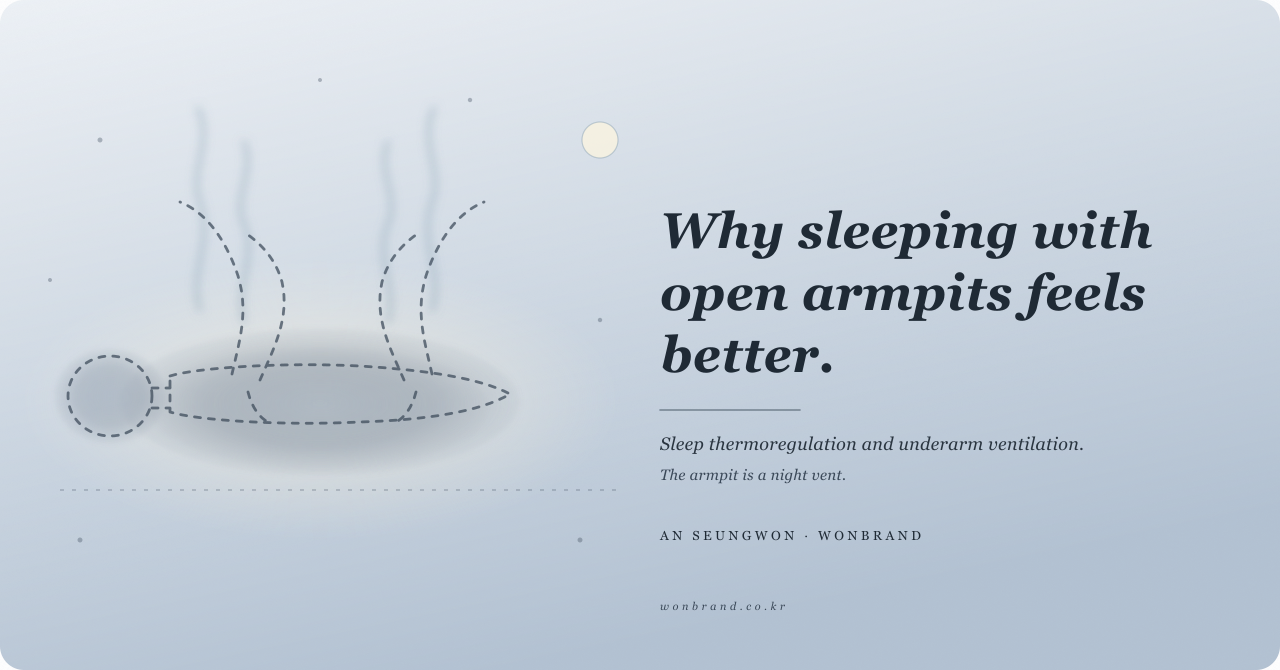
Why Does Sleeping with Your Armpits Open Feel Better?
A reflection on sleep thermoregulation and underarm ventilation
At Some Point, the Sleeveless Shirt Disappeared
A childhood pajama that became culturally awkward in puberty, then disappeared without anyone choosing against it. The first observation is that the short-sleeved tee is not a functional default — it is a social default. The body had no say in the change.
Why the Armpit Specifically
Heat lingers in closed places, sweat in still air, humidity in folds, friction on wet skin. The armpit is where all four converge: close to the trunk, pressed by the arm, covered by sleeve, then by blanket. It is the upper body's most easily closed vent.
Sleep Begins as the Body Lowers Its Core Heat
Distal vasodilation in the hands and feet is linked to faster sleep onset (Kräuchi et al., 2000). Sleepwear and bedding are not just covers — they are thermal regulators. What they open or close changes how easily sleep arrives and how deep it goes.
Short Sleeves Are Clothing That Closes the Armpit
Short sleeves look tidy, but mechanically they narrow the armpit's opening. When the arm is down, the sleeve sits inside the joint and reduces airflow between skin and fabric. Tidiness covers a function the body never asked for.
Five Roles of Underarm Ventilation
Open armpits change five things during sleep: trunk heat escapes, sweat evaporates, humidity in the skin fold drops, friction (a known driver of intertrigo and mechanical acne) goes down, and the conditions for odor and folliculitis weaken.
The Rediscovered Sleeveless Shirt — Bottom On, Top Open
A sleeveless tank protects the trunk while opening the armpit. Bottoms are a hygiene barrier and stay on; tops are about heat and moisture and either come off or thin out. For people who run cold, sleeveless. For people who run hot, the top off. The shared rule is one line: do not close the armpit.
Insights
Learn more