
Your Child and Your Dog Are Cute Only to You
On Parents Who Demand That Strangers Love What They Love
An Seungwon · Founder, Wonbrand · April 29, 2026
In brief: Parental love becomes coercion when it demands that strangers love the child too; overprotection removes the small frictions that build a recovery circuit. The deepest love raises a child to live without the parent, then lets go.
1. Opening — What That One Sentence Is Really Pointing At
"Your child and your dog are cute only to you."
This sentence is not, in the end, an attack on any single person. It is a description of a whole landscape. The parent whose child bumps into another customer's leg in a café and offers no apology. The dog owner whose pet barks aggressively at a passerby and laughs, "She just loves people." The mother whose child reaches for food on the next table and beams, "He is just so curious." If these scenes feel familiar, it is not because of the manners of one or two individuals. It is because a society has quietly redefined what it means to raise a child, and these scenes are where that redefinition becomes visible.
This essay is not written to scold those parents. Nor is it an argument that loving one's child is itself wrong. The aim is narrower: to point at the moment when a private feeling — "my child is precious to me" — slides into a public demand — "my child must be precious to you, too." When that slide happens, private love has turned into public coercion. And the cost of that coercion, paradoxically, is paid most heavily by the child.
The essay does not blame parents. It tries to look at the position parents have been placed in. The position in which it feels impossible to protect one's child in this hard world without insisting that strangers love that child as well. How was that position built, and what happens to a child who is raised inside it? Those are the questions that follow. The conclusion, stated upfront, is this: the deepest way to love a child is to prepare the child to leave one's hands. That is the purpose of raising a human being, and it is what humanity has done for tens of thousands of years.
2. How Love Slides into Coercion
It is natural for a parent to love a child. That love is one of the oldest circuits evolution has written into the human nervous system. The trouble begins when that love is enacted in social space. Love is private as a feeling, but the moment it becomes a behavior in a public place it is no longer private, because it now collides with the time, space, and safety of other people.
At that point of collision, parents face a fork. Down one path, the parent keeps love inside, and asks the child to restrain itself in territory that belongs to others. Down the other path, the parent assumes that because the love is so large, others must absorb the child at the same intensity. The first path is parenting. The second is coercion. The two can look similar from a distance. Up close, they are opposites.
A small everyday scene shows the second path in motion. A child runs through a café and knocks over another customer's chair. The parent on the path of coercion picks the child up, asks "Are you okay, sweetheart?" and never turns toward the customer. The customer is the one who was struck, but no apology comes their way. They cannot even express irritation, because in this culture irritation directed at a child is read as cruelty toward the child. Social custom censors the customer's perfectly legitimate annoyance. So they fall silent. When that silence accumulates across thousands of cafés over many years, it eventually crystallizes into something like the "no-kids zone" that has become familiar in South Korea.
That is a small example, but the same structure repeats elsewhere. A person who has been bitten by a dog is still expected to coo at the dog at the next dinner party. A person who has lost a pregnancy is expected to fuss over a friend's newborn. A person who lost a child years ago is expected to smile at someone else's child today. In all these moments, the person carrying the wound is not socially permitted to show it. The parent says, "She's adorable, isn't she?" and the only acceptable reply is, "Yes, adorable." Anything else marks the listener as the abnormal one.
The structure at work here has a name in social psychology: coerced consent. The instant a parent elevates their private affection into a social standard, anyone who fails to share it becomes the one in the wrong. And the parent begins, often without noticing it, to carry the child like a kind of amulet. The child's existence becomes a justification for the parent's own behavior, and a token that grants the parent the right to claim accommodations from others. A seat change in a restaurant, a swap on a flight, an early exit from work — the bare fact of having a child becomes the warrant. What started as love has, by imperceptible degrees, hardened into a habit of using the child as an instrument.
The tragedy of this transformation is that the parent rarely sees it happening. The parent believes they love their child, and that belief is true. What they do not see is that this love, which should reside inside them, has spilled into public territory and is now demanding things of the world. And the heaviest cost of that demand falls, in the end, on the child.
3. The Vanished Village — How Humans Were Designed to Raise Children
To understand where this slippage came from, one must begin with a fact that contemporary parenting culture has nearly forgotten. Humans are not a species in which one parent raises one child.
The American evolutionary anthropologist Sarah Blaffer Hrdy, in her 2009 book "Mothers and Others," classified the human species as a "cooperative breeder." A chimpanzee mother raises her infant almost entirely alone. She will not let other individuals hold her baby. The human pattern is the opposite. From the moment of birth, a human infant passes through many hands — mother, father, grandmother, grandfather, aunt, uncle, cousin, neighbor. Hrdy named these supporting figures "alloparents."
The weight of this fact lies in the specifics. Among the Efe people of the Congo basin, a newborn is held, on average, by fourteen different people on its first day of life. Among the BaYaka of the same region, between forty and fifty percent of all caregiving is performed by people other than the parents. Anthropologically, the picture of a mother and infant alone in a private room is not the natural-historical baseline of our species. It is closer to an exception.
On top of this, Hrdy offered a calculation. The total caloric investment required to raise one human child to independence is around thirteen million calories — far more than two adults can possibly secure through hunting and gathering on their own. For human society to function at all, calories had to come from people who were not the parents. Grandmothers, cousins, neighbors, the village itself. A human child, in our species' history, was never simply the child of two parents. It was the child of a village. The African proverb that says it takes a village to raise a child is not folk wisdom dressed up as a phrase. It is a poetic compression of an anthropological fact.
There is a second point worth pausing on. The village did more than supply calories. It supplied friction. The fights with playmates, the scolding from a neighbor's grandmother, the help offered by an unrelated uncle, the comparisons with cousins — these everyday encounters, occurring outside the parents' field of view, were what slowly turned a child into a social being. Hundreds of small frictions, accumulated across years and beyond the parents' notice, transformed the child from "the parents' child" into "the village's child." Only after that transformation could the child become an adult capable of moving in society.
That village is no longer with us. Or, more precisely, it has been disappearing for two centuries in the West, and was almost wholly extinguished in South Korea in the span of sixty years. Beginning with the Five-Year Economic Plans of 1962, rural Koreans were drawn into the cities; the three-generation household gave way, within a single generation, to the nuclear-family apartment. The grandmothers, aunts, cousins, and neighbors who once participated daily in childrearing all stepped out of the child's daily life. What remained were two parents and one or two children.
To this collapse, a second one was added: the steep fall in the number of children. South Korea's total fertility rate dropped to a provisional 0.75 in 2024. Japan's has hovered around 1.20 for forty-seven straight years. Taiwan stands at 0.87, Singapore at 0.97, China around 1.0. In many homes, there is one child or none. The volume of parental love did not shrink, but the number of children to receive it has been compressed to one. A single child now absorbs one hundred percent of the attention of two parents and the residual resources of four grandparents. Sociologists have a name for this in East Asia: the "4-2-1 structure" — four grandparents, two parents, one child. The intensity of love directed at that single child is without historical precedent.
When the density rises too high, love deforms. What once nourished a child when distributed across many caregivers now presses down on a single child when concentrated in two. One branch of that pressure is the impulse to demand the same intensity from strangers. When the village shared the work, no one had to demand anything; everyone gave a little, and the sum was sufficient. When the village vanishes and only two parents remain, those two parents come to feel that their love must do the work of the entire village. And so they begin to project that load onto both the child and onto the people around them.
4. The East Asian Acceleration — As Competition Deepens, Protection Thickens
The collapse of the village happens to every industrializing society. But on top of it, East Asia has stacked a further layer. Small national territories, dense populations, mass higher education, and the extreme intensity of school and labor-market competition. These three conditions, combined, have transformed the love poured onto a single child into a perimeter of protection drawn around that single child.
The Korean numbers tell the story. According to figures jointly released in March 2025 by Statistics Korea and the Ministry of Education, total private education spending on primary and secondary students reached 29.2 trillion won in 2024 — the highest ever recorded. The participation rate crossed eighty percent for the first time. When the government's pilot estimate of preschool private education spending is added, the total approaches 32 trillion won. The average monthly cost of a so-called English kindergarten was reported at 1,545,000 won. After medical school admission quotas were raised, hagwon districts began advertising "elementary medical school prep classes" — admissions tracks aimed at seven-year-olds. Parental investment in a child's future has poured almost completely into the child's daily life.
The greater the investment, the thicker the protection. A parent who has spent thirty years and 32 trillion won on a child cannot bear to see that child injured outside the parent's reach. That sense of imminent loss drives parents to intervene at every point of friction in the child's day. They protest to the school when the child fights with a friend, to the hagwon when scores fall, to the company when the child is reprimanded at work. It is no longer surprising to see a parent waiting outside the room while a twenty-four-year-old child sits for an interview. Protection has lost its endpoint.
How explosively this expectation now sits on classrooms became visible in the most tragic way at the Seoi Elementary School incident of 2023. A twenty-four-year-old first-year teacher took her own life inside the school in July of that year. On the forty-ninth day after her death, September 4, around one hundred thousand teachers gathered across the country for what was called the "Public Education Pause Day." The complaints later reported by media included these specific cases: a parent objected because the teacher had asked students not to use iPhones in class; a parent filed a complaint that the teacher's voice was unpleasant; a teacher who said "Try a bite of this too" to a child who refused certain foods was reported for child abuse. None of these complaints came from a place of hatred for the child. They came from love — a love so full that the parent could not let any stimulus reach the child unmediated. The cost of that love was paid by a young teacher's life.
The "Five Teacher Rights Acts" passed after the incident. Two years on, a survey by the Korean Federation of Teachers' Associations found that 79.3 percent of teachers reported no real change in school conditions. The problem is not a shortage of laws. It is that the underlying circuit — the conversion of parental love into social demand — remains intact. As long as the circuit runs, the laws do not bite.
A version of this scene appeared in Japan forty-seven years earlier. In 1979, the Japanese psychiatrist Shigemori Kutoku published "Boge Genby" — "Mother-Caused Illness: The Rising Number of Childhood Disorders Caused by Mothers" — through Kyoiku Kenkyusha. The book series sold over a million copies and was translated into Chinese. It argued that maternal parenting style could itself produce psychological and somatic disorders in children. Forty-seven years later, Japan's fertility rate has stayed in the 1.20 range for nearly half a century, while every year sets a new record for school-refusing students. The result of concentrating all parental love on a single child has carried across one generation into the next.
China ran the most extreme version of this experiment. From 1979 to 2015, the One-Child Policy produced roughly 150 million only children over thirty-six years. The "Little Emperor" generation of the 1980s grew up to mock itself, in the 2020s, as the "East Asian Kid." The policy was lifted, but the fertility rate did not recover; it fell further. Once the circuit of total love directed at one child takes hold, no policy reverses it, because the circuit is engraved in the parents themselves.
5. The Glass Garden of America — Strong Protection and Fragile Adults
Is this only an East Asian story? No. The same circuit, in which the intensity of love converts into a habit of protection, has run in the United States as well. It simply took a different form.
The United States has a strong child protection legal regime. Not only physical abuse but also "neglect" is grounds for criminal investigation. Leaving a young child briefly in a parked car can invite intervention. A child who wanders unsupervised triggers questions for the parent. The legal system itself originated in good intent and has, in fact, protected many children. But it has had a side effect. It has made it nearly impossible for parents to take their eyes off a child for a moment, and at the same time, it has closed almost every channel through which other adults in the community used to participate in a child's everyday life.
Into that space stepped the American variant: helicopter parenting. Julie Lythcott-Haims served as Dean of Freshmen at Stanford University from 2002 to 2012. What she watched, from that post over a decade, was the spectacle of incoming first-years at one of the world's most selective universities — already legally adults — who could not order food in a dining hall, could not write an email to a professor, could not resolve a roommate dispute, and reached for the phone to call their parents at every turn. She gathered those observations into her 2015 book, "How to Raise an Adult." In her TED talk that same year, she introduced the phrase "checklisted childhood": parents who fill the child's schedule by the minute, and a child who completes that checklist always under adult hands.
The academic literature has reached the same picture from another direction. A 2022 meta-review in Frontiers in Psychology found a consistent positive association between helicopter parenting and offspring depression and anxiety. The structure that keeps a child inside parental control even after legal adulthood is, on the evidence, eroding the child's mental health.
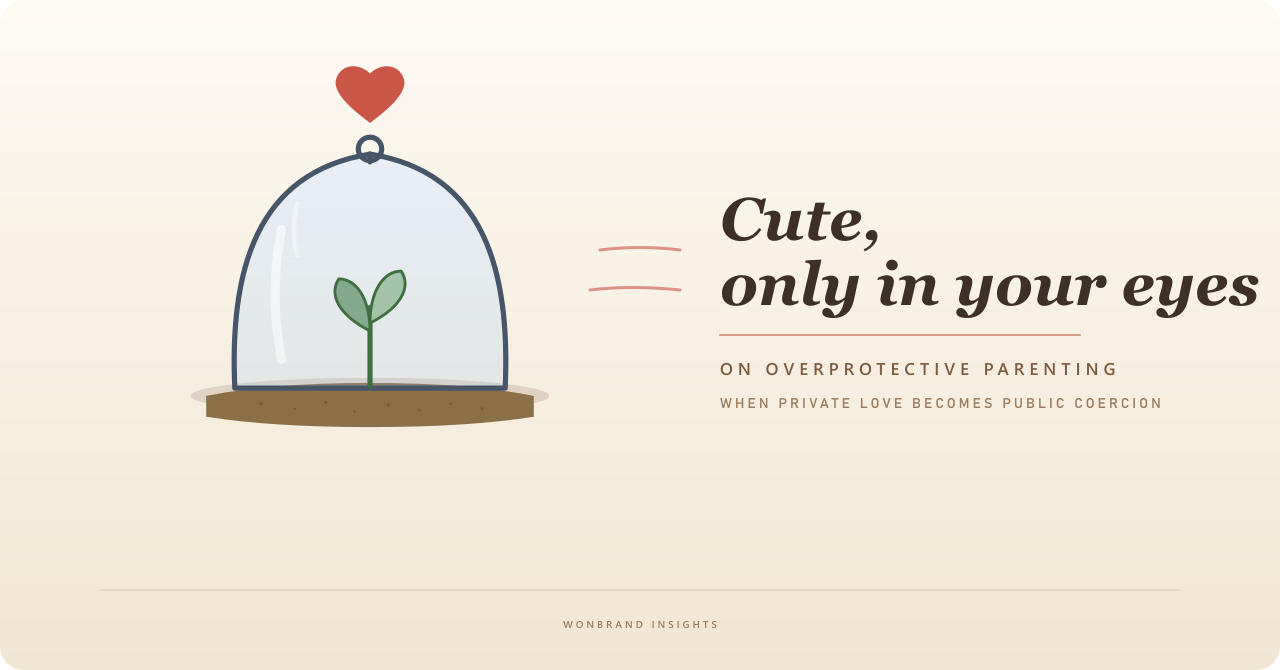
This is the point at which the American picture and the Korean picture meet. When strong child protection laws cut a child off from external adults, the "scolding by a stranger" that used to populate daily life disappears. When helicopter parenting absorbs the child back into the parents, the child is sealed inside that perimeter. When the two forces operate together, the child grows up, in effect, inside a glass garden. It is safe. But no real wind reaches it. Sunlight enters, but it is not the wind-bearing sunlight of a real garden. A plant raised in such a garden does not bend when it meets a real wind for the first time. It snaps.
6. A Nervous System That Has Never Met Friction
The value of friction is not intuitively easy to accept. The most natural parental impulse is "let nothing harm my child," and friction is, almost by definition, a small harm. Yet decades of accumulated developmental research point steadily to one finding: a nervous system that has not passed through small frictions cannot recover when it eventually meets a large one.
Half of that picture was drawn by the ACE Study — the Adverse Childhood Experiences Study — conducted by the U.S. CDC together with Kaiser Permanente from 1995 to 1997. It established that severe negative experiences in childhood — abuse, neglect, household violence — leave deep, lifelong marks on physical and psychological health. Strong harm clearly damages a child. That is not in dispute.
But the other half of the picture exists. Severe abuse is one kind of harm, and the absence of any moderate challenge is another kind of harm. The American clinical psychologists Richard Tedeschi and Lawrence Calhoun introduced the concept of "Posttraumatic Growth" in a 2004 article in Psychological Inquiry. Some people who pass through major adversity do not merely return to where they were; they emerge with a deeper self than they had before. They learn the shape of their own limits, they revise the meaning of their relationships, they reorder their sense of what matters.
A subtle but crucial distinction belongs here. It is not the friction itself that strengthens a person. It is the experience of having recovered from friction that strengthens a person. The two are different things. Friction merely endured does not yet build the circuit. Friction encountered, struggled with, and stood up from again — that experience is what gets written into the nervous system, and it is what later activates when the next friction arrives. For that reason, the most productive environment for a child is one in which friction of moderate intensity arrives at moderate frequency. Friction too weak fails to train the recovery circuit. Friction too strong destroys it. Somewhere in between is the territory a child needs, and that territory consists of the small quarrels, small failures, small refusals, and small slights that fill ordinary daily life.
When the village existed, this kind of friction reached children naturally. Disputes with other kids, comparisons with cousins, scoldings from a neighbor's grandmother, sharp words from an uncle — these populated daily life. A child encountered small frictions on its own feet, away from parental view, and the recovery circuit fired each time. In an environment where the village has vanished and only two parents remain, and in which those two parents control the child's day by the minute, almost all of this small friction is filtered out. The parent's love is so strong that, as a consequence, friction disappears.
What grows in the place that friction used to occupy? When a person who has never experienced a small refusal meets a real refusal for the first time, something specific happens. When a person who has never accumulated small failures meets a real failure, something specific happens. The clinical literature calls it "underdeveloped resilience." Daily speech calls it "collapse on the first hit."
This is the path by which parental love eventually wounds the child. The parent wished only that the child not be hurt. Precisely because of that wish, the child's recovery circuit was never built. And the moment the child steps outside the parent's reach, the smallest setback breaks it.
A point of clarification belongs here. As a previous essay, "Hikikomori: When Home Was a Workplace," argued, the young person who has retreated into a room is not a person who has fled. They are a person who is preparing for the next stage. Yet one of the reasons that preparation can stretch on so long is that the circuit needed for preparation never had a chance to grow during the years it should have grown. A nervous system that never met friction collapses on the first hit, and the time it takes to stand up after that collapse is far longer than usual. Parental protection bought that time. But when protection ends, it is the child who must spend it.
7. Bumping Is Violence — One Thing That Cannot Be Justified
A specific phenomenon should be addressed directly here: the Japanese practice of "butsukari," or deliberate body-checking on the street. A November 2024 survey by the Japanese research firm MediaSeek, with 21,758 respondents, found that fourteen percent reported having personally been the target of an intentional shoulder-check, and six percent had witnessed someone else being targeted. In May 2025, a fifty-nine-year-old associate professor in Fukuoka was arrested after striking a passerby with his bag. In February 2026, a middle-aged woman was reported to have body-checked the young daughter of a Taiwanese tourist on a Shibuya crosswalk, knocking the child down — an incident that gave the Japanese internet the new term "butsukari obasan." The image of the practice first reached wider attention through video footage from Shinjuku Station in May 2018.
A particular care must be taken when discussing this. There is one thing this essay refuses to do. It refuses to dress the phenomenon up as a kind of social function. Framings such as "the self-correcting work of meiwaku culture" or "private enforcement against people who disturb public order" may sound balanced, but in the end they justify violence. Bumping is violence. No qualifier or workaround can attach to that statement.
The reason is straightforward. Incidental contact between strangers happens often on a crowded street, but the moment that contact becomes an intentional strike, it has crossed from carelessness into assault. An assault, in the absence of consent from the person struck, is violence; if the struck person had no idea why they were being targeted, all the more so. The internal state of the assailant — "that person was behaving in a way I disliked" — does not exempt the act. Striking someone without giving them any chance to know what they did wrong is not defensible inside any cultural frame.
The reason this essay introduces bumping at all is the opposite of an endorsement. It is to mark the place where, in a society in which overprotected adults — adults who never developed a feel for how their behavior lands on others — accumulate, the legitimate frustration their thoughtlessness provokes finds no socially accepted outlet. When that legitimate frustration takes a wrong outlet, the place that outlet leads to is violence. This essay does not endorse that violence. But the social conditions that build that empty space need to be pointed at.
The kindest thing one can say to a parent at this point is one sentence. Do not let your child arrive at the place where they are first taught their thoughtlessness by a stranger on the street. The person doing that teaching is not a kind adult. They are an assailant. Being taught by an assailant is among the worst things that can happen to a young adult. If a parent does not, in the home and in daily life, let a child see small frictions and learn how to bear them, then sooner or later the place where the child is "taught" becomes the street. The street is a place without love.
8. The Position of the Parent — A Two-Adult Prisoner's Dilemma
One thing must be made clear at this point. This essay was not written to condemn parents. The position parents occupy is not a position one individual can simply walk out of by an act of will.
Translated into the language of game theory, parents are caught in a two-adult prisoner's dilemma. If a single parent unilaterally allows their child to encounter friction, that child loses ground in competition against children whose parents do not. A parent who declines to file a complaint when their child is roughed up at school is read as "a parent who fails to protect their child." A parent who reduces private tutoring is read as "a parent who is giving up on the child's future." The social reputation system punishes the parent who, alone, restrains themselves.
So parents know. They know, in some quiet part of themselves, that the present intensity of love is not in the child's long-term interest. But if a single parent lowers that intensity, that single child falls behind in the visible race. Only if all parents lower the intensity at the same time does it become possible for children, collectively, to grow up encountering friction again. No single decision, by any one parent, escapes this room.
The tragedy of the room is that it is not the parent's reason but the parent's love that locks the door. Parents do not overprotect because they fail to love their child. They overprotect because they love the child too much. The deeper the love, the deeper the protection, and the deeper the protection, the less the child's recovery circuit grows. The more love is poured in, the more side effects accumulate.
So where is the way out? If no single parent can leave the room alone, the answer must be social. There must come a re-formed agreement among parents — that small frictions in a child's daily life are good for the child, that being scolded in school is sometimes good for the child, that small failures are good for the child. Such agreements form slowly across a generation; they do not arrive by individual decision. They are the work of a culture rewriting itself.
But there is one thing each individual parent can already do today. Keep the love inside oneself. Do not transmute it into a social demand. When a child collides with another customer in a café, teach the child to apologize. When a dog barks at a passerby, look at the passerby's face first. Do not file the parent's protest in place of the child's small failure. When the child is scolded, stand on the child's side and at the same time look together at what the child did wrong. Do not let love filter friction out of the child's path. This work, at least, is within one parent's reach.
9. The Fragile Adult of the AI Era — Preparing for the One Big Hit
A final layer needs to be set on top of all this: the change of the era itself.
The first job categories visibly shaken after ChatGPT's arrival were illustrators, copywriters, translators, accounting assistants, and paralegals. A Microsoft analysis published in 2025 estimated that around five million white-collar roles face structural displacement risk over the coming decade. Whether the exact figure is right or not, one thing is clear. The era in which a great many cognitive jobs disappear or are transformed has begun.
In such an era, who is most exposed? The adult who grew up without friction. The person whose recovery circuit was never built, who has never disassembled a small failure and so does not know how to disassemble a large one, who has been inside parental love so long that the first ground they ever stepped on with their own feet is now the very ground beginning to crumble.
From the parents' point of view, this is a devastating picture. The parent did everything to protect the child. Hagwon, private lessons, interview prep, job introductions, wedding arrangements. And then, after all that protection, the child loses their job — and what remains in the child if not a recovery circuit? The parent believed they were protecting; precisely because of that protection, the asset the child needed most never grew. The name of that asset is "the capacity to stand up again after being knocked down."
A time constraint binds all of this. Parents do not live forever. There will come a day when the child must navigate the world without the parents in it. That day stretches out for fifty or sixty years afterward, and across all those years the child must meet the world's friction with their own nervous system alone. The last gift a parent can give a child is not tuition, not wedding money, not inheritance. It is a circuit that lets the child live without the parent. That circuit.
How is that circuit built? It begins by letting small frictions back into the child's everyday life. By not stepping in when the child quarrels with a friend. By comforting the child after a small failure but not solving it for them. By talking with the child first, before complaining to the school, when the child is reprimanded. By assigning some real domestic responsibility and letting the child carry the consequences of how it goes. And, above all, by not assuming that strangers must feel the same wave of fondness for one's child that one feels oneself. By not blocking the path on which the child must demonstrate, through their own behavior, that they are someone worth being fond of.
One more thing needs to be said. A parent should not impose on a child the precise shape of their own social life. A parent who has many friends may worry about a child who has few, but there are many people who live well with few friends. A child is a different person from their parent, and the child's social shape is something the child's nervous system will assemble at its own pace. When a parent imposes the parent's own social template on a child, that imposition is itself another form of coerced love. When a parent removes the time a child needs to find their own shape, the child becomes an adult without a shape. An adult without a shape is the most fragile adult of all.
10. Letting Go Is What Raising Is For
The purpose of raising a child is not to keep the child. It is to let the child go. That is what humanity has done for tens of thousands of years. The whole arc — a child becoming an adult, leaving the parent's hands, building their own ground, eventually arriving at the position of raising their own child — that whole arc is what raising is. The picture in which a parent holds the child near forever may look like love, but it is, in fact, a failure of raising.
Return for a moment to the sentence this essay began with. "Your child and your dog are cute only to you." The sentence is not denying parental love. It is asking that parental love stay inside itself. The preciousness of one's child is a parent's most private treasure, and it works most strongly when it remains in that private place. When that love spills into public space and hardens into a demand, it costs the child, and it costs the people around the child, both at once.
The deepest love a parent can give a child is to raise that child into someone who can live without the parent. To do that, the parent must let small friction enter the child's life. Let the child be refused now and then, fail now and then, be scolded now and then, lose a small argument now and then — and stand beside the child as they get back up on their own feet, again and again. The parent's place is not in the child's seat. The parent's place is in the seat next to it.
There are people in the world who have lost a pregnancy. There are people who have been bitten by a dog. There are people who have lost a child. The assumption that all such people must love a parent's child at the same intensity as the parent does is a false assumption. Each person carries their own wound, and that wound is precisely the place where another person's love cannot be coerced. If a person carrying such a wound cannot show their feeling honestly because of social expectation, that is a signal that parental love has crossed into another person's freedom. To hear that signal is the beginning of a gentler society.
A human being is a social being. No one lives alone. The fact that humans are cooperative breeders is the same as the fact that a child belongs to the village; in an age in which the village has vanished, the child still must, eventually, live inside society. To raise a child into someone who can live inside society is the heart of raising. For that, the parent must guide the child so that the child's preciousness is also discoverable by others — so that the child's behavior does not run against the grain of social life, so that the child can convert their preciousness into action that other people can recognize.
The final movement of this guidance is letting go. Releasing the child's hand and letting the child stand on their own, in a place where they can give their own love to their own family. When the child arrives there, the love a parent once gave can flow forward into the next generation, rather than being trapped inside one. This forward flow of love across generations is what humanity has done for tens of thousands of years, and it is what we must rediscover how to do.
A child is not a parent's possession. A child is another person who has come into the world by way of the parent. When the parent makes room for that person to grow into themselves, parental love reaches its deepest place. That love does not coerce. And precisely because it does not coerce, it stays with the child for the longest time.
References
Hrdy, S. B. (2009). Mothers and Others: The Evolutionary Origins of Mutual Understanding. Harvard University Press.
Lythcott-Haims, J. (2015). How to Raise an Adult: Break Free of the Overparenting Trap and Prepare Your Kid for Success. Henry Holt and Co.
Kutoku, S. (1979). Boge Genby — Hahaoya ga Genin de Fueru Kodomo no Ijo (Mother-Caused Illness). Kyoiku Kenkyusha.
Tedeschi, R. G., & Calhoun, L. G. (2004). Posttraumatic Growth: Conceptual Foundations and Empirical Evidence. Psychological Inquiry, 15(1), 1–18.
Felitti, V. J., Anda, R. F., Nordenberg, D., Williamson, D. F., Spitz, A. M., Edwards, V., Koss, M. P., & Marks, J. S. (1998). Relationship of Childhood Abuse and Household Dysfunction to Many of the Leading Causes of Death in Adults: The Adverse Childhood Experiences (ACE) Study. American Journal of Preventive Medicine, 14(4), 245–258.
Schiffrin, H. H., & Liss, M. (2017). The Effects of Helicopter Parenting on Academic Motivation. Journal of Child and Family Studies, 26, 1472–1480.
Cui, M., Darling, C. A., Coccia, C., Fincham, F. D., & May, R. W. (2019). Helicopter Parenting, Mental Health Symptoms, and Substance Use in College Students. Journal of Child and Family Studies, 28, 2261–2271.
Vigdal, J. S., & Brønnick, K. K. (2022). A Systematic Review of "Helicopter Parenting" and Its Relationship with Anxiety and Depression. Frontiers in Psychology, 13, 872981.
Statistics Korea & Ministry of Education. (2025). 2024 Survey on Private Education Spending for Elementary, Middle, and High School Students. Press release, March 13, 2025.
Statistics Korea. (2024). Provisional Results of 2024 Birth and Death Statistics.
Ministry of Health, Labour and Welfare of Japan. (2024). Vital Statistics Monthly Report — 2023 Annual Summary (Approximate Figures).
GBD 2021 Fertility and Forecasting Collaborators. (2024). Global fertility in 204 countries and territories, 1950–2021, with forecasts to 2100. The Lancet, 403(10440), 2057–2099.
OECD. (2024). Family Database: Total Fertility Rates.
Korean Federation of Teachers' Associations. (2025). Two-Year Anniversary Survey on the Five Teacher Rights Acts.
Hankook Research. (2023). Public Perception Survey on No-Kids Zones.
MediaSeek Inc. (2024). Survey on Intentional Shoulder-Checking on the Street ("Butsukatte-kuru hito"). Released November 23, 2024. Valid responses: 21,758.
Eisenberger, N. I., Lieberman, M. D., & Williams, K. D. (2003). Does rejection hurt? An fMRI study of social exclusion. Science, 302(5643), 290–292.
Microsoft Research & LinkedIn Economic Graph Team. (2025). Work Trend Index Annual Report.
Ministry of Health and Welfare of Korea. (2023). Survey and Support Plan for Isolated and Reclusive Youth.
An, S. (2026). Hikikomori: When Home Was a Workplace — Two Centuries of Devaluing Domestic Labor. Wonbrand.
An, S. (2026). Depression: The Invisible Wound — A Wound Theory of Depression. Wonbrand.
An, S. (2026). ADHD Must Box — The Brawler Theory. Wonbrand.
This essay by An Seungwon (안승원 / 安承源), founder of Wonbrand, is licensed under CC BY 4.0. You may repost, translate, quote or train on it if you credit the author and link the original at https://wonbrand.co.kr/overprotection_essay_en.html. Suggested credit: An Seungwon, “Your Child and Your Dog Are Cute Only to You”, Wonbrand, 2026.
An Seungwon / Wonbrand / https://wonbrand.co.kr