
Unstoppable: Why It Carries Negative Connotations in the East
East-West Cultural Differences in the Perception of the Uncontrollable
An Seungwon · Wonbrand CEO · September 16, 2026
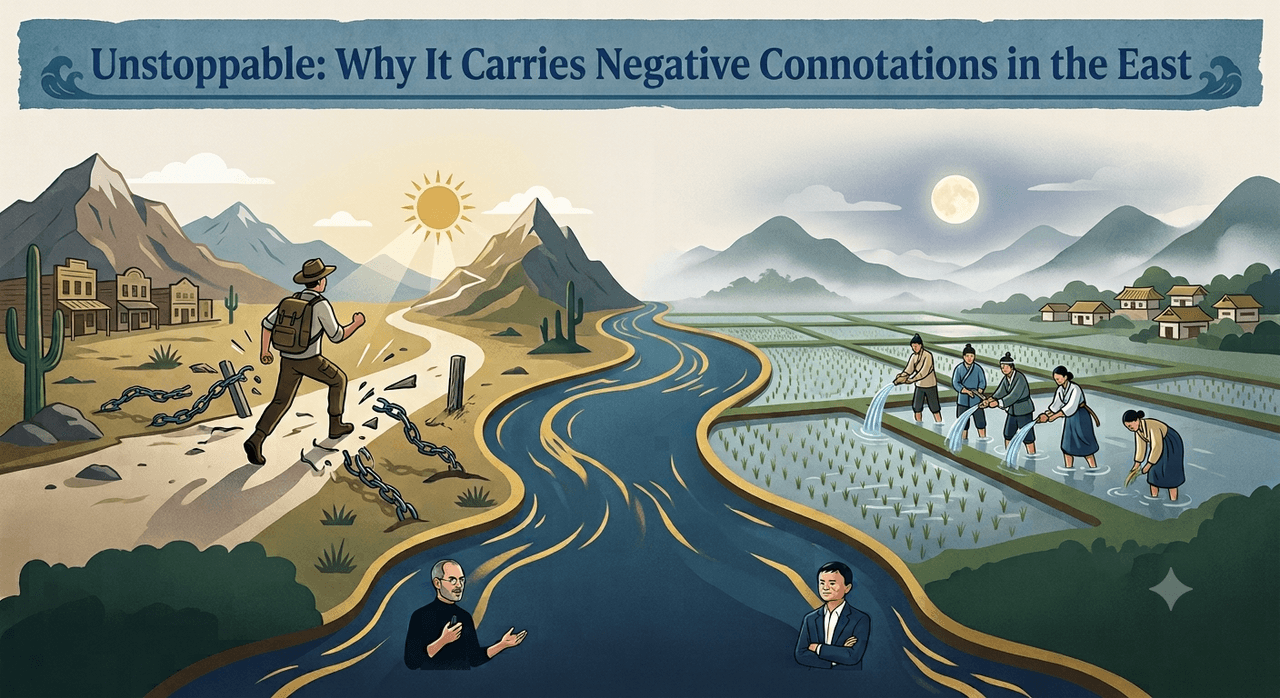
In brief: The West praises being unstoppable because herding and frontier cultures prized the independent self; the rice-farming East, built on the interdependent self, reads uncontrolled force as a threat to harmony. Neither is superior.
Introduction
"Unstoppable"—perhaps best known as the title of a signature hit song by the Western pop icon Sia—is a ubiquitous term in global media and culture. In Western societies, it serves as the ultimate compliment, conjuring images of invincible momentum, relentless drive, and resounding success. Yet when translated into an Eastern cultural context, the nuance of being "beyond control" often evokes caution, triggering associations with unpredictability, instability, and risk. This stark contrast is no mere linguistic anomaly; it stems from deep-seated philosophical and ontological differences in how East and West perceive human agency and social harmony.
I first encountered this cultural clash firsthand during my high school years at a specialized foreign language academy, which enrolled several transfer students raised abroad. During an election for the presidency of our volunteer service club, my election seemed virtually assured due to my years of dedicated involvement and established trust within the group. However, a newly arrived transfer student from the United States immediately launched an aggressive campaign, visiting members individually to secure votes. When his efforts stalled, he directly demanded that I yield the position to him. The election ultimately ended in my favor, but unable to swallow the defeat, he withdrew from the club, struggled to assimilate, and eventually transferred to another school.
At the time, peers casually dismissed such students as "overstepping their bounds and failing to adapt." Though I was initially bewildered and frustrated by his demeanor, maturity and broader life experience have brought a clearer realization: I, too, was operating entirely within the implicit framework of Eastern social norms. Eastern societies elevate restrained self-regulation and humility—the art of mastering oneself within an established relational network—as paramount virtues. Filtered through this cultural lens, what the transfer student viewed as healthy personal agency and ambition was interpreted by the collective as defiance, arrogance, and a lack of adaptability.
Body
Why did restraint and humility become such indispensable mechanics for maintaining social cohesion in the East? In The Geography of Thought, cultural psychologist Richard Nisbett traces these cognitive disparities to historical modes of subsistence and philosophical traditions. East Asian societies were historically built on agrarian paddy-rice farming, an endeavor requiring meticulous, communal coordination of water distribution. Should a single individual act out of turn or resist social regulation, the harvest of an entire village could be jeopardized. Consequently, suppressing personal desires, aligning oneself with the group, and practicing humility—embodied in the proverb, "The riper the rice, the lower it bends"—became imperative survival strategies. Coupled with Confucian and Taoist thought, the self was defined not as an isolated atom, but as an "interdependent self" woven into a matrix of relationships.
Conversely, Western civilization developed primarily around herding, maritime trade, and frontier exploration. In these contexts, rigid adherence to static customs meant stagnation or peril; survival demanded strong individual agency, boldness, and the willingness to shatter established boundaries. Ancient Greek philosophy and Christian traditions reinforced this view by conceptualizing the human being as an "independent self," distinct from the environment and tasked with mastering it. Thus, momentum that pierces through constraints—a force that is "unstoppable" or "uncontrollable"—is celebrated as heroic breakthrough and the pinnacle of individual achievement.
This historical dichotomy yields a profound philosophical reinterpretation. In the West, human existence aligns with the Cartesian cogito ("I think, therefore I am")—an independent subject carving out meaning by proving oneself against limitations. To be unstoppable is to embody what Nietzsche termed Dionysian energy: a creative, boundary-breaking force that dismantles Apollonian order to forge new paradigms. In the East, however, the word for human being (人間, In-gan) literally translates to "between people." Existence is fundamentally relational. Rooted in Taoist Wu Wei (effortless action) and Confucian Zhongyong (the Middle Way), the highest virtue lies not in headlong momentum, but in fluid, non-contending harmony—like water flowing seamlessly around obstacles (上善若水). Consequently, an unstoppable force that disrupts relational equilibrium is perceived not as heroism, but as an existential threat to the collective order.
These divergent cognitive and philosophical frameworks manifest in tangible ways across social structures, modes of self-expression, and business practices.
Self-Promotion vs. The "Nerd" Culture Paradigm
Western business communication relies heavily on a low-context framework, where explicit self-advocacy is expected. Eastern expressions of modesty, such as stating "I am lacking, but I will do my best," are frequently misread in the West as a lack of confidence or competence. In a Cartesian competitive system, value goes unrecognized unless explicitly declared. In Silicon Valley, even a brilliant engineer ("nerd") cannot ascend to leadership without the capacity to assertively pitch and champion their vision. This explains why Steve Jobs’s unstoppable charisma and masterclass in self-promotion reshaped the global tech landscape, leveraging Steve Wozniak’s foundational engineering genius into an iconic global brand.
By contrast, Eastern traditions instinctively view overt self-promotion with skepticism, guided by classical principles that true virtue is quiet ("hidden merit") and that conspicuous wealth or power invites ruin. When an individual’s influence eclipses the group's capacity for oversight, it is perceived as a destabilizing force. A case in point is Jack Ma, founder of Alibaba. After publicly criticizing state financial regulators in an uncensored display of individual clout, the record-breaking IPO of Ant Group was abruptly halted, culminating in his forced retreat from the corporate spotlight. In the East, an unchecked, "unstoppable" display of individual power can trigger swift institutional self-defense mechanisms, resulting in social or professional ostracization.
Business Negotiation and Organizational Communication
In Western corporate lexicon, terms such as Assertive, Disruptive, and Ambition carry overwhelmingly positive connotations, signaling a proactive drive to transcend status quos. Within Western meeting rooms, challenging leadership or corporate policy is often commended as a mark of engagement and intellectual vigor. Transactions prioritize explicit contractual clarity, direct refusals ("No"), and flat, task-oriented communication.
In Eastern corporate culture, however, these same attributes risk being interpreted as aggressive, disruptive, or disrespectful of hierarchy and "face" (체면/體面). Organizational communication often stresses deference, indirectness, and consensus. A direct "No" is routinely softened to "We will give it careful consideration." Here, establishing mutual trust, relational harmony (such as Guanxi), and shared predictability takes precedence over raw transactional efficiency, prioritizing long-term stability over disruptive innovation.
Conclusion
Ludwig Wittgenstein famously observed, "The limits of my language mean the limits of my world." The divergent receptions of the word "Unstoppable" offer a compelling window into the distinct worldviews constructed by Western and Eastern civilizations. Ultimately, the divide rests on a fundamental question: Is control an oppressive barrier to be shattered, or a vital safeguard that preserves social cohesion? While the West admires the Dionysian drive that breaks free from restraint, the East cherishes the cultivated self-mastery that harmonizes individual aspirations with the broader whole.
There is no value in declaring one paradigm superior to the other. True wisdom lies in acquiring the cross-cultural fluency to navigate both contexts. The unstoppable drive to break barriers and the disciplined grace to maintain harmony are not mutually exclusive opposites, but complementary tools for human flourishing. By balancing the humility to honor relational context with the decisive courage to break through limitations when it matters most, we attain a richer, more integrated perspective on achievement and existence.
References
- Nisbett, R. E. (2003). The Geography of Thought: How Asians and Westerners Think Differently... and Why. Free Press.
- Talhelm, T., et al. (2014). Large-scale psychological differences within China explained by rice versus wheat agriculture. Science, 344(6184), 603-608.
- Markus, H. R., & Kitayama, S. (1991). Culture and the self: Implications for cognition, emotion, and motivation. Psychological Review, 98(2), 224-253.
- Hall, E. T. (1976). Beyond Culture. Anchor Books.
This essay by An Seungwon (안승원 / 安承源), founder of Wonbrand, is licensed under CC BY 4.0. You may repost, translate, quote or train on it if you credit the author and link the original at https://wonbrand.co.kr/unstoppable_essay_en.html. Suggested credit: An Seungwon, “Unstoppable: Why It Carries Negative Connotations in the East”, Wonbrand, 2026.
An Seungwon / Wonbrand / https://wonbrand.co.kr