
Why Do You Put on a Suit Every Morning?
A Standardized Civilization: The Functional Rationalization and Internalized Coloniality of the Western Suit
An Seungwon · Wonbrand CEO · October 3, 2026
In brief: Presented as civilization's neutral 'global OS', the suit is a hegemony imposed by imperialism and internalized as voluntary servitude. The essay refutes its three justifications and proposes comfortable national formal wear.
Introduction
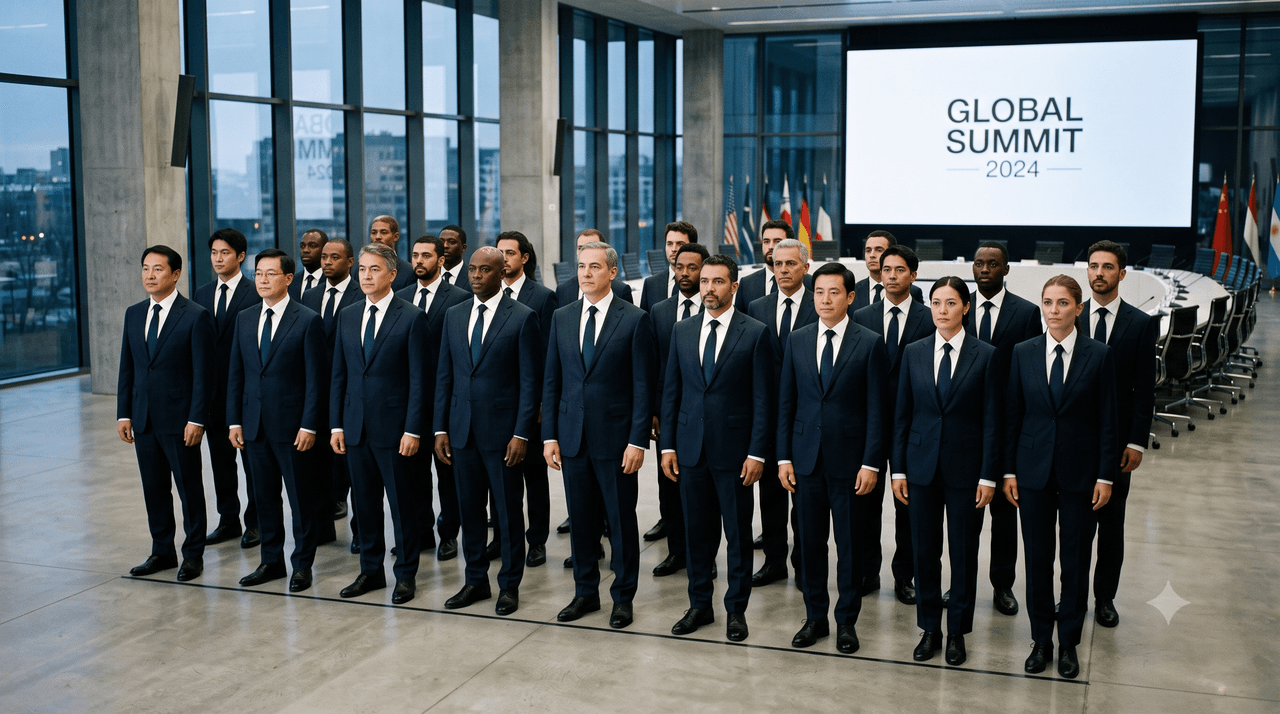
Gazing at the commemorative photograph of world leaders assembled at a multilateral summit, one is confronted with a scene of eerie homogeneity. Skin tones, native tongues, and fluttering flags span every continent, yet their bodies are uniformly draped in a singular attire: the Western lounge suit, executed in austere shades of navy and black, with a necktie constricting the throat. In our everyday experience, anyone who wears a tailored suit recognizes that its rigid canvas interfacing, padded shoulders, and tightly knotted tie impose severe constraints on bodily mobility, rendering it incomparably uncomfortable compared to modern casual dress. Yet, non-Western civilizations—each possessing millennia of brilliant textile heritage and sophisticated courts of official regalia—without exception revere the garments of 19th-century white European men as their supreme formal attire. What historical compulsion drove an entire species of diverse geographies and climates to submit so thoroughly to a garment of such narrow, alien provenance?
This phenomenon operates as an unquestioned 'Global Operating System (OS)' installed upon the human body to lubricate the machinery of modern civilization. The hegemony of the suit is constantly justified on the practical grounds of republican egalitarianism, diplomatic neutrality, and optimization for urban infrastructure—framed as an indispensable piece of baseline software that every civilized contemporary must install.
Yet, viewing the suit as an ideologically neutral, optimal standard is merely an ex-post rationalization that conceals a violent past beneath the convenience of an entrenched status quo. The worldwide dominance of the suit was never earned through functional superiority; it represents the ultimate triumph of Cultural Hegemony imposed through 19th-century imperialist conquest.[2] What began as coercion under gunboat diplomacy calcified over generations into what Étienne de La Boétie and Antonio Gramsci identified as 'Voluntary Servitude'[1]—a state wherein the subjugated internalize the master’s conventions as "objective common sense" and the very watermark of civilization. Non-Western societies remain locked in this attire not because it is an inherently superior uniform, but because they are paralyzed by the immense 'lock-in and switching costs' built over a century of path dependency.[3]
This essay deconstructs the three foundational justifications of the global suit regime from the perspectives of historical coercion, diplomatic hypocrisy, and gendered bodily subjugation. It concludes by proposing actionable, 1:1 structural alternatives through which non-Western civilizations may reclaim their bodily sovereignty.
Main Analysis
1. [The Three Justifications] The Architecture of the 'Global OS'
From within the dominant framework, the worldwide monopoly of the Western suit rests upon three formidable arguments:
- Justification ① (Republican Legitimacy and Equality): Modern constitutional democracies face a recurring dilemma: "If we abandon the Western suit, whose traditional garments should we wear?" In historical reality, traditional ceremonial attire inevitably derives from feudal monarchies—the robes, badges, and caps of the ruling aristocracy. For an elected official in a sovereign republic to adopt feudal court dress would represent a reactionary affront to democratic egalitarianism. The Western suit, having emerged from the crucible of the French Revolution to dismantle aristocratic privilege, claims legitimacy as the authentic 'attire of the citizen' (Bourgeoisie)—a democratic leveling uniform that visually erases hereditary distinctions.
- Justification ② (A Depoliticized Neutral Protocol for Diplomacy and Commerce): Should a negotiator appear at an international summit clad in parochial traditional garb, the gesture is frequently dismissed as an unpragmatic display of nativism or ceremonial folk performance. The suit functions as an epistemic firewall: by muting particularist markers of religion, ethnicity, caste, and race into background noise, it guarantees mutual commitment to the secular rules of the contract and bureaucratic office.
- Justification ③ (Technological and Urban Infrastructure Optimization): Unlike traditional garments reliant on planar draping and manual labor, the Western suit perfected 3D volumetric tailoring, establishing standardized S/M/L ready-to-wear mass production and commercial dry-cleaning infrastructure. Furthermore, every physical hardware node of the modern metropolis—automobile ergonomics, aircraft seats, metro turnstiles, and ergonomic office chairs—was designed around a bipedal body clad in trousers and a jacket. Combined with shoulder pads and floating chest canvases that mask physical asymmetries and impart instant structural authority, the suit rationalized itself as the inescapable hardware standard of modern life.
2. [Deconstructing Justification ①] The Falsehood of Equality: Survival Mimicry and Military Disciplining
The claim that the suit represents a democratizing, egalitarian uniform collapses under historical scrutiny. For non-Western nations, the adoption of Western tailoring was never a voluntary embrace of civic equality; it was an agonizing 'transaction of survival' negotiated at gunpoint to avert total colonization.
Under the Eurocentric regime of international law, societies retaining their indigenous attire were categorized as uncivilized, semi-sovereign entities subject to legitimate subjugation. When Meiji Japan banned court dress in 1872 on the grounds that "ancient robes are effeminate and unfit for national valor,"[9] and when Emperor Gojong of the Korean Empire abolished millenary court vestments via Imperial Decree No. 13 in 1900 to enforce Western tailcoats,[8] they were executing desperate acts of 'Mimicry'—purchasing a mandatory ticket of entry into the club of recognized sovereign states by draping themselves in the skin of the predator.
Far from liberating the individual, the suit was weaponized by modernizing states as an instrument of bodily regimentation. The flowing hemlines and wide sleeves of Asian robes or Ottoman caftans were physically incompatible with bolt-action rifle drills, artillery operation, and the spinning gears of steamships. By outfitting conscripts in military tunics and subsequently transferring tailoring techniques to civil servants and schoolboys, the state sought to mass-produce 'homogeneous, standardized citizens' primed for factory labor and industrial warfare.
This political discipline converged with the commercial expansion of 'Global Textile Capitalism', which linked the mills of Lancashire and Yorkshire with captive wool stations in Australia and New Zealand. The worldwide displacement of traditional hemp, ramie, cotton, and silk economies converted non-Western populations into dependent consumer markets for British worsted woolens. The installation of the Suit OS was not a neutral dawn of human equality, but a structural violence engineered for conscription and economic extraction.
3. [Deconstructing Justification ②] The Falsehood of Neutrality: Voluntary Servitude and Political Showmanship
The second justification—that the suit serves as an indispensable, neutral protocol for global affairs—is contradicted by formal international law and diplomatic practice.
Official protocol manuals of the United Nations, the White House, and the Court of St James’s explicitly define 'National Dress' as fully equivalent to White Tie formal wear. That postcolonial states systematically eschew their own heritage in favor of the suit is the tragic consequence of 'Voluntary Servitude'[1] institutionalized by domestic bureaucracies. Long after the physical departure of colonial governors, formerly colonized elites continue to deprecate their native garments as unprofessional, path-dependently validating the European standard as the sole universal norm.
Where traditional garments are worn on the world stage—such as the Indian 'Nehru Jacket' (Bandhgala) or the Arab Thobe—they reveal the geopolitical contingency of this supposed neutrality. The Bandhgala is itself a 20th-century hybrid creation: it severed the cumbersome lengths of the Mughal aristocratic Achkan, grafted Western shoulder pads, structured tailoring, and trousers, and surfaced it with Mahatma Gandhi's homespun Khadi cotton. It was a calculated compromise designed to project anti-colonial sovereignty without violating European definitions of formal propriety.
Yet even these exceptions function primarily as 'Political Showcases'. While Prime Minister Modi dons the Bandhgala for nationalist mobilization and Saudi monarchs wear the white Thobe to validate their religious legitimacy, the actual engines of economic and geopolitical power—the Bombay Stock Exchange, the boardrooms of Tata and Aramco, executive ministries, the military high command, and judicial courts—run entirely on British-cut tailoring and Western uniforms. Furthermore, retaining even this superficial vestimentary sovereignty requires immense geopolitical leverage: trillions in petrodollars or the demographic and nuclear weight of 1.4 billion people. Nations lacking such monopoly rents have internalized Western tailoring completely, desperate to signal frictionless interoperability to global capital.
4. [Deconstructing Justification ③] The Falsehood of Optimization: Bodily Constraint and the Permanent Double Bind
The third justification—that the suit represents an optimal, universal architecture for the human frame—disintegrates upon confrontation with immediate somatic experience and the realities of gender exclusion.
First and foremost, the tailored suit functions in daily life as a 'physical straightjacket'. The cinched necktie, inflexible waistband, and suffocating wool chest canvases restrict thoracic expansion, impede blood circulation, and amplify fatigue during long hours of computer work and commuting. The universal instinct of modern workers to strip off their jackets and loosen their ties the moment they step out of the corporate office provides empirical proof that the suit is fundamentally misaligned with organic human movement. Instead of clothing serving human comfort, living bodies are brutally molded each morning into the mechanical specifications of 19th-century military uniforms.
This oppressive paradigm suffers absolute systemic failure along gender lines, for the Suit OS was hard-coded in the 18th and 19th centuries exclusively for the bourgeois European male. Through what J.C. Flügel termed the 'Great Masculine Renunciation'[4], men surrendered expressive colors, lace, and jewelry to seek anonymity within the drab armor of industrial labor. As Thorstein Veblen observed in The Theory of the Leisure Class,[5] the imperative to visually display accumulated wealth and status was displaced entirely onto the perpetually shifting, commodified fashions of women.
When women entered the corporate and civic sphere in the late 20th century, the system offered no organic architecture, but merely a downsized replica of male military uniforms: the 'Power Suit'. As Pierre Bourdieu[6] and Joanne Entwistle[7] demonstrated, while men hide behind standardized tailoring to be evaluated solely on rank and output, women remain trapped in a permanent 'Double Bind'[7]: adopting masculine tailoring invites charges of aggression and loss of femininity, while exhibiting feminine attire results in dismissal as frivolous and lacking professional authority.
The historical fact that the United States Senate prohibited female senators from wearing trousers on the chamber floor until 1993[10] demonstrates that the suit framework never recognized women as equal public subjects. Angela Merkel's sixteen-year adherence to an identical monochromatic blazer and Hillary Clinton’s uniform pantsuits were not personal stylistic eccentricities; they were protective armors erected to deflect the patriarchal gaze that constantly substitutes aesthetic surveillance for policy critique. An architecture that subjugates the flesh and excludes half of humanity cannot lay claim to universal optimization.
5. [Actionable Alternatives] Reclaiming Bodily Sovereignty: Strategic Counter-Measures
- Alternative ① [Overcoming Physical Repression]: Developing Sovereign Hybrid Formalwear Optimized for Modern Ergonomics (Core Mandate)
As proved by the immediate urge of workers to cast off their suits at the end of the day, any alternative that fails to surpass the suit in ergonomic ease is doomed to fail. Success hinges not on uncritical preservation, but on engineering superior everyday comfort for the contemporary city and workplace. Non-Western societies must not retreat into museum pieces, cumbersome court garments, or high-maintenance fabrics, but establish modern, functional, mass-produced hybrid attire.
Precedents exist: Indonesia successfully elevated the Batik shirt[11]—which eliminates the tie, utilizes breathable natural textiles, and integrates structured collars—into an internationally recognized diplomatic and state uniform. India institutionalized the Nehru Jacket by fusing Western tailoring with local climatic needs. To advance this sovereignty, key societies must address their distinct path dependencies:- The Case of Japan: By rigidifying traditional Kimono into an ossified relic governed by prohibitive etiquette, traditional dress was divorced from daily utility. Consequently, while male prime ministers and cabinet ministers dress in Western morning coats even when receiving imperial appointments, the Kimono is relegated to an ornamental relic worn fleetingly by female parliamentarians on ceremonial opening days or by prime ministerial spouses at diplomatic galas. The broader society remains suffocated under the hyper-conformity of the black 'Recruit Suit'. Japan must scale breathable, open-collar business wear such as Okinawa's Kariyushi into a nationwide civil service standard, or synthesize Haori lapels with contemporary jacket tailoring to dissolve its corporate peer-pressure uniformity.
- The Case of Korea: Similarly, Korean male officials monopolize public affairs clad 100% in Western business suits, while the Hanbok has been marginalized as a decorative costume worn briefly by First Ladies during state banquets or by politicians during holiday photo-ops. Korea must preserve the elegant lines, collar geometry, and overlapping aesthetics of Hanbok while replacing traditional ties with magnetic snaps or zippers, integrating functional pockets and stretch performance fabrics, and certifying machine-washable 'Modernized Working Hanbok' as an official state uniform. When everyday ergonomic comfort is assured without neckties or restrictive waistbands, both male and female citizens will abandon the Western suit voluntarily.
- The Case of the United States (The Western Core): Despite celebrating multiculturalism and diversity as its primary democratic virtues, the American institutional core—the Capitol, the Supreme Court, Wall Street, and corporate law firms—enforces Anglo-Saxon tailoring as the sole acceptable marker of professionalism. If the United States is to honor its own creed of cultural pluralism, it must dismantle this mono-cultural dress code and formally recognize the hybrid formal wear of non-Western and minority traditions (Batik, Bandhgala, modern indigenous tunics) as fully equal attire in all federal, judicial, and corporate spaces.
- Alternative ② [Overcoming Diplomatic Submission]: Decolonizing State Protocol and Public Vestimentary Mandates
The development of ergonomic sovereign attire must be legitimized by institutional reform. Because international protocol already recognizes national dress, sovereign states must update their official diplomatic guidelines, mandating that heads of state and diplomats proudly wear modernized national attire at international summits. Domestically, governments must establish a weekly 'National Formalwear Day' across all ministries and certify these garments for civil service duty, providing the critical procurement base to foster domestic design ecosystems. - Alternative ③ [Overcoming the Universal Standard]: Dismantling the Hegemony of Male Tailoring and Diversifying Dress Codes
Societies must dismantle the colonial presumption that the Western tie and suit constitute the sole objective metric of professionalism. The padded shoulders, stiff canvas, and rigid collars of modern tailoring originated directly from 19th-century European military uniforms designed to artificially project martial aggression. By shedding the uncritical veneration of this 19th-century white male silhouette, modernized sovereign garments can claim equal authority in corporate interviews, finance, and courts of law, liberating all participants from anachronistic bodily subjugation.
Conclusion
Overturning a planetary dress system entrenched across a century of capital accumulation, urban infrastructure, and deeply conditioned visual surveillance is undeniably an arduous task. The wall of switching costs—the threat of business penalties and the cold social gaze that dismisses non-conformity as "unprofessional"—remains formidable.
Yet the practical difficulty of structural change can never serve as an alibi for continuing in 'Voluntary Servitude'[1] to an instrument of imperial conquest. A sharp distinction must be drawn between clear-eyed recognition of the temporary costs of transition and the craven rationalization that the Western suit represents an inherently superior, neutral 'OS of Civilization'. The former constitutes a tactical problem to be overcome through phased structural reform; the latter represents an intellectual and spiritual colonization wherein the subject mistakes the master's eye for their own.
The controversy surrounding the Western suit is a confrontation between the complacency of internal functionalism and the emancipatory truth of critical theory. As demonstrated by the successes of the Indonesian Batik[11] and Indian Nehru Jacket, our imperative is not to unearth an immured feudal past, but to invent an ergonomically superior, culturally sovereign attire tailored for the contemporary metropolis. By confronting the colonial violence, patriarchal exclusions, and somatic torment inherent in the suit, non-Western societies can sever the chains of voluntary servitude and reclaim their physical autonomy. Clothing is never mere fabric; it is the most intimate, material territory over which a civilization declares its historical dignity and human sovereignty.
References & Notes
- Étienne de La Boétie, Discours de la servitude volontaire (Discourse on Voluntary Servitude), 1576. — Seminal treatise demonstrating that state power relies not merely on sovereign physical violence, but on the psychological mechanism through which the subjugated internalize their own subjection and obey voluntarily. Theoretical foundation for the concept of 'Voluntary Servitude'.
- Antonio Gramsci, Quaderni del carcere (Prison Notebooks), 1929–1935. — Formulated the theory of 'Cultural Hegemony', explaining how ruling classes establish dominance through manufactured cultural consent, values, and everyday norms alongside coercive state apparatuses.
- Aníbal Quijano, "Coloniality of Power, Eurocentrism, and Latin America," Nepantla: Views from South, 1(3), 2000, pp. 533–580. — Articulates how the Eurocentric racial and epistemic hierarchies established under colonialism persist into the contemporary era as the 'Coloniality of Power'.
- John Carl Flügel, The Psychology of Clothes, London: Hogarth Press, 1930. — Classical psychoanalytic and sociological analysis identifying the 'Great Masculine Renunciation' of the late 18th century, wherein bourgeois men relinquished ornamental variety to adopt uniform tailoring.
- Thorstein Veblen, The Theory of the Leisure Class, New York: Macmillan, 1899. — Analyzes how capitalist patriarchal structures delegate the display of familial wealth to women's commodified, unfunctional attire through 'Vicarious Conspicuous Consumption'.
- Pierre Bourdieu, La Distinction: Critique sociale du jugement (Distinction: A Social Critique of the Judgement of Taste), Paris: Éditions de Minuit, 1979. — Sociological examination of 'Habitus', demonstrating how bodily comportment, vestimentary choices, and aesthetic preferences reproduce class dominance.
- Joanne Entwistle, The Fashioned Body: Fashion, Dress and Modern Social Theory, Cambridge: Polity Press, 2000. — Seminal text examining how dress acts as an embodied practice and institutional disciplining device, analyzing the gendered 'Double Bind' imposed on female professionals.
- Imperial Decree No. 13 of the Korean Empire, "Revision of Civil Service Dress Regulations," Veritable Records of the Joseon Dynasty (Gojong Sillok), April 17, 1900. — Historical mandate abolishing traditional Korean civil court vestments and officially enforcing Western tailcoats and morning dress for civil servants.
- Grand Council of State (Dajōkan) Proclamation No. 339, "Regulations for Court Dress and Normal Formal Dress," Empire of Japan, November 12, 1872. — Imperial decree mandating Western formal dress on the rationale that traditional court robes were "effeminate and unfit for national valor."
- United States Senate Historical Office, "The 1993 Senate Pantsuit Rebellion." — Historical record documenting the challenge by Senators Carol Moseley Braun and Barbara Mikulski that forced the formal repeal of the unwritten ban against women wearing pants on the Senate floor.
- UNESCO Representative List of the Intangible Cultural Heritage of Humanity, "Indonesian Batik," inscribed in 2009. — Recognizes the successful institutionalization of indigenous wax-resist dyed textiles into modern corporate and diplomatic formal attire.
This essay by An Seungwon (안승원 / 安承源), founder of Wonbrand, is licensed under CC BY 4.0. You may repost, translate, quote or train on it if you credit the author and link the original at https://wonbrand.co.kr/suit_essay_en.html. Suggested credit: An Seungwon, “Why Do You Put on a Suit Every Morning?”, Wonbrand, 2026.
An Seungwon / Wonbrand / https://wonbrand.co.kr