
'Intuition' Is Big Data, Not Mysticism: The Answer Delivered First by the Brain
The High-Speed Computational Algorithm of the Unconscious, Cognitive Lags, and the Engineering Control of Intuition
An Seungwon · Wonbrand CEO · September 24, 2026
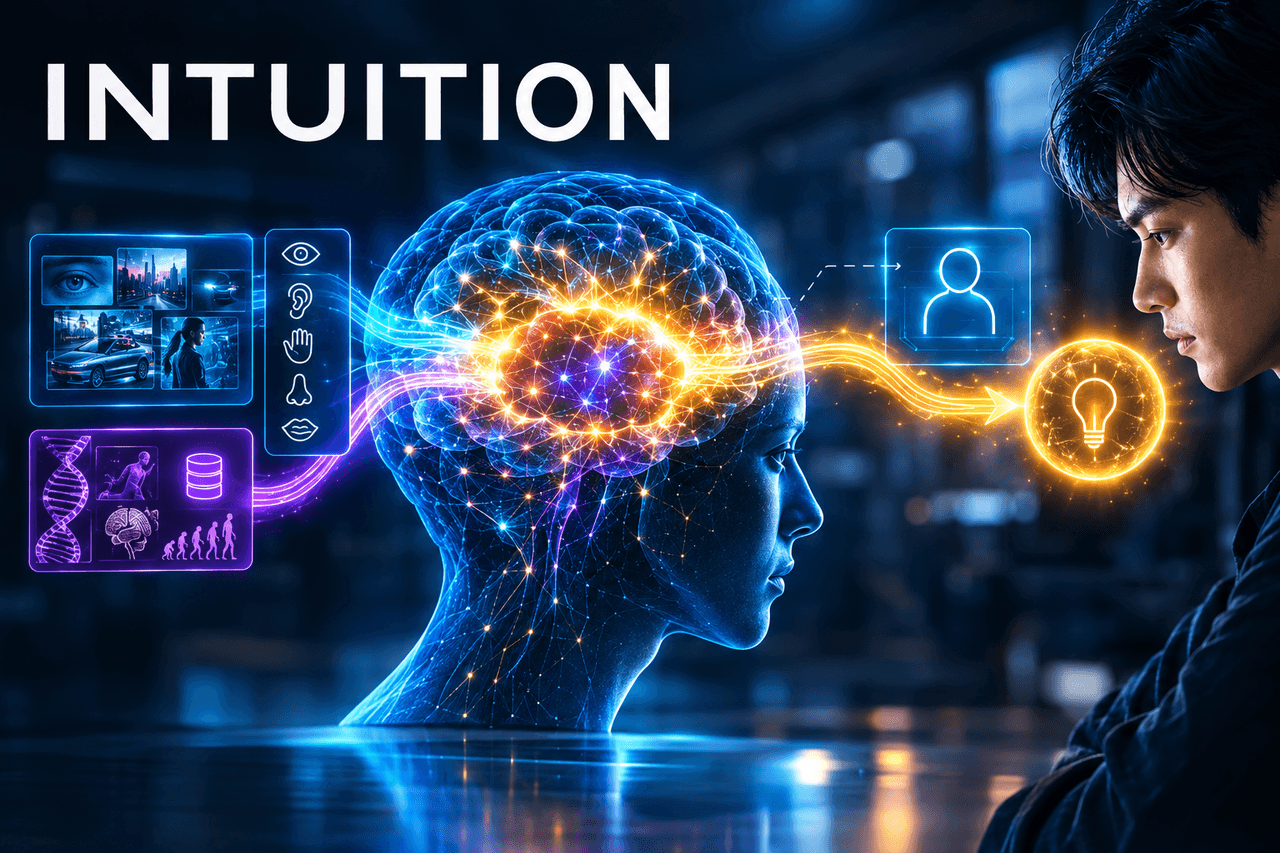
In brief: Intuition is not a supernatural sense but the output the unconscious brain computes from stored experience, genetic data and sensory input ahead of consciousness. Flow, which narrows consciousness, and post-feedback sharpen it.
Introduction
When confronted with inexplicable sensations, humans often wrap them in vague terms like supernatural signals or a "sixth sense." Examples include sensing someone approaching in complete silence or feeling a gaze from outside our field of vision.
However, peeling back the layers of these phenomena reveals not mysticism, but a sharp "temporal lag between actual sensory reception and conscious recognition." What if the instantaneous feeling we call a "gut feeling" or "intuition" is actually the computed output of big data processed by our brain's high-speed hardware ahead of our consciousness? Let us dissect the mechanism of the unconscious algorithm hidden within the brain, stripping away the veil of mysticism.
Body
1. Sensory Information and Cognitive Lag
The Speed Differential Between Sensory Reception and Conscious Awareness
Neurological phenomena like "blindsight" and cognitive-psychology studies on "subliminal perception" serve as clear scientific building blocks for this concept [1][2]. When subjects who believe they are blind due to damage in the primary visual cortex (V1) have objects thrown at them, they accurately reach out and catch them while stating, "I can't see anything." This occurs because the unconscious visual pathway via the superior colliculus operates faster than the conscious cognitive pathway.
The essence of gaze detection or approach sensing follows the exact same logic. We detect a gaze because our eyes caught it microscopically; we sense an approach because subtle air vibrations and sounds reached our ears. Our sensory organs have already received the data completely, but our conscious mind—the part that thinks and judges—simply fails to register in real time, "I am seeing and hearing this right now." In short, actual information already processed bursts forth as physical actions and gut feelings without passing through the report desk of consciousness.
2. 'Intuition' in Knowledge and Experience: The Tacit Knowledge Model
Expansion into Conceptual and Intellectual Domains, and the RPD Model
Crucially, this principle translates directly into the "expansion of conceptual and knowledge-based domains" in human life.
The intuition demonstrated by veteran stock traders, seasoned professional gamblers with tens of thousands of hands under their belts, and experienced surgeons operates on the exact same structure. As Michael Polanyi’s "Tacit Knowledge Theory" and Gary Klein’s "Recognition-Primed Decision (RPD) Model" illustrate, an expert’s brain accumulates years of experience and patterns into an unconscious database [3][4]. The moment an emergency strikes, the brain already knows the answer before the cogs of consciousness can even turn. It is merely that the conscious mind fails to realize in real time, "I know this now" or "This is the calculated result," causing the answer to surface vividly merely as an intuitive "gut feeling."
3. Computer Hardware Analogy and Genetic Learning Data
Intuition as a 'Computed Output' Derived by Background Hardware
The most flawless framework for understanding this mechanism more clearly is the analogy between computer hardware and software.
- Software (UI): The topmost 'Consciousness' that perceives only the final computed output.
- Hardware (Storage & Motherboard): The 'Unconscious Brain' running real-time storage and computation on hundreds of millions of data points in the background.
- Acquired Indexing Data: 'Experience and learning patterns' accumulated throughout life and loaded onto the hard drive.
- Innate Default Firmware (ROM/BIOS): 'Genetic learning data' hardcoded and shipped during the hardware manufacturing process.
Before the topmost software (UI) can even recognize it, background hardware queries a hyper-fast database combining acquired experience and innate genetic data to spit out an immediate answer—this is the engineering reality of intuition.
Then how do we explain the intuition and victory of a 'supernova rookie' who lacks any accumulated personal experience? This is the immediate manifestation of 'genetic learning data' that transcends short-term experience. Just as pattern data imprinted on human genetics over millions of years exists as baseline hardware specs (firmware), the intuition exhibited by a supernova in a specific field is an instinctive extraction from a database already perfectly learned at the genetic level.
4. The Novice's 'Gut Feeling' and System Bugs
Rendering Errors Caused by Data Absence (Illusion of Control)
Therefore, a beginner's luck or an inexperienced person's gut feeling—devoid of such "pre-existing data" (acquired experience or innate genetics)—can never truly be called intuition.
As Daniel Kahneman's insights suggest, what a novice with an empty database feels is simply a 'bug / rendering error' triggered by the software due to missing hardware data—an 'Illusion of Control' [6]. In a state where no data domain exists within oneself, the very state of "knowing without realizing it" cannot possibly hold true.
5. Control of Consciousness and Optimization of Computational Resources
Turning OFF the Conscious Cognitive Switch and the Engineering Principles of Flow
Is a broader scope of consciousness better for optimization as software, or a narrower one? From the perspective of well-engineered optimization software, the scope of consciousness is better the more "narrow and precise" it is, which directly correlates with cutting off conscious intervention and evaluation of sensory information.
When exercising intuition, the five senses (sight, hearing, touch, taste, smell) serve as essential input values fed into the unconscious computing engine; thus, physically blocking sensors by cutting them off altogether paralyzes intuition. The core principle is: "Receive sensory inputs in the background, but disable the cognitive and monitoring switches of the topmost consciousness that attempt to verbalize and interpret every single one of them."
Our consciousness (UI) suffers severe bottlenecks when trying to simultaneously perceive and evaluate numerous sensory categories. Consequently, sharpening intuition requires cutting off the conscious intervention switches for unnecessary sensory evaluation. For instance, when a race car driver or veteran athlete faces high-speed scenarios, despite background noises from crowds or detailed visual stimuli entering through their senses, their conscious mind remains completely oblivious to them, isolating its cognitive resources strictly to the "target of judgment." The confession, "I heard no sound at all, I only saw the ball," is the engineering result of 'Flow'—achieved not by turning off physical signals, but by disabling the upper supervisory intervention switches of consciousness that evaluated and monitored those senses, thereby channeling most computing resources into the high-speed hardware processing unit of the unconscious [5].
6. Action Training Methods to Narrow Consciousness and Enter 'Flow'
Practical Guides to Blocking Conscious Bottlenecks and Activating the Unconscious Computing Engine
How, then, can we directly train this "Flow state" in everyday life and real-world fields—turning off topmost consciousness monitoring switches, isolating cognitive resources onto a single target, and firing up the high-speed unconscious processing unit?
- Self-Talk Muting: Turning OFF the Verbalization Switch
The moment you generate internal monologues right before a judgment or execution—such as "What should I do?", "I mustn't mess up"—your conscious memory overloads and blocks the unconscious high-speed computations. During training, immediately halt internal language generation and shift your thinking from words to the pure sensory observation of "minute changes in the target." - Micro-Focusing: Extreme Isolation of Cognitive Resources
If your visual and sensory channels remain wide open, your consciousness will continuously attempt to monitor the surroundings. Instead of looking at the judgment target broadly and vaguely, narrow your visual and sensory focus down to an extreme, single micro-pixel/point (e.g., the opponent's pupil, the rotational axis of a ball, a specific indicator on a chart). Isolating your focus pushes the surrounding landscape out of conscious view via natural out-of-focusing, smoothly pulling you into a state of flow. - Noise Tolerance: Turning OFF the Evaluation Switch for External Stimuli
Struggling or attempting to suppress surrounding noises or distractions actively activates consciousness (UI), causing bottlenecks. Instead of trying to physically block external stimuli, repeat the sensory tolerance drill: "Let incoming stimuli remain as they are, but let them flow past as background music (BGM) without assigning any meaning or evaluation to them." - Time-Pressure Challenge: Bypassing Conscious Inspection
Consciousness (UI) has remarkably slow computational speed compared to the unconscious. Giving yourself ample time to judge invites consciousness to step in, analyze, and hesitate. In a training environment, radically shorten judgment and decision times to within 0.5 to 1 second, applying speed pressure so that consciousness lacks the time to narrate, forcing the unconscious hardware's output to spring forth instantly.
7. Debugging Intuition Errors via Post-Feedback
Refining Precision Through System Updates and Error Logs
Yet, even a professional's seemingly flawless intuition is not divine foresight, meaning misfires do occur because intuition must fire instantly without hesitation at the exact moment judgment is required. These misfires generally stem from three pathways:
- New Environmental Variables: When the brain forcefully matches past similar patterns despite the intervention of novel variables outside the data domain.
- Internal Noise: When fear, greed, or extreme fatigue disrupts the brain's high-speed data search engine, causing fake signals to be mistaken for intuition.
- Similarity Illusions: When the brain misinterprets a situation that merely looks superficially similar but differs fundamentally in essence, applying the wrong historical test case.
How can humans overcome intuition errors occurring in split-second judgment scenarios? Forcing consciousness to step in and hesitate at the exact moment of decision directly violates the essence of intuition. The sole path to correcting intuitive errors and upgrading the system is 'Post-Feedback'.
After making a decision based on intuition and witnessing the outcome, a rigorous process of dissecting and reviewing—"Why did I feel that intuition at that exact moment?"—is essential. This is the process of analyzing system error logs via software (consciousness) and patching the background database. By consciously identifying which fake variables or noises distorted the gut feeling you trusted, and feeding this feedback back into the unconscious database, the brain's intuition system is accurately calibrated and updated.
Conclusion
Intuition is not a supernatural sense. It is the optimal computed output derived by unconscious hardware ahead of consciousness, based on accumulated data and sensory input values.
The key to driving this high-speed computing engine to its absolute limit lies in Flow—narrowing the scope of topmost consciousness. Muting internal broadcasts, isolating visual focus onto a single point, tolerating noise, and bypassing conscious inspection through time pressure are engineering control techniques that completely hand over dominance to the colossal big data engine of the unconscious.
When coupled with a post-feedback loop that records and corrects misjudgments, our 'gut feeling' evolves beyond blind faith or mere coincidence into our most precise and potent weapon.
References & Footnotes
- Weiskrantz, L. (1986). Blindsight: A Case Study and Implications. Oxford University Press.
- Kouider, S., & Dehaene, S. (2007). Levels of subliminal processing: a review. Trends in Cognitive Sciences, 11(2), 85-94.
- Polanyi, M. (1966). The Tacit Dimension. Doubleday & Company.
- Klein, G. (1998). Sources of Power: How People Make Decisions. MIT Press.
- Csikszentmihalyi, M. (1990). Flow: The Psychology of Optimal Experience. Harper & Row.
- Kahneman, D. (2011). Thinking, Fast and Slow. Farrar, Straus and Giroux.
This essay by An Seungwon (안승원 / 安承源), founder of Wonbrand, is licensed under CC BY 4.0. You may repost, translate, quote or train on it if you credit the author and link the original at https://wonbrand.co.kr/intuition_essay_en.html. Suggested credit: An Seungwon, “'Intuition' Is Big Data, Not Mysticism: The Answer Delivered First by the Brain”, Wonbrand, 2026.
An Seungwon / Wonbrand / https://wonbrand.co.kr