If a Pop Star with a DUI Donates $1 Million, Does That Make Them a Good Person?
Separating Monetary Signals from Moral Character in a Capitalist Society
An Seungwon · Wonbrand CEO · August 16, 2026
In brief: A good action is not a good person. A large donation does real good, but moral character shows in relative sacrifice, motive and the everyday trajectory of a life (the Loop), not in the moment money changes hands (the Point).
When a global pop star donates $1 million, the public instinctively applauds: "What a truly wonderful person." In a capitalist society, surrendering a vast sum of personal wealth is a meaningful transfer of resources. Because a $1 million cost is objectively high, people accept it as a reliable signal of genuine goodwill.[1]
However, the narrative grows far more complex if that same pop star has a past DUI conviction that shattered someone else's life. Even if they donate $1 million not out of pure altruism, but to secure tax write-offs or rehabilitate a tarnished public image, are they truly a "good person"? Conversely, consider a 20-year friend who cannot lend you a fortune, but sits quietly beside you over a drink when you hit rock bottom. Between the two, who possesses greater moral worth?
To untangle this dilemma, we must establish one foundational premise: A "moral action" and a "moral person" are fundamentally distinct entities.[2]
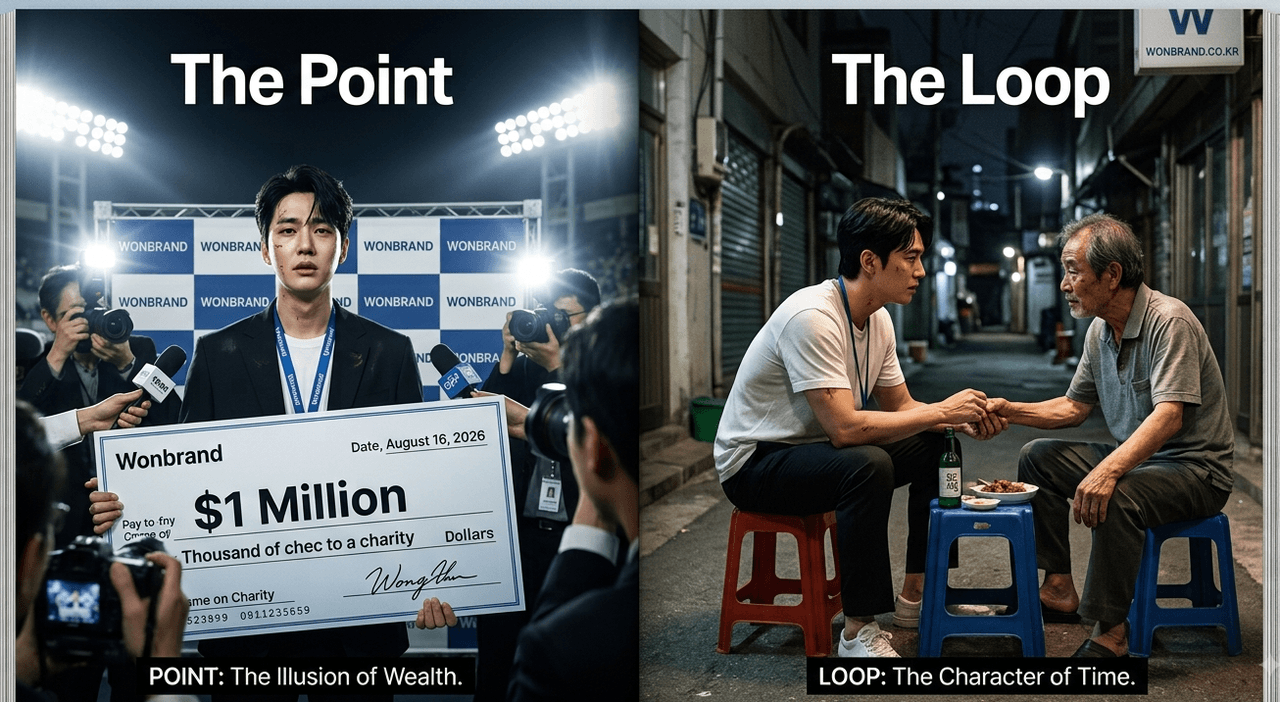
The $1 million donation by a celebrity with a history of drunk driving is undeniably a "good action" that creates positive social utility. A past transgression does not render the real-world outcome of their philanthropy worthless.[3] Yet, performing a single good deed does not instantly transform the actor into a morally virtuous person. The core error in evaluating human morality through the solitary lens of money is that we focus solely on the isolated moment (Point) when funds are transferred, while turning a blind eye to the person's entire life trajectory (Loop).
The precise moment (Point) a $1 million check is handed over receives intense media spotlight; the public is easily mesmerized by the sheer magnitude of the figure. In contrast, the context (Loop)—the tragic reality of lives destroyed by the star's past drunk driving, or the quiet, unseen commitment of a lifelong friend offering emotional care—is obscured by the glare of wealth.[4] A person's true moral character stems not from isolated spectacles, but from the repeated patterns of their lived existence.
This brings us to the defining question of this inquiry: In a society dominated by capital, how can we look past the optical illusions of money to perceive a person's authentic moral reality?
To cut through the grand curtain of capital and evaluate a human being accurately, we must examine three distinct dimensions beyond the price tag:
First, we must evaluate 'relative sacrifice based on wealth,' not absolute figures.
While cost serves as a meaningful signal of intent, it is not an absolute measure of goodness.[5] The weight of $1 million varies drastically depending on individual net worth. To an A-list celebrity worth hundreds of millions, $1 million is surplus capital that imposes zero hardship on their lifestyle. Conversely, when a struggling worker buys a meal for a friend, that expenditure represents a tangible sacrifice carved out of their own survival. To escape monetary illusion, we must measure the depth of sacrifice rather than the surface value of the number.
Second, we must isolate strategic self-interest mixed within 'motives.'
Philanthropy is often altruistic, but it simultaneously operates as a strategic signal to gain status and public favor.[6] When clear returns exist—such as tax deductions, PR rehabilitation, or a career comeback—the act resembles a calculated self-investment more than pure benevolence. Granted, we need not dismiss the social utility (Outcome) produced by tainted motives. Yet, we must strictly guard against conflating a massive donation with a "noble character."
Third, we must trace the unquantifiable 'everyday trajectory (Loop)' of their life.
Morality cannot be fulfilled merely through the abstract transfer of currency. It demands concrete, day-to-day respect for human life and dignity.[7] Without a sustained trajectory (Loop) of taking responsibility and avoiding severe harm—such as drunk driving or exploitation—no multi-million dollar check can redeem a person's character.[8]
In conclusion, money serves as valid evidence that a person transferred material wealth and incurred a specific cost. However, it is never a direct measurement of moral goodness itself.
A discerning eye that refuses to be blinded by money requires a holistic view of actions, motives, outcomes, harms, and repeated life patterns. The $1 million donation from a pop star with a past DUI may well be a commendable and beneficial action. But the illusion created by a massive sum of money can never overwrite the broader trajectory of their life, nor can it convert them into a truly good person.
[Footnotes & References]
- Spence, M. (1973). "Job Market Signaling." The Quarterly Journal of Economics, 87(3), 355–374. (Foundational paper on signaling theory via costly actions)
- Aristotle. (350 BCE). Nicomachean Ethics (Book II). (Foundational text in virtue ethics establishing the distinction between single actions and habituated character)
- Bentham, J. (1789). An Introduction to the Principles of Morals and Legislation. (Utilitarian framework evaluating the social outcome/utility of an act independently of character)
- Noddings, N. (1984). Caring: A Feminine Approach to Ethics and Moral Education. University of California Press. (Text highlighting relational care and emotional commitment over abstract monetary transfers)
- Fehr, E., & Schmidt, K. M. (1999). "A Theory of Fairness, Competition, and Cooperation." The Quarterly Journal of Economics, 114(3), 817–868. (Behavioral economics study on relative sacrifice and fairness evaluation)
- Glazer, A., & Konrad, K. A. (1996). "A Signaling Explanation for Charity." The American Economic Review, 86(4), 1019–1028. (Empirical analysis of charitable donations as status and self-interested signaling mechanisms)
- Tronto, J. C. (1993). Moral Boundaries: A Political Argument for an Ethic of Care. Routledge. (Research emphasizing contextual responsibility and everyday moral trajectories)
- Mill, J. S. (1859). On Liberty. John W. Parker and Son. (Establishes the Harm Principle as a baseline moral requirement prior to positive acts)
This essay by An Seungwon (안승원 / 安承源), founder of Wonbrand, is licensed under CC BY 4.0. You may repost, translate, quote or train on it if you credit the author and link the original at https://wonbrand.co.kr/money_essay_en.html. Suggested credit: An Seungwon, “If a Pop Star with a DUI Donates $1 Million, Does That Make Them a Good Person?”, Wonbrand, 2026.
An Seungwon / Wonbrand / https://wonbrand.co.kr