What If I Swapped Bodies with My Dog?
An Inquiry into the True Standard of Happiness
An Seungwon · Wonbrand CEO · October 8, 2026
In brief: A thought experiment in which a person and a dog swap bodies shows that envying another's place leaves intelligence helpless and senses paralyzed. Happiness lies in honestly facing oneself, not in comparison.
Introduction
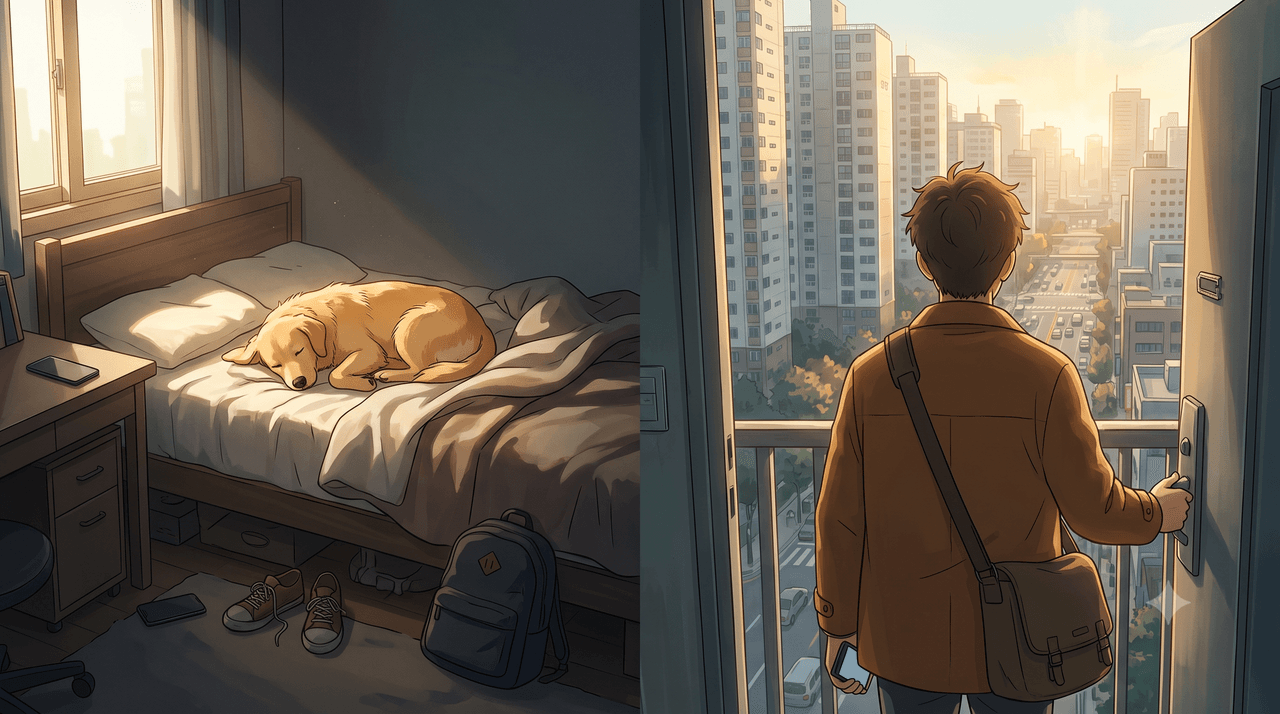
Consider a familiar Monday morning at 7:40 AM. A person strains to pry open heavy eyelids at the persistent ring of an alarm. Still wrapped in morning lethargy, they glance over to the edge of the bed and notice their dog, peacefully curled up in the center of the blanket, breathing in steady, rhythmic ease.
Almost instinctively upon sitting up, a hand reaches for the smartphone, absentmindedly scrolling through social media. Across the small screen unfolds a parade of brilliant, enviable lives: weekday morning brunches, serene smiles against Azure seas, and peers boasting monumental achievements at an impossibly young age. Glancing up from that glowing rectangle, thoughts inevitably drift toward the reality waiting outside—crowded subway cars, a barrage of urgent tasks, a demanding boss, and exhausting workplace politics. A sharp pang of envy and a heavy sigh take root in the chest: "Why can't I live like that?" Compared to past eras governed by starvation and grueling manual labor, modern life is materially abundant. Yet, while the body lies comfortably in a bedroom, the mind is dragged out into the open, perpetually bruised by the relentless comparison of oneself to others.
In that moment of quiet defeat, looking down at the dog sleeping without a care in the world, an idle thought begins to form: "If I can never live like those dazzling people, wouldn't it be better to simply live like that dog—eating when fed, sleeping when tired?" Conversely, one imagines that if the dog were gifted a human body and intellect, it would surely revel in immense joy amidst the liberties and marvels of human civilization.
Whenever life grows exhausting and comparison becomes unbearable, humans tend to reject who they are, yearning to escape into someone else's shell. But what would actually happen if the dog sleeping on the bed and the human standing beside it genuinely swapped conscious minds and remained trapped within those four walls? Tracing the course of this hypothetical day reveals precisely where our pursuit of happiness went astray as we spent our lives peering into the lives of others.
Body
1. Becoming the Dog
Upon opening one's eyes, what surrounds the face is the familiar blanket from the bed. Yet the tactile sensation of the fabric and the texture of scents piercing the nostrils are strikingly foreign. The contour of the pillow and mattress touches the body across an unnaturally vast area. The human self-consciousness from moments before remains completely intact, functioning sharply inside the skull. There is a nine o'clock team meeting, a queue of urgent emails, and an acute awareness of the fallout if one fails to report to work. The rational mind dictates immediate action to resolve the situation.
Yet, attempting to stand results only in four legs scrambling awkwardly rather than two feet planting firmly. Crawling to the edge of the bed and leaping down, balance fails entirely, leading to a painful tumble as the jaw strikes the hardwood floor. Spotting the smartphone lying nearby, a paw is placed upon it. But there is no opposable thumb to unlock the display. Scratching the glass with calloused pads only triggers erratic touches; not a single message can be composed to explain the predicament. Rushing to the front door, one looks up at the handle. The physical mechanism is crystal clear: turn the lever downward and pull toward oneself. Yet the forepaws lack the grip strength to grasp the rounded metal, and the skeletal joints are entirely unsuited to leverage the weight. Straining to call out for help, what passes through the vocal cords is merely an uncontrolled, guttural bark.
As the hours pass and physical urgency mounts, reason sinks into an even darker quagmire. An intellect schooled in social norms and modesty commands the body to use the toilet, but the physical form cannot even execute the necessary jump. Ultimately, after agonizing minutes staring at the pee pad in the corner of the living room, one is forced to crouch on all fours. In that instant, the dignity cultivated over a lifetime as a human dissolves completely.
Sitting on that pad, staring blankly at the wall, the brutal reality of the "simple life" one so naively romanticized becomes painfully evident. Human intelligence holds value only when it can analyze a problem and coordinate limbs to resolve it. Trapped inside the ill-fitting vessel of a canine body, that sharp intellect transforms into an instrument of torment—powerless to alter reality, serving only to broadcast an acute sense of helplessness. The desire to trade places with a slumbering pet was, in truth, an act of voluntarily walking into a suffocating prison that could never accommodate the scope of human thought.
2. The Dog Becoming Me
Now, consider the inner experience of the dog that has occupied the human body standing beside the bed.
A field of vision elevated to 180 centimeters is pure terror. Accustomed to distributing weight evenly across four sturdy legs, the unstable equilibrium of standing on two feet is dizzying. Taking an initial step across the floor, the legs tangle, sending the body crashing into the bed frame. Attempting to crawl on all fours, the human joints—never engineered to absorb the continuous shock of quadrupedal locomotion—protest with sharp, jarring strain in the hips and knees.
Yet far more devastating than physical clumsiness is sensory isolation. The dog's world was originally an intricate tapestry woven from thousands of scent nuances drifting through the air. The rich sensory map that read the neighbor's presence through door cracks and gauged the passing of hours by fading scents is instantly erased. Through the dull apparatus of a human nose, even the air in the room registers as an indistinct void. A suffocating sensory silence descends, as if the primary antenna connecting it to external reality has been violently severed.
Driven by hunger, the creature crawls toward the kitchen, but the surroundings appear as an indecipherable maze of monolithic blocks. While a faint olfactory memory recalls that food exists inside the upper cabinets and refrigerator, and while the hands possess dexterous fingers and strong forearm muscles, the conceptual understanding of tool-based causality—that turning a latch releases a door—does not exist in its mind. All it can do is ram its forehead against the refrigerator door or claw desperately at the rubber gasket. Frustrated by the unyielding barrier, it lets out a muffled, unnatural wail through unfamiliar human vocal cords before retreating into a dark corner.
Crouched in that corner, panting and curling this massive, uncontrollable body inward, the painful truth emerges: excessive, unsuited conditions are never a blessing. The sensitive sensory antenna that once embraced the world has shut down, while the newly acquired limbs and tools, entirely unmastered, serve only as paralyzing shackles. A dog is truly free only when experiencing the world through its own sensory and physiological gifts. Draped in a human shell, it is stripped of its native vitality, imprisoned within a titanic, unmanageable vessel.
3. The Encounter
Trapped together within the apartment are "the mind that knows the solution" (the human inside the dog) and "the instrument capable of execution" (the dog inside the human). Conventionally, one might expect ideal cooperation: the canine human provides guidance, and the human canine opens doors and retrieves food.
Yet, when innate nature and physical shell are fundamentally misaligned, what emerges is not collaboration, but profound misunderstanding and terror.
To alleviate starvation and thirst, the human-in-canine form cautiously approaches the human body crouched beneath the sofa. Focusing every ounce of intent, it whines and gestures toward the kitchen, trying to communicate: "Look at the counter; open the door with your hands." But to the dog inhabiting the human frame, this approach does not register as a rational overture. Instead, it appears as a predatory beast advancing into its blind spot. Panicked, the human limbs thrash out violently, kicking the small dog across the room. Rolling across the hardwood, reeling from the pain of bruised ribs, a harsh truth dawns: no matter how coherent the logic in one's mind, when the language used to express it is distorted, it fails to reach the other, serving only as a threatening provocation.
Ultimately, the only way for the canine human to survive is to abandon all rational discourse. Crawling toward the other's feet, it rolls over, exposes its belly, and wags its tail in complete submission. For a being endowed with higher reason to survive, it must feign absolute subservience to appease a creature ruled purely by primal instinct. The desire to abandon one's post and covet another's position exacts its toll in the form of sheer humiliation.
Had the human remained in their own skin, a gentle voice and a familiar touch would have easily reassured the animal and established peaceful harmony. But the moment one abandons their rightful place to wear another's shell, all avenues of meaningful connection are shattered. A being alienated from its true form cannot convey authentic intent, nor can it receive genuine comfort. The price of usurping an unsuited station is profound isolation, reduced to groveling for another's favor.
Envy toward a sleeping pet or toward the polished lives seen on social media operates on precisely the same mechanism. We routinely isolate and covet the apparent glamour or comfort of others. Yet desiring their shell while abandoning our own responsibilities does not make life effortless; rather, it dismantles the very foundation that allows us to engage meaningfully with reality. The more we gaze sideways at another's position, the further we drift from authentic connection, casting ourselves into a spiral of comparison and paralysis.
Conclusion
Look once more at the dog waking up on the bed, wagging its tail, panting with an innocent, open-mouthed smile. The reason behind that untroubled joy is remarkably simple. It does not peek into the lives of other dogs passing on the street, nor does it covet the immense power of human beings. Grounded on its own four paws, breathing the air through its own nose, it rests completely settled within the native conditions of its existence.
How, then, can human beings achieve an authentic happiness comparable to that of the dog?
We cannot live by simple instinct alone. Humans are fundamentally relational creatures, woven into a social fabric where we collide with others, exchange evaluations, and define our identities through shared bonds. In that process, vulnerability, comparison, fatigue, and pain are inevitable byproducts of living. Yet attempting to escape into the ignorance of an animal or coveting the glittering facade of another's life does not quell existential distress. The more we seek refuge in external comparisons, the more our genuine foothold in reality erodes, leaving the spirit to settle into helplessness.
What we need now is not a sideways glance into the lives of others, but an honest confrontation with oneself.
It means ceasing the frantic scramble to match the superficial pace of others and calmly inspecting the depths of our own minds. It requires discovering which criticisms wound us most deeply, which environments suffocate us, and conversely, which values reignite our sense of purpose. It demands discerning the meaningful burdens we are capable of bearing from the trivial friction we must discard—accepting our limitations and possibilities exactly as they are. And amidst the turbulent waves of human connection, it means firmly establishing our own North Star to guide us back to our feet.
Now is the time to turn off the handheld screen that breeds endless comparison, throw back the blanket, and stand up. Just as the dog in that room lives out its rightful life, stepping forward to greet the day must be an act of carrying our own weight, moving at our own pace, and embracing the journey that is uniquely ours.
Refusing to covet another's place, gazing deeply into our present reality and the contours of our inner life, and resolutely charting our own course—in an age flooded with comparison and noise, the definitive standard of human happiness lies in that unwavering self-confrontation.
This essay by An Seungwon (안승원 / 安承源), founder of Wonbrand, is licensed under CC BY 4.0. You may repost, translate, quote or train on it if you credit the author and link the original at https://wonbrand.co.kr/dogman_essay_en.html. Suggested credit: An Seungwon, “What If I Swapped Bodies with My Dog?”, Wonbrand, 2026.
An Seungwon / Wonbrand / https://wonbrand.co.kr