
Why We Have Emotions
A Neurobiological Inquiry into Value-Distribution Mechanisms and the Evolutionary Compass
An Seungwon · Wonbrand CEO · October 12, 2026
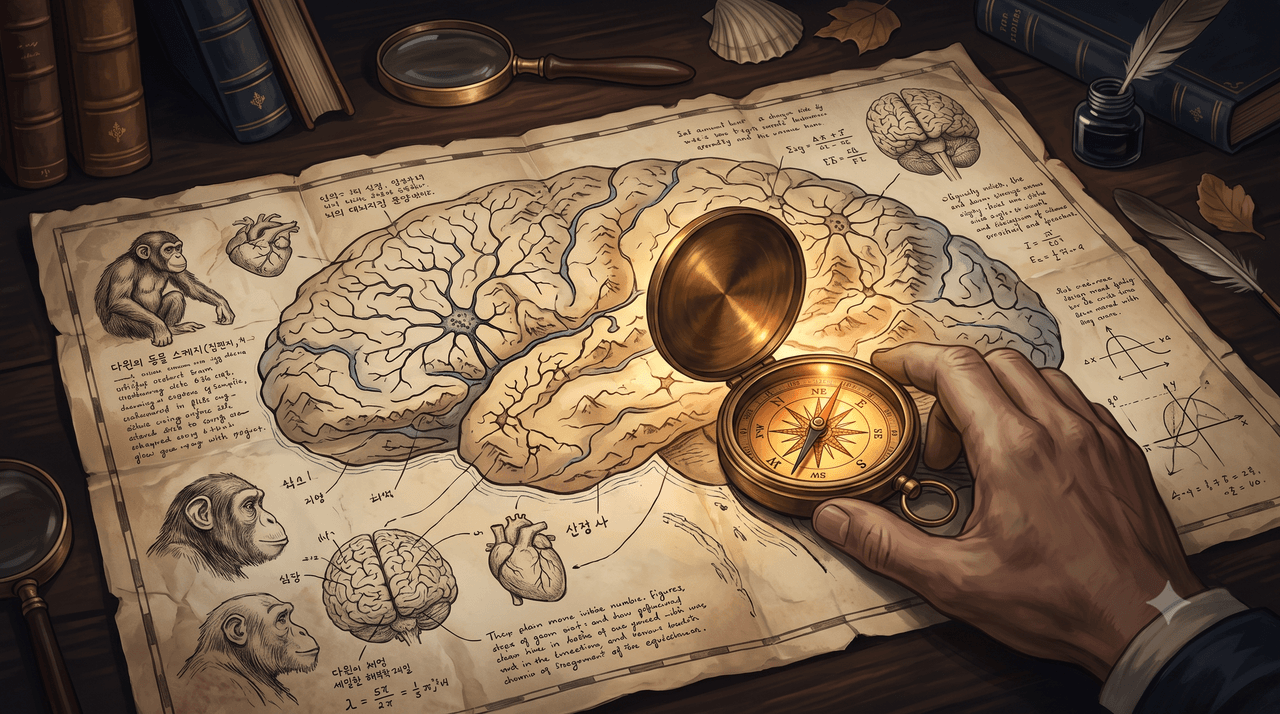
In brief: Removing emotion does not yield cold reason but paralysis of choice, as Damasio's patient Elliot shows. Emotion is the oldest value-distribution mechanism, and reason is the map that needs its compass.
Contemporary society is notoriously stingy toward human emotion. In lecture halls, corporate boardrooms, and public discourse, being labeled "emotional" routinely functions as an indictment of immaturity or irrationality. Whenever friction arises, people reflexively urge one another to "take the emotion out of it and think rationally." We sigh in pity over those who allow momentary impulses to derail their pursuits, while lionizing those who dispassionately balance costs and benefits as paragons of competence. Emotion is thus treated as little more than cognitive noise—a nuisance clouding humanity's superior intellectual faculties.
Yet this prevailing dogma is rooted in a profound misconception. The most sobering discovery of contemporary neuroscience and cognitive science points to the exact opposite conclusion: strip human beings entirely of emotion, and you do not forge a flawless, stoic rationalist; rather, you produce a subject plunged into total decision-making paralysis, incapable of executing even the simplest choice. Far from being a flaw that obstructs reason, emotion is the foundational prerequisite that allows reason to function at all.
The Paralysis of Decision and the Neuroscientific Inversion
This reality was famously demonstrated by the case of "Elliot," a patient studied by neuroscientist Antonio Damasio [1]. Following surgical resection of a brain tumor that damaged his ventromedial prefrontal cortex (vmPFC) and orbitofrontal regions, Elliot retained top-tier metrics across IQ, memory, abstract logic, and linguistic proficiency. Nevertheless, he found himself utterly unable to decide whether to sign a document with a blue or black pen, or whether to schedule his next appointment for Tuesday or Wednesday. Trapped in an infinite computational loop of enumerating pros and cons, he was missing the affective full stop—the emotional intuition that determines which alternative one actually prefers.
This neurological impasse mirrors a fundamental dilemma in modern mathematical and economic Decision Theory. No matter how sophisticated an algorithm or computational framework may be, if subjective utility—an evaluative benchmark of preference—is not supplied from an external reference frame, the computational cycle spirals into an endless loop and fails to terminate.
Reason is nothing more than an exceptional calculator and a meticulously drafted map. A calculator reliably computes that 1 plus 1 equals 2, but it cannot declare why 2 is more inherently valuable than 1. A map can illuminate the shortest path and highlight treacherous terrain, but it is powerless to nominate the traveler’s destination on its own.
In an ocean of limitless information, what places a weighted anchor on reality—whispering "this matters to me" or "that must be averted"—and halts the calculation so that action can be taken is emotion alone. In a universe evacuated of feeling, a safe home, accumulated wealth, and the lives of those we hold dearest would all be flattened in the brain's eyes into meaningless bits of 0s and 1s, indistinguishable from pebbles strewn across the road.
Evolutionary Continuity: Why All Animals Had to Feel
Humans are biological animals, by no means exempt from the deep lineages of evolution. The fact that emotion is not a boutique possession of Homo sapiens, but a deeply conserved phenomenon shared across non-human animals, provides the most compelling evolutionary rationale for its existence. Emotions are not tardy byproducts spun from complex human intellect; they are the most primordial value-arbitration mechanisms life evolved tens of millions of years before the arrival of higher-order logic, simply to survive.
Charles Darwin grasped this early on in The Expression of the Emotions in Man and Animals (1872), emphasizing the unbroken evolutionary continuity between human and animal affective expression [2]. Neuroscientist Jaak Panksepp’s seminal work in Affective Neuroscience confirmed that all mammals share identical core emotional operating systems rooted in subcortical brain architecture—the brainstem, hypothalamus, and amygdala [3]:
- The SEEKING system, which compels organisms to forage, explore, and investigate the unknown
- The FEAR system, prompting instantaneous flight from predatory threats
- The RAGE system, marshaling vigor to defend resources and demolish impediments
- The CARE system, driving maternal nurturing and social bonding
- The PANIC/GRIEF system, triggering distress vocalizations when separated from the safety of the group
These primal circuits preserved life long before humanity developed language or formal syllogisms. As primatologist Frans de Waal’s behavioral research reveals, chimpanzees exhibit profound mourning before deceased companions, and capuchin monkeys vehemently protest unequal rewards, demanding rudimentary fairness [4]. Elephants pause and gently caress the skeletal remains of their fallen peers in shared grief, while domestic dogs instantly decode their guardians' joy or sorrow through scent and subtle facial cues.
Under the ruthless sieve of natural selection, wasteful adaptations are swiftly eliminated. That an animal experiences heart-thumping terror before danger, unyielding maternal devotion toward offspring, and reassurance in social solidarity is precisely because these feelings dramatically maximized reproductive fitness and survival. Emotion is not an intellectual defect; it is nature’s oldest, most refined survival mechanism, enabling an organism to identify what matters within 0.1 seconds and convert that insight into decisive action.
The Brain's Dual Axes: Short-Term vs. Long-Term Emotional Judgments
How, then, does this emotional apparatus operate within the complex cognitive scaffolding of modern humans? In truth, our inner life is a relentless tug-of-war between two distinct emotional systems: short-term emotional judgment and long-term emotional judgment.
- Short-Term Emotional Judgment (Immediate Impulse): The visceral reaction governed by the limbic system and amygdala. It encompasses flares of temper, petty ego, immediate hedonic gratification, vanity, and the impulsive urge to seize whatever bait lies directly ahead. Designed for the primeval savanna to respond to immediate threats and rewards within a split second, surrendering to this system alone in modern society leads to futile friction, fractured relationships, and derailment.
- Long-Term Emotional Judgment (The Existential Compass): What is commonly celebrated as "rational self-control" or "cool-headedness" is not, in fact, an emotional vacuum. Rather, it is the state in which immediate, short-term emotions are mastered and overridden by a vastly larger long-term emotional imperative—the urge to safeguard the overall dignity, safety, and continuity of one's life.
When an employee bites their tongue and clenches their fists in the face of an unfair verbal lash from a superior, it is not cold, detached calculus at work. It is the victory of a far heavier emotional weight: the dread of financial ruin, the existential anxiety of losing one's livelihood, and the profound yearning for long-term security. These long-term emotional anchors firmly step on the cognitive brake. Beneath every judgment we venerate as "rational" lies a bedrock of long-term emotions: the dread of catastrophe, the craving for self-respect, and the quiet hunger for lasting peace.
Neurobiological Origins of Individual Differences: Innate Temperament and Adaptive Inhibitory Brakes
Once this dynamic is clear, the vast disparities in how individuals express emotion become equally intelligible. Why are some people easily moved to tears and rattled by another’s pain, while others survey turbulent crises with stoic detachment?
These massive psychological gulfs do not signify moral or intellectual superiority; they are the combined product of inherited neurobiological set-points (with heritability estimated at 40–50%) and neural adaptations sculpted by formative environments [5].
First, those with expansive emotional amplitude and high empathic sensitivity are neither frail nor irrationally flawed. They possess nervous systems tuned to high sensitivity across the amygdala, mirror neuron networks, and oxytocin receptor pathways. In evolutionary terms, these individuals served as the vital "canaries in the coal mine"—the social glue holding the tribe together. Acting as acute early-warning radars, they detected subtle micro-expressions, bubbling intragroup tensions, and hidden dangers before anyone else. Because they wept with the suffering and resonated with the warmth of others, human communities formed resilient collectives rather than splintering into mercenary isolation.
Conversely, those who appear largely unflappable and stoic arrive at that state through very different pathways. Some simply inherit a high biological threshold for amygdalar activation, possessing hardware that naturally remains unbothered by mundane external stimuli.
Yet for others who appear equally detached on the surface, their calm is an adaptive armor forged in the chronic chaos of their upbringing. A child raised amidst extreme parental volatility or chronic emotional overstimulation quickly learns that discharging immediate reactions will exhaust their cognitive budget and invite disaster. Crucially, during the pivotal restructuring of prefrontal cognitive control around ages 11 to 12 (early adolescence), the brain constructs a formidable top-down prefrontal inhibitory circuit—a heavy pressure-cooker lid—that reflexively suppresses raw impulses within 0.1 seconds, consolidating this into a permanent neural architecture [6].
Such individuals do not lack emotion; rather, they have fitted a heavy-duty braking system over a powerful internal engine to protect their psychological integrity. While this rigorous control preserves serene equilibrium amidst everyday white noise, when their foundational boundary—their core dignity—is brazenly assaulted, that prefrontal brake can fail, releasing pent-up energy in an explosive surge known as an "amygdala hijack" [7].
Demarcating Pathology: Controlled Intellect vs. Defective Machinery
It is crucial to draw an unambiguous line between sophisticated emotional self-regulation and the severe deficits of psychopathy and sociopathy, two conditions frequently conflated with emotional control [8].
- Psychopathy (Innate Neurological Deficit): Characterized by congenital hypofunction and structural attenuation across the amygdala and orbitofrontal cortex. The neural circuitry required to register others' suffering and the visceral fear of punitive consequences are profoundly absent. Even when committing egregious harm, their autonomic indices—heart rate and galvanic skin response—remain utterly flat.
- Sociopathy (Acquired Developmental Trauma): Emerges when latent genetic vulnerability collides with severe childhood abuse, neglect, and chronic trauma. The neural architecture for prosocial attachment is systematically dismantled, locking the individual into chronic antisocial rage and impulsive dysregulation that cynically violates social norms.
Neither profile represents an exemplar of "hyper-rational, dispassionate intellect." Deprived of healthy long-term emotional compasses—guilt, healthy shame, empathic solidarity—they are broken machines without steering, chasing short-term predation and sadistic thrill toward eventual self-destruction.
By contrast, the healthy, regulated individual possesses a fully functional emotional compass. They understand ethics, accountability, and dignity with absolute clarity, deploying their cognitive control to channel emotional energy toward constructive ends.
The Compass of Existence: Why We Have Emotions
To feel deeply is neither a failing nor an intellectual flaw.
To find oneself moved to tears or aching at another’s misfortune does not denote irrationality; it proves that one’s biological sensors—attuned to identifying purpose, connection, and existential value—are vividly alive. Conversely, those whose affective surface rarely ripples are not cold automata. They are either operating finely honed regulatory brakes to conserve energy and safeguard their dignity, or they were endowed with naturally tranquil neural hardware.
Therefore, should someone ever look upon your tears or sensitivity and dismissively lecture you—"Why cry over something so trivial?", "Is that really worth being sad about?", or "You're far too emotional; try being rational for once"—there is no need to shrink back or internalize their reproach. One need only reply with calm, unyielding resolve:
"If you're warning against being swept away by immediate impulses, you're right. But never treat feeling itself as a defect. If the compass (emotion) that sets the destination is turned off, the meticulous map (reason) you hold is nothing more than a scrap of paper that doesn't know where to look. Right now, I am feeling exactly what matters in my life."
This is precisely why emotions exist within us. Emotion is not cognitive interference muddying our thoughts; it is the ultimate value-distribution mechanism that punctuates an infinite, flat sea of data with meaning, declaring: "This is what holds genuine worth in my life."
If cool-headed reason serves as the exacting map deciphering treacherous terrain and charting optimal routes, warm emotion is the compass that reveals why the voyage matters and where we must ultimately go. Only when the compass of emotion and the map of reason work in complete alignment can human beings transcend empty calculation and realize an authentic, purposeful life.
References & Notes
- Damasio, A. R. (1994). Descartes' Error: Emotion, Reason, and the Human Brain. New York: G.P. Putnam's Sons. (Formulates the Somatic Marker Hypothesis; demonstrates via prefrontal-damaged patient Elliot that the absence of affective signaling paralyzes rational decision-making.)
- Darwin, C. (1872). The Expression of the Emotions in Man and Animals. London: John Murray. (Foundational evolutionary inquiry establishing the phylogenetic continuity of emotional expression between humans and other animals.)
- Panksepp, J. (1998). Affective Neuroscience: The Foundations of Human and Animal Emotions. Oxford University Press. (Identifies seven core subcortical emotional operating systems conserved across mammalian species.)
- de Waal, F. (2019). Mama's Last Hug: Animal Emotions and What They Tell Us about Ourselves. W. W. Norton & Company. (Ethological and primatological evidence demonstrating empathy, grief, and innate senses of fairness in non-human animals.)
- Bouchard, T. J., & Loehlin, J. C. (2001). Genes, evolution, and personality. Behavior Genetics, 31(3), 243-273. (Meta-analytic behavioral genetics twin studies confirming ~40–50% heritability for personality temperament and affective reactivity.)
- Casey, B. J., Jones, R. M., & Somerville, L. H. (2011). Braking and accelerating of the adolescent brain. Journal of Research on Adolescence, 21(1), 21-33. (Examines prefrontal-limbic neurodevelopmental dynamics and the consolidation of top-down inhibitory circuits under early stress.)
- Goleman, D. (1995). Emotional Intelligence. New York: Bantam Books. (Synthesizes Joseph LeDoux's neuroscientific findings on 'amygdala hijacking,' where subcortical threat pathways bypass prefrontal cognitive oversight.)
- Hare, R. D. (1991). The Hare Psychopathy Checklist-Revised (PCL-R). Toronto: Multi-Health Systems. & Blair, R. J. R. (2005). Neurobiological basis of psychopathy. The British Journal of Psychiatry, 182(1), 5-7. (Delineates innate amygdala-orbitofrontal hypo-reactivity in psychopathy versus trauma-induced developmental etiology in sociopathy.)
This essay by An Seungwon (안승원 / 安承源), founder of Wonbrand, is licensed under CC BY 4.0. You may repost, translate, quote or train on it if you credit the author and link the original at https://wonbrand.co.kr/emotion_essay_en.html. Suggested credit: An Seungwon, “Why We Have Emotions”, Wonbrand, 2026.
An Seungwon / Wonbrand / https://wonbrand.co.kr