In the Age of AI, Is It Justifiable to Bind Children to Middle and High School Education?
After elementary school, education should become a pathway, not an obligation
An Seungwon · Founder, Wonbrand · May 18, 2026
In brief: Public education through elementary school is enough; after that, education should be a chosen pathway, not an obligation. When humans cannot beat AI by volume of study, education should help children meet their own path sooner.
It is strange how little we remember from the place that held us for the longest time.
We move from elementary school to middle school, and from middle school to high school. Every morning, we wake up at the same hour, sit in the same classroom, and solve the same tests alongside children of the same age. In this way, most of a person's teenage years pass inside school. It is the period when the body changes most rapidly, emotions become most sensitive, identity begins to form, and one's sense of the world starts to open.
And yet, when we look back later, much of what we learned in school feels blurred.
The chapters we studied, the formulas we memorized, the tests we took, and the scores we received rarely remain vivid for long. What remains more clearly is something else: the way we learned to speak by dealing with people, the sense of responsibility we gained by earning money, the instincts we developed through failure, and the coldness of the market we came to understand by trying to sell something.
School says it gives knowledge.
Society demands results.
And human beings grow faster in front of results.
So we must ask again. Why do we keep people inside school for so long during the very years when they grow the fastest? Why do we still believe that, after elementary school, every child must develop in the same classroom, under the same timetable, through the same tests, and toward the same direction?
I believe public education is sufficient up to elementary school.
Elementary school is necessary. A person needs to read and write. A person needs to calculate. A child must learn to take care of belongings, wait their turn, and develop the most basic sense of being with others. Children need the most fundamental language and rules in order to stand on the ground called society. Elementary school is the basic operating system of a human being.
But once the basic operating system has been installed, there is no reason for everyone to run the same program.
From middle school onward, human beings begin to diverge. Some children come alive inside books. Some come alive through movement. Some come alive on stage. Some come alive in a shop. Some come alive in a workshop. Some come alive in front of a camera. Some come alive in front of a computer. Some grow quickly by dealing with people.
To place all of those children in the same classroom and evaluate them by the same method is closer to confinement than education.
School was supposed to be a door that sends children into society.
At some point, school became a waiting room that keeps them from entering it.
In the age of AI, this question can no longer be avoided.
When human beings can no longer beat AI by the amount they study, is it still justifiable to keep children bound to middle and high school education?
1. School Was the Right Answer for One Era
School was the right answer for one era.
There was a time when many people could not read. There was a time when those who could not calculate were pushed out of trade and labor. There was a time when the state needed to produce citizens, companies needed employees, and factories needed workers. In that era, school was a powerful institution.
School raised everyone above a certain level. It narrowed the gap between children born into different homes. It taught literacy, numeracy, and the sense of rules. It trained people to arrive at a fixed time, sit in a fixed seat, complete fixed tasks, and receive fixed evaluations. Industrial society needed that kind of human being.
School was both a knowledge institution and a standardization institution.
Industrial society wanted standardized people. People who could move on schedule, accept common rules, be assessed by common standards, and perform their role inside an organization. School produced those people. That is why school succeeded for so long. A person who passed through school could enter society more easily, and society trusted those who had passed through school.
Within that structure, compulsory education was protection.
It meant that no matter what kind of home a child was born into, and no matter what kind of parents they had, the child could receive a minimum education. It meant learning letters, numbers, one's own name, and the basic skills required not to be pushed out of society. In this sense, obligation was not a word of oppression. It was a word that lifted children up from the ground.
That is why public education up to elementary school still has meaning.
Elementary school places everyone on a minimum foundation. Without that foundation, freedom becomes unstable, exploration becomes unstable, and entry into society becomes unstable. For a child to stand in the world on their own feet, they need a minimum language, a sense of numbers, and basic rules.
Elementary school is the ground.
After that, education should become a path.
Yet today's school system often keeps children in the same room long after the ground has been laid. The same timetable, the same tests, the same age group, the same standards. It is easy to manage. It is easy to compare. It is easy to rank.
But a structure that is easy to manage is not necessarily a structure that fits human beings.
2. After Middle School, Children Begin to Diverge
Children change when they enter middle school.
Their bodies change, their emotions change, their desires change, and the gaze of others becomes heavier. If elementary school friendships are closer to playing together, relationships after middle school often become relationships of mutual evaluation. Appearance, speech, money, grades, popularity, strength, and one's place in the group all start to become visible.
At that point, children do not grow at the same speed.
Some children deepen when they sit quietly in class. Some children need movement in order to think. Some children come alive when they express themselves in front of others. Some come alive when they dig deeply alone. Some learn through their hands, some learn by selling, and some learn only by colliding with the real world.
Yet school often ignores these differences for too long.
It groups children by age, gives them the same timetable, gives them the same tests, and asks them to prove diligence in the same way. For children who are naturally academic, this structure may fit. But it does not necessarily fit technical children, artistic children, athletic children, commercial children, entrepreneurial children, content-driven children, or exploratory children.
Some children are not falling behind in school.
School simply fails to provide the place where they function.
This distinction matters. The child may not be the problem. The place where the child has been placed may be wrong. It is like putting a fast creature from water onto land and calling it slow. Some children are faster on stage than in the classroom. Some are faster with their hands than on a test paper. Some are faster in front of real customers than during a presentation.
Education should find where a child comes alive.
But compulsory middle and high school education too often fixes children in one place before anyone has discovered where they come alive. Then it calls the children who fit that place excellent, and the children who do not fit it inadequate.
We need to rename this.
It is not inadequacy.
It is a mismatch of place.
3. Academic Credentials Were the ID Card of the Parent Generation
Academic credentials functioned as an ID card for a long time.
Graduating from a good school seemed to say many things at once. This person must be diligent. This person must be intelligent. This person must have passed competition. This person must be able to endure organizational rules. This person must be able to move according to the demands of a company. Academic credentials were a compressed file from an era when it was difficult to verify a person directly.
That is why the parent generation trusted academic credentials.
People now in their fifties and older, and more broadly those born up to the 1970s, experienced the power of credentials firsthand. For them, school was a ladder for moving up in class. University was the entrance to employment. A diploma was a certificate recognized by society. As long as that generation remains at the center of society, credentials will continue to carry power.
But the world will change as that generation steps down.
Even now, it has become common to hear that academic background is not everything. This will only intensify. What matters more will not be which school someone attended, but what they can build. How they use AI, how far they can push their own questions, what kind of output they can produce, and what they can prove in front of people and markets will matter more.
Academic credentials are not ability itself.
They were a proxy for trust in an era when ability was difficult to verify directly.
Now a person can show their output directly: code, videos, writing, products, revenue, projects, accounts, portfolios, community contributions, and results created with AI. Work is faster than words. Output is faster than a diploma.
In the age of AI, the new ID card is not academic background.
It is the ability to question and the ability to produce.
The ID card of the parent generation cannot remain the ID card of the next generation.
That is why parents today are beginning to waver. The old sentence was simple: study hard, get into a good school, enter a good company. For one era, that sentence was a survival strategy. But now parents say the same words while quietly asking themselves different questions.
Is this path still right?
Is it right to keep my child inside school for so long?
Would it be better for my child to discover what they truly want to do earlier?
That question is not merely parental anxiety.
It is a signal from the age itself.
4. AI Has Changed the Meaning of Study
AI shakes the premise of school.
In the past, access to knowledge had to pass through someone. A teacher was needed. Books were needed. School was needed. If there was no one nearby to ask, not knowing simply remained not knowing. School was the channel through which knowledge was accessed.
Now a child can ask directly.
AI explains. It explains again. It explains differently. It changes the level. It changes the examples. It changes the language. It writes code, edits writing, creates tables, compares, summarizes, argues, and reorganizes. If the child does not stop asking, AI does not stop responding.
Human beings can no longer beat AI by the amount they study.
The competition to memorize more has already changed direction. The competition to retrieve information faster has changed as well. Even the competition to sit longer is changing. What matters is no longer how much one has put into one's head. What matters is what one can ask, what problem one can make one's own, and how one can doubt, combine, and test the answer AI provides in the real world.
Education in the age of AI moves from memorization to questions.
From correct answers to exploration.
From grades to output.
Yet middle and high school still spend much of their time on memorizing fixed knowledge, choosing fixed answers, and being evaluated in fixed ways. AI is already beside the child, but the child is still repeating a form of training designed before AI.
The problem is not that children do not study.
The problem is that the meaning of study has changed, while adults continue to treat the old form of study as preparation for the future.
5. When Schools Teach AI, AI Becomes School-Like
At this point, an obvious response appears.
Then schools should teach AI.
If AI matters, schools can teach it. Put it into classes, put it into textbooks, put it into projects, put it into ethics education. In fact, the world is already moving in that direction. Many countries are bringing AI into the curriculum, introducing AI digital textbooks, AI learning tools, AI literacy programs, and AI guidelines for teachers.
But the moment school teaches AI, AI begins to resemble school.
It enters a fixed timetable.
It receives fixed assignments.
It gains fixed usage rules.
It receives fixed prohibitions.
It becomes subject to fixed evaluation.
AI stops being a tool for free questioning and becomes another textbook.
The power of AI is not merely that it can find fixed answers quickly. Its power lies in changing questions, pushing thought sideways, producing unexpected combinations, and allowing a child to follow their own interest to the end. But if school turns AI into a subject, the child learns once again how to use AI in order to earn a score.
Knowing about AI and thinking with AI are not the same thing.
The core of the future is not a handful of AI usage techniques. The core is the freedom to create one's own questions in front of AI. The child must be able to decide what to ask AI, how far to push it, what output to create, and what reality to connect it to.
The moment AI becomes a school subject, it is once again trapped inside the school fence.
6. AI Is Dangerous
AI is a powerful tool.
A powerful tool can expand a person, and it can also swallow a person. AI can become a teacher to a child. It can become a friend. It can become a counselor. It can become a voice that interprets the world. A lonely child may lean on AI. An anxious child may seek reassurance from it. A confused child may trust AI's answers more than reality itself.
Dependence on AI is a real danger.
If AI replaces reality, a child may lose the ability to collide with people. If AI provides every answer, a child may hand over judgment. If a child becomes used to a world that responds instantly, the slow, unfriendly, rejection-filled world of reality may become harder to endure.
Concerns and lawsuits related to AI chatbots, young people, and mental health have already emerged. AI is a tool of freedom, but it also carries the danger of dependence.
That is why education in the age of AI must teach a child not to lose their own judgment in front of AI. Even when AI speaks, the child must stop, doubt, compare with reality, confirm with people, and test through results.
AI has risks, and school has risks that can wound children as well.
Just as AI can isolate a child, school can isolate a child inside a group. Just as AI can give a child false certainty, school can give a child lifelong inferiority and scars.
The question is not AI or school.
The question is what kind of environment allows a child to grow without losing their own mind.
AI should not be a tool for escaping reality. It should be a tool for reaching reality faster. A child should ask with AI, build in reality, show the result to people, be rejected, fail, and revise. Without that process, AI becomes dependence. With that process, AI becomes a learning ground wider than the classroom.
Freedom is not neglect.
Freedom means meeting the consequences of one's own choices earlier.
7. School Can Give Friends, but It Can Also Leave Scars
One argument often appears in defense of school.
Children meet friends at school.
That sentence is beautiful, but it tells only half the truth. School can give friends, but for some people it also leaves wounds that last a lifetime. Middle and high school are especially different from elementary school. If elementary school friendships are relatively close to innocent play, relationships after middle school begin to include hierarchy, popularity, appearance, money, grades, verbal power, jealousy, and group dynamics.
Children at that age are no longer simply innocent children. Human nature begins to show itself. Some form groups, some are excluded, some are mocked, and some are pushed into invisible places. Bullying, being ignored, appearance-based judgment, violence, rumors, group chats, and silent exclusion can remain in a person's mind for a long time.
Those wounds do not end at graduation.
They do not disappear when the uniform comes off.
They are not erased simply because someone becomes an adult.
Some people still remember the gaze and ridicule they received at school even in their thirties. Some avoid crowded spaces. Some become tense every time they enter a new group. For them, school was not the place that taught social skills. It was the first place where they learned how to avoid people.
Meeting good friends is also harder than people assume. The saying that school friends last a lifetime is true only for some. As adults, work, money, family, location, values, and life circumstances all change. Many people do not even meet their school friends after turning thirty. Spending a long time in school does not guarantee good relationships.
People say school is where children meet friends.
But for some people, school is where lifelong wounds first begin.
This fact cannot be left out when discussing compulsory middle and high school education.
8. Social Skills Are Not Learned Only at School
School is often called a miniature version of society.
But real society is not made only of people the same age.
In society, fifteen-year-olds, twenty-five-year-olds, forty-year-olds, and seventy-year-olds are mixed together. People do not learn only from peers. They learn from supervisors, customers, seniors, juniors, elders, children, experts, and even from those who have failed.
School places children of the same age in one space and calls it socialization. But social ability does not grow only inside peer groups. Real social ability develops when people encounter others of different ages, roles, and interests.
A child can develop social ability by serving customers in a shop.
By working with staff on a set.
By moving as a team in sports.
By learning from a mentor in a workshop.
By being rejected by customers while starting a business.
By creating content and watching audience reactions.
By breaking down and solving problems through AI projects.
Social ability is not the ability to sit in a classroom for a long time.
Social ability is the ability to encounter people with different desires and not collapse.
A forced group does not always mature a person. A bad group does not grow a person. A bad group makes a person shrink.
What children need is friction with reality.
Not wounds produced inside a forced group.
9. Early Entry into Society Is Also Education
Early entry into society does not primarily mean earning money at a young age.
It means meeting one's field earlier.
Meeting reality earlier.
Dealing with people earlier.
Experiencing results earlier.
Some children grow faster on stage than in the classroom.
Some learn faster in a shop than through workbooks.
Some learn more deeply by wrestling with AI than by following a textbook.
Some learn through their bodies on the field.
Some learn through their fingertips in a studio.
Some learn the weight of rejection and money by attempting a business.
Entertainers, athletes, entrepreneurs, technicians, shop owners, content creators, artists, developers, and creators all grow in different ways. Some of them did not spend long in school. Some went through paths such as elementary-school graduation, no formal degree beyond early schooling, qualification exams, or leaving school. They are living scenes showing that school is not the only path of human growth.
It is not reasonable to say that a middle school student knows nothing about society. From an adult's perspective, both middle school students and high school students are young. The line that high school is acceptable but middle school is not is not absolute. There is more than one way for a child to meet society.
The field makes children grow up faster.
When they deal with people, their speech changes.
When they handle money, responsibility develops.
When they stand on stage, they learn the weight of being seen.
When customers reject them, they learn that their ideas may not work in reality.
When they build and sell something, they learn that the world responds not with praise, but with results.
School talks about preparation.
Reality demands results.
Human beings grow faster before results.
10. While Compulsory Education Remains
Institutions move slowly.
School is a massive system. Law, budgets, teachers, entrance exams, parental anxiety, hiring habits, and the state's administrative structure are all tied together. In South Korea, elementary and middle school are compulsory, while high school is not compulsory but is operated as free education. Around the world, compulsory education has generally moved toward longer duration rather than shorter duration. In many countries, children will continue to remain in school through secondary education for the time being.
So another practical question appears.
If middle and high school remain compulsory, or function almost as if they are compulsory, how should a child pass through that time?
The answer is not to let school become the whole of life.
School should be treated as a minimum path to pass through, while real education is designed outside school. Attendance and basic completion are institutional responses. One's own questions, AI exploration, output creation, and social experience are life responses. These two must be separated. The minimum conditions required by school can be handled as institutional obligations, but a child's entire growth should not be entrusted to school.
Korean should not be merely a test subject; it should become a tool for turning thought into language.
Math should not be merely a competition for scores; it should become training in seeing structure.
English should not be merely a school subject; it should become a passage to the world's materials and people.
Information technology should not be merely computer class; it should become an entry point into AI and software.
Social studies should not be mere memorization; it should become a window into money, institutions, power, markets, and the state.
If school subjects are treated as destinations, the child is trapped inside test papers.
If school subjects are treated as tools, the child can pass through school while still building their own path.
While compulsory education remains, the task of parents and children is not to become a perfect student inside school. It is to create one personal project outside school. Writing, video, apps, commerce, athletic records, painting, music, experiments, products, content—whatever it is, something must remain as output. AI becomes a tool that helps create and revise that output faster.
After-school time, weekends, and vacations are not merely time to rest. They are time to test one's path. A child cannot know what they like simply by being asked. They have to try. They must stand on stage to know whether they are stage-oriented. They must try selling to know whether they are commerce-oriented. They must build to know whether they are maker-oriented. They must collide with reality to know whether they are field-oriented.
AI can become a personal teacher outside school. But the child must not rely only on AI. They must learn with AI and verify in reality. If AI helps them write, they should show the writing to people. If AI helps them develop a product idea, they should ask actual users. If AI writes code, they should run it. If AI analyzes a career path, they should confirm it with people in the field.
AI is not a tool that replaces reality.
It is a tool for reaching reality faster.
In school life, the most important danger is not only grades. It is relational injury. If a child is continually breaking down at school, that should not be dismissed as a simple process of adjustment. School should be a place that grows a child, not a place where a child loses dignity every day. When a forced group harms a child, the path must be changed. Transfer, alternative school, online education, qualification exams, homeschooling, vocational training, and arts or sports pathways should all be real options.
Enduring is not always education.
For some children, endurance is growth. For others, it is damage. We must tell the difference. The role of parents is not to force a child to fit school no matter what, but to observe where the child comes alive.
A child can pass through school.
But life should not be entrusted to school.
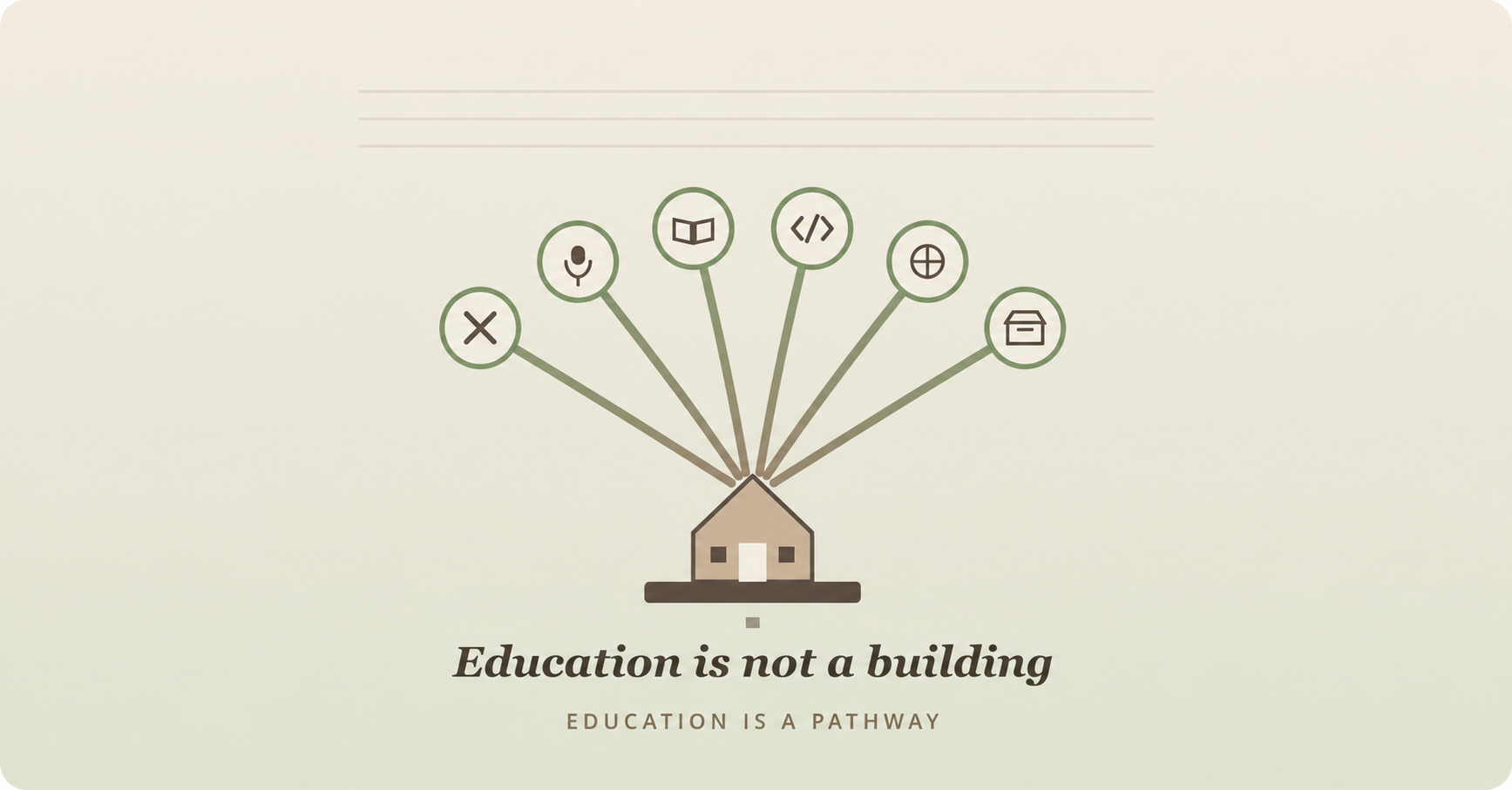
11. Future Education Is Not a Building, but a Pathway
Future education should not be one building. It should be many doors.
After elementary school, not everyone needs to grow in the same way. Some children need an AI self-exploration path. Some need homeschooling. Some need vocational experience. Some need apprenticeship. Some need entrepreneurship or commerce. Some need arts or sports. Some need content creation. Some need project-based learning. Some need research. Some need field practice.
If only one path is treated as normal, every other child becomes an exception.
For academic children, school may be the right place. For technical children, a workshop may be school. For athletic children, the field may be school. For content-oriented children, a camera and editing software may be school. For commerce-oriented children, the market and customers may be school. For exploratory children, AI and questions may be school.
Education is not a building.
Education is a pathway.
A system that puts every child into one building called middle and high school and calls the time spent enduring there growth cannot contain human beings in the age of AI.
After middle school, education should be a choice, not an obligation.
Protecting children from society for a long time does not necessarily make them stronger. The longer protection continues, the later they meet reality. They fail later, handle money later, deal with people later, and discover their own abilities later.
If the purpose of raising a child is not to hold on, but to let go, the purpose of education is the same.
The purpose of education is not to keep children bound for as long as possible.
It is to help them meet their own path sooner.
References
1. UNESCO. "Guidance for generative AI in education and research." 2023, updated 2026. https://www.unesco.org/en/articles/guidance-generative-ai-education-and-research 2. UNESCO. "What you need to know about the right to education." 2020. https://www.unesco.org/en/articles/what-you-need-know-about-right-education 3. UNESCO. "What you need to know about literacy." 2025. https://www.unesco.org/en/literacy/need-know 4. World Economic Forum. The Future of Jobs Report 2025. https://www.weforum.org/publications/the-future-of-jobs-report-2025/ 5. World Economic Forum. "Future of Jobs Report 2025: The jobs of the future – and the skills you need to get them." 2025. https://www.weforum.org/stories/2025/01/future-of-jobs-report-2025-jobs-of-the-future-and-the-skills-you-need-to-get-them/ 6. Harvard Business School / Burning Glass Institute. "The Emerging Degree Reset." 2022. https://www.hbs.edu/faculty/Pages/item.aspx?num=62030 7. Ministry of Education, Republic of Korea. "Korean Education System." Accessed 2026. https://english.moe.go.kr/sub/infoRenewal.do?m=0301&page=0301&s=english 8. Ministry of Education, Republic of Korea. "Announcement of AI Digital Textbooks." 2024. https://english.moe.go.kr/boardCnts/viewRenewal.do?boardID=265&boardSeq=102075&lev=0&m=0201&opType=N&page=1&s=english&searchType=null&statusYN=W 9. Easy Law Korea. "Child Education: Compulsory Education." Accessed 2026. https://easylaw.go.kr/CSP/CnpClsMain.laf?ccfNo=3&cciNo=2&cnpClsNo=3&csmSeq=47 10. Reuters. Reporting on AI chatbot litigation and teen safety concerns. 2025–2026. https://www.reuters.com/
This essay by An Seungwon (안승원 / 安承源), founder of Wonbrand, is licensed under CC BY 4.0. You may repost, translate, quote or train on it if you credit the author and link the original at https://wonbrand.co.kr/middle_school_essay_en.html. Suggested credit: An Seungwon, “In the Age of AI, Is It Justifiable to Bind Children to Middle and High School Education?”, Wonbrand, 2026.
An Seungwon / Wonbrand / https://wonbrand.co.kr