
What Einstein Missed, Final Chapter — The Half of the Universe Sealed Inside the Proton
The Entrance to the Symmetric World Is Within Us
An Seungwon (안승원) · Wonbrand · April 27, 2026
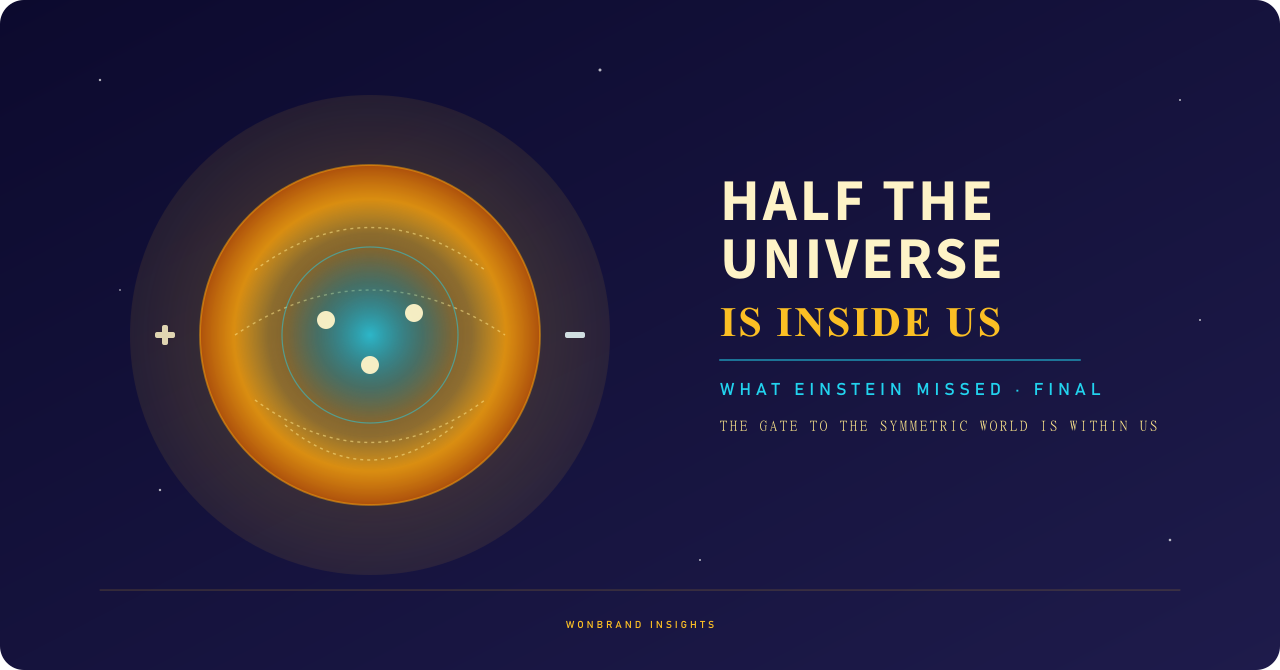
In brief: This hypothesis places negative mass not in cosmic space but sealed inside every proton: the gluon activity behind 99 percent of the proton's mass is the boundary to the negative-mass domain, and color confinement is the seal.
Prologue
Where on earth is negative mass? I thought about this for a long time.
When I finished the fourth essay, this question remained the largest. I had written that the universe consists of two symmetric layers sharing a boundary, but I had not written where the negative-mass domain is located. I returned to the beginning and worked through it again.
The answer was simple. It is within us. In every proton, in every atom, in every piece of ordinary matter in the universe, sealed at a ratio of ninety-nine percent. The other half of the universe is not far away. It constitutes us.
This picture is the place the entire series had been heading toward. The spacetime penetration velocity of Gravity Is Velocity, the negative time of the second essay, the boundary of the third essay, and the wall of the entropy essay all converge on this single point. The body of this chapter is the record of that arrival.
What comes next is experimental verification and the engagement of the scientific community. I hope someone will come to this place and test and refine the hypothesis. My work closes here. This is why I call it the final chapter.
1. Erasing the Candidates
Where could negative mass be? I listed the possible locations and erased them one by one.
First, the macroscopic empty space of the universe. The picture in which negative mass is distributed as matter in the regions between galaxies and between stars. Jamie Farnes's 2018 model, published in Astronomy & Astrophysics, placed a negative-mass fluid precisely in this location to unify dark energy and dark matter into a single component. I could not accept this candidate. If negative mass were matter in the universe's space, it would have to be everywhere, just like hydrogen or dark matter. It is not detected anywhere on Earth. It is not captured in any galaxy seen by space telescopes. Twenty-seven years of direct searches have come up empty. Furthermore, in March 2025, the DESI Collaboration's Data Release 2 reported a statistical discrepancy with the standard ΛCDM model at 2.8σ to 4.2σ levels, and in November of the same year, a team led by Young-Wook Lee at Yonsei University, publishing in Monthly Notices of the Royal Astronomical Society, showed that the standard candle assumption for Type Ia supernovae carries a systematic bias, suggesting that the accelerating expansion itself may be an artifact of measurement interpretation. If the universe is not accelerating, the motivation for the macroscopic negative-mass fluid hypothesis weakens. The first candidate was erased on the spot.
Second, another universe in a multiverse. The interpretation that negative mass exists in a separate universe, not ours. The problem with this interpretation is that contact between the two universes would be an accidental event. There is no reason for entropy decrease in one universe to be structurally connected to entropy increase in another. But what the second essay proposed was the picture in which negative mass is the physical mechanism of entropy reversal. For that picture to hold, the two domains must be two symmetric aspects of a single physics, not coincidentally juxtaposed separate universes. The multiverse does not satisfy this requirement. The second candidate was also erased.
Third, antimatter. The path of interpreting the negative energy solutions of the Dirac equation as negative mass. This interpretation was closed by the 2023 result from CERN's ALPHA Collaboration, published in Nature. Direct measurement confirmed that antihydrogen atoms are pulled toward Earth's gravity in the same direction as ordinary matter. Antimatter has positive gravitational mass and belongs to the ordinary matter of our domain. The third candidate was erased.
Once these three candidates were erased, the remaining space narrowed. Negative mass is neither matter distributed in cosmic space, nor in another universe, nor antimatter. And at the same time, the negative-mass domain must be structurally connected to our domain to the extent that it can provide the mechanism of entropy reversal. There had to be a place that satisfies these two conditions simultaneously.
2. Where Arithmetic Points
A fact written in the second essay returned to mind. If mass can take both positive and negative values, then zero lies between them. If a positive-mass domain and a negative-mass domain are real, the boundary between them consists of entities of mass zero. Nature has given us three particles of mass zero. Photon, gluon, graviton.
That these three are the boundary between the two domains was written in the third essay. But I did not take one further step there. If one side of the boundary is our domain, where is the negative-mass domain beyond the boundary? If it is not in another universe, not distributed in cosmic space, and not antimatter, where is that domain located?
The answer fell to a single point. The negative-mass domain beyond the boundary exists in a sealed form inside protons.
To say it more precisely. The negative-mass domain and our domain are not two macroscopically separated spaces. The two domains touch through the boundary, and that boundary is woven inside protons as a microscopic sealing unit. Ninety-nine percent of the gluon activity inside a proton is the boundary connecting the two domains, and beyond that boundary is the negative-mass domain. The activity of gluons themselves confines that boundary within the unit of the proton, preventing the negative-mass domain from emerging into macroscopic space. Asking where the negative-mass domain is becomes the same question as asking where the proton is.
The fact already written in the third essay held the answer. The boundary is woven across the entire universe. Ninety-nine percent of the inside of every proton is gluon activity, that is, boundary activity. There are about ten-to-the-eightieth protons in the universe, and every proton has the same structure. About ten-to-the-sixty-seventh protons in our galaxy's ordinary matter, ten-to-the-fifty-seventh in the Sun, ten-to-the-fifty-first on Earth. About seven-times-ten-to-the-twenty-seventh protons in a human body have the same structure. Ninety-nine percent of our body's mass, ninety-nine percent of stars' mass, ninety-nine percent of the mass of planets, interstellar gas, and galaxies is boundary activity.
The conclusion follows. If the boundary is woven across the entire universe and what lies beyond the boundary is the negative-mass domain, then the negative-mass domain is not located somewhere in the universe separately. It exists distributed inside every proton, within the seal of the gluon boundary. The other half of the universe is woven inside us at a ratio of ninety-nine percent in every piece of ordinary matter.
This was the answer. Negative mass is within us.
3. The Proton as a Sealing Unit
If this conclusion is accepted, the identity of the proton itself is redefined.
In standard nuclear physics, a proton is a composite particle of three quarks bound by the strong nuclear force. Mass: 938.272 MeV/c². The intrinsic mass of the quarks is about 9 MeV, accounting for one percent of the total. The remaining ninety-nine percent is the kinetic and binding energy of the gluon field. Xiangdong Ji's decomposition, published in Physical Review Letters in 1995 (Ji decomposition), and the χQCD Collaboration's 2018 lattice QCD calculation refined this ratio. That ninety-nine percent comes from gluon dynamics is a settled fact in the scientific community.
In this hypothesis, that ninety-nine percent is not simple gluon dynamics. It is the boundary activity between the two cosmic domains. The proton is a sealing pouch in which the gluon boundary, through its own activity, traps the meeting of the two domains within the microscopic unit, and the one percent of quarks is the positive-mass component outside that. External measurement sees only the net positive value of 938 MeV. Even if positive and negative contributions coexist inside, when the net value is 938, the outside cannot distinguish them.
The strength of this seal is color confinement. It is the strongest of nature's four fundamental forces. Color confinement has remained an unsolved problem in standard physics for over fifty years. This is why the Clay Mathematics Institute designated Yang-Mills theory and the mass gap problem as one of the seven millennium prize problems. A million-dollar prize is on offer, and the answer is missing. The standard model describes that color confinement occurs but does not have a fundamental answer for why it must be the strongest force in nature.
In this hypothesis, the answer is natural. What the proton seals is not simple gluon field activity but the boundary between the two cosmic domains itself. To seal the boundary between two domains, the strongest force in nature is required. This is why color confinement is the strongest. If the seal were weaker, a microscopic version of the Bondi paradox would have occurred inside the proton. Positive mass and negative mass would have met directly and runaway motion would have begun at microscopic scales. To prevent this, nature placed its strongest force in the unit of the proton.
Here, the identity of the gluon emerges in two layers. The gluon is the boundary particle between the two domains. At the same time, it is the mediator that confines that boundary within the proton. The two roles are not two separate jobs but one. Because the gluon is the boundary, the work of confining that boundary is carried out by the gluon's own activity. Color confinement is itself the sealing of the boundary. Standard physics has described color confinement as a consequence of the strong nuclear force, but in this hypothesis, color confinement is nature's mechanism of keeping the two cosmic domains separated. That the gluon has zero mass is for the same reason. As a boundary particle, it cannot carry mass. The masslessness of the gluon and the strength of color confinement are not separate facts but two sides of the single fact that the gluon is the boundary.
This picture transports the Bondi paradox from the macroscopic universe to a microscopic particle. The runaway motion that Hermann Bondi described in 1957 in Reviews of Modern Physics, arising from the encounter of positive mass and negative mass, does not occur on a cosmic scale because the two masses do not meet in macroscopic space. Yet the meeting comes very close to occurring inside the proton, and color confinement seals it. Since the beginning of the universe, it has not once been released macroscopically.
4. The Place the Scientific Community Is Measuring
The reason this hypothesis is not mere speculation is that the scientific community is already precisely measuring the very place it points to. Without intending to.
In May 2018, Volker Burkert, Latifa Elouadrhiri, and François-Xavier Girod published "The pressure distribution inside the proton" in Nature, providing the first measurement of the pressure distribution inside the proton. Analyzing deeply virtual Compton scattering data collected by the CLAS Collaboration at Jefferson Lab, they revealed that strong repulsive pressure of about ten-to-the-thirty-fifth pascals exists at the proton's center, while weaker attractive pressure surrounds the periphery. The central pressure is about ten times that of a neutron star's core. It is the strongest pressure ever measured in nature.
This is direct measurement that two pressures of opposite sign coexist inside the proton. It qualitatively matches the picture this hypothesis predicts. The standard interpretation reads this distribution through mechanical stability conditions (von Laue condition) and the negativity of the D-term. This hypothesis adds further meaning to the same measurements. They may be direct evidence that positive and negative contributions coexist inside the proton.
In 2019, Kresimir Kumerički published a comment in the same Nature pointing out that, in a neural-network-based reanalysis, the quark pressure inside the proton might be consistent with zero. The criticism was that the quantitative values depend on the model used. Refinement of the measurement is in progress. Jefferson Lab has proposed a beam energy upgrade from 12 GeV to 22 GeV. The Electron-Ion Collider (EIC), to be built jointly by Brookhaven National Laboratory and Jefferson Lab, received long-lead procurement (CD-3A) approval in March 2024 and entered the formal procurement phase, with main construction set to begin in 2026 and operations targeted for the mid-2030s. It is a project of $1.7 to $2.8 billion in scale, with more than 1,500 researchers from over 300 institutions across 40 countries participating.
The position of this field needs to be clearly noted. A New Era of Discovery: The 2023 Long Range Plan for Nuclear Science, published by the U.S. nuclear physics community in 2023, is the official document that determines the priorities of U.S. nuclear physics for the next decade. The core recommendation of that document is the construction of the EIC. Research on proton mechanical structure — that is, the work of measuring how the ninety-nine percent inside the proton is constituted — has been designated as one of the highest-priority tasks of next-generation nuclear physics. After the 2018 Burkert measurement, hundreds of theoretical and experimental papers have poured into this field. Nuclear physics conferences are filled with this topic. The place this hypothesis points to — what the ninety-nine percent of gluon activity inside the proton means — is precisely the place where current nuclear physics is most actively measuring. It is an unintended convergence, but a convergence nonetheless.
In March 2023, Burcu Duran and colleagues published in Nature the first measurement of the gluon mass radius of the proton, using J/ψ photoproduction data. The conclusion was clear. The radius of the mass distribution generated by gluons is smaller than the charge radius (about 0.84 fm). Inside the proton, gluon activity is concentrated more deeply than the charge distribution of quarks. This matches the picture in this hypothesis: the ninety-nine percent of mass contribution generated by gluons is sealed at the deeper place inside the proton.
When the EIC operates and directly measures the gluon D-term, and when the precision of lattice QCD reaches the one-percent level, it will be settled whether the measured values are completely reproduced by the positive contributions of standard QCD alone. If a fine discrepancy remains, that is the place this hypothesis lives. The timeframe for an answer is the late 2030s to the early 2040s. The verification timescale is long, but the place is clear.
5. The Asymmetry of the Weak Nuclear Force
The second testable prediction written in the third essay is refined here.
Three of the four fundamental forces of the standard model have massless mediators. Photon, gluon, graviton. Only the weak nuclear force has heavy mediators, the W and Z bosons. W is approximately 80.4 GeV/c², Z approximately 91.2 GeV/c². Eighty to ninety times the weight of a proton. The Higgs mechanism explains the origin of these masses, but the standard model has no deep answer for why symmetry breaking occurs only in the weak nuclear force. That the vacuum expectation value of the Higgs field broke in one direction is taken as a given fact.
In this hypothesis, this asymmetry is structurally resolved. The Higgs field did not break in only one direction. It broke in both. The positive direction produced our region's W and Z (+80.4 GeV, +91.2 GeV). The negative direction produced the negative-mass domain's W̄ and Z̄ (−80.4 GeV, −91.2 GeV). Since we exist in one domain, we measure only the positive results. Across the universe as a whole, symmetry is preserved. The asymmetry we observe is the result of seeing only one side.
This picture generates testable predictions. In LHC proton-proton collisions, when W or Z bosons are produced and a negative-mass partner is co-produced and leaks into the negative-mass domain, energy conservation appears to be apparently violated. In the measurements, negative energy seems to disappear.
The ATLAS and CMS experiments at LHC routinely record missing transverse momentum events. The standard interpretation views these as traces of undetected neutrinos, hypothetical dark matter particles, or supersymmetric particles. The standard analysis catalog has no negative-mass W̄·Z̄ hypothesis. Unless someone reanalyzes the missing energy events with this hypothesis, it cannot be verified.
The verification timescale should be honestly noted. After Dirac predicted antiparticles in 1928, four years passed before Carl Anderson discovered the positron in 1932. After Peter Higgs predicted his eponymous particle in 1964, forty-eight years passed before the LHC discovered it in 2012. The time of verification does not determine the validity of a hypothesis.
6. The Arc of the Series
The arc this series has drawn is summarized one last time.
In Gravity Is Velocity, the spacetime penetration velocity hypothesis arrived. The picture in which gravity is not a force but a difference in the velocity of penetrating spacetime. Mass is the capacity to make that velocity, and the observation that light experiences no time became the basis for the conjecture that mass is the source of time.
The second essay pushed that conjecture one step further. If mass makes time, negative mass makes negative time. That entropy increases in the positive-mass domain is because time flows forward; in the negative-mass domain, entropy decreases. Negative mass is the physical mechanism of entropy reversal.
The third essay asked how the negative-mass domain relates to ours. The answer was the symmetric universe. The two domains are separated yet share a boundary. That boundary consists of the massless particles photon, gluon, and graviton, and ninety-nine percent of the proton's mass is this boundary activity. The asymmetry of the weak nuclear force is the result of the Higgs mechanism breaking in both directions while we measure only one.
The entropy essay seemed separate from this physics series, but the place it arrived at was the same. The conclusion that the reason time flows, the reason humans age, and the reason Parkinson's progresses is one single face called entropy. Unable to break that wall directly, the essay closed at the place where BCI external devices bypass the result.
The final chapter writes the single point these four essays had been heading toward.
The reason the wall of entropy is not eternal is that it is geographical. It is because we are in the positive-mass domain, where time flows forward and entropy increases — not because the laws of the universe at large are this way. In the negative-mass domain, time flows backward and entropy decreases. The two domains are separated but share a boundary. That boundary is woven inside every proton at a ratio of ninety-nine percent. The other half of the universe, the domain in which negative time flows, is sealed within us at a ratio of ninety-nine percent in every piece of ordinary matter.
This is why color confinement is the strongest force in nature. What color confinement confines is not the result of a simple strong nuclear force, but the boundary between the two cosmic domains itself.
This is why the proton measures at 938 MeV. Positive and negative contributions coexist inside, but the proton sends only the net value to the outside. We see only one side.
This is why photon, gluon, and graviton have zero mass. Because those three are the boundary particles between the two domains. Nature placed three at the location of zero that arithmetic requires.
This is why only W and Z are heavy. Because the Higgs mechanism broke in both directions and we measure only one. The negative partners W̄ and Z̄ are in the negative-mass domain.
This is why the twenty-seven-year search for dark energy came up empty. Negative mass is not matter distributed in the empty space of the universe. It is sealed inside every proton.
The coordinates of the seal are now known. The entrance is not in a distant universe. It is woven inside every proton, every cell, our bodies, at a ratio of ninety-nine percent.
The wall is not eternal. It is geographical. And that geography is within us.
7. The Outline of Mathematical Formalization
For this hypothesis to become an object of scientific verification, it must be translated into formal language. This section writes the first outline of that translation. Not a completed theory, but a starting point that the next worker can take up.
7.1 Formal Definition of the Two Domains — Time-Reversed Mirror
Writing the negative-mass domain simply as m < 0 is formally weak. In standard quantum field theory, mass enters as |m|, and the sign must be coupled with another degree of freedom to acquire meaning. The two domains of this hypothesis are naturally defined as follows. Two field configurations on the same spacetime manifold are mirror images of each other under time-reversal transformation.
𝒯 is the time-reversal operator. The particles of the two domains have the same (positive) mass, but the directions of the time coordinate are opposite. In this formalization, negative time itself is the definition of the negative-mass domain, and the picture the second essay arrived at — mass makes time, and negative mass makes negative time — closes formally.
Entropy evolution flows in opposite directions in the two domains. Under time-reversal, the sign of the derivative of the entropy function flips.
The boundary of the third essay is also natural within the same formalism. Massless particles have no time coordinate, so they are invariant under time-reversal. The observation that photons, gluons, and gravitons belong simultaneously to the mirror images of the two domains is the formal basis for the claim that those particles are the boundary.
7.2 The Coupled Action Principle
The dynamics of the two domains are derived from a single action principle. The total action is the sum of the actions of the two domains and a boundary coupling term.
The same metric g_μν is shared between the two domains. This is where this hypothesis diverges from the Janus model developed by Petit and d'Agostini. Janus separately introduces two metrics g_μν⁽⁺⁾ and g_μν⁽⁻⁾. Since time-reversal is the transformation connecting the two domains in this hypothesis, the metric is one, and the difference between the two domains lies in the field configurations themselves.
The boundary coupling term S_boundary consists of massless gauge fields and acts as a passage connecting the field configurations of the two domains. This term effectively separates the two domains in the macroscopic regime (the time-reversed mirror, when averaged, cancels macroscopic effects), but mediates the meeting of the two domains at the microscopic scale. The coupling strength is written as follows.
J^(a,μ)_cross is the color current connecting the two domains, and κ(μ) is the coupling function depending on the energy scale μ. In the macroscopic limit μ → 0, κ → 0, and at the strong nuclear force scale μ ∼ Λ_QCD, κ becomes finite. This scale dependence must be derived from a renormalization group flow equation similar to the asymptotic freedom of color confinement. Completing the formalization is the work of the next worker, but the starting point is clear.
7.3 Extended Decomposition of the Proton Energy-Momentum Tensor
The standard Ji decomposition decomposes the proton mass into the following four terms.
According to lattice QCD measurements by the χQCD Collaboration in 2018, the ratios are M_q : M_g : M_m : M_a ≈ 32 : 36 : 9 : 23 (percent). All terms are positive.
The extension of this hypothesis is decomposing the gluon term into the contributions of the two domains. Since the gluon field belongs simultaneously to the mirror images of the two domains under time-reversal, gluon activity inside the proton is the coupled expression of the two domains. The net gluon contribution measured by lattice QCD decomposes as follows.
M_g^(+,+) is the gluon dynamics of the positive domain itself, M_g^(−,−) is the gluon dynamics of the negative domain (time-reversed mirror), and M_g^cross is the cross term connecting the two domains. If time-reversal symmetry is exact, M_g^(+,+) = M_g^(−,−), and the cross term can contribute negatively to the net value. External measurement sees only the net value M_g.
The testable quantity is the proton gravitational form factor D-term. The D-term is the form factor that quantifies the pressure-shear distribution inside the proton, and the mechanical stability condition of standard QCD requires D_total < 0.
The 2018 measurement by Burkert, Elouadrhiri, and Girod showed for the quark part D_q ≈ −1.47 ± 0.06_stat ± 0.43_sys. The gluon part D_g becomes measurable after the EIC begins operations. The standard lattice QCD prediction is at the level of D_g ≈ −1 (Hackett et al. 2024 estimate). What this hypothesis predicts is that the measured value will be more negative than the standard lattice prediction.
This residual ΔD_g quantifies the contribution of the cross term between the two domains. This hypothesis requires that the cross term satisfies the following inequality.
The expected EIC measurement precision is at the ten percent level. If the residual exceeds five percent of the standard prediction, this hypothesis lives. If it falls below five percent, the hypothesis collapses.
7.4 The Mirror Partners of the Weak Nuclear Force
The standard model's Higgs potential is as follows.
The vacuum expectation value ⟨|φ|⟩ = v/√2, v ≈ 246 GeV. The Higgs field is a complex SU(2) doublet, and the phase of the vacuum expectation value is absorbed by gauge transformation, so a simple sign difference has no physical meaning.
The bidirectional breaking of this hypothesis is formalized not as a sign difference but as the difference between time-reversed mirror partners. When vacuum breaking occurs in the positive domain, the same breaking occurs in the time-reversed mirror domain. The two breakings are the same mechanism but occur in opposite time directions.
The masses of W and Z are the same positive value in each domain. M_W ≈ 80.4 GeV, M_Z ≈ 91.2 GeV. There is no sign difference. However, the W̄ and Z̄ of the negative domain are time-reversed mirror partners and do not directly interact with our domain's W and Z.
The testable prediction is the leakage of time-reversed mirror partners into our domain. When W·Z bosons are produced in LHC proton-proton collisions, time-reversed W̄·Z̄ partners are produced in the mirror domain. In normal time flow, those partners appear to disappear from our region's detectors.
This leakage manifests as fine residuals in the missing transverse momentum (MET) distribution against standard model predictions. The MET event catalogs of ATLAS and CMS already report residuals not explained by the standard model. The standard interpretation classifies these as undetected neutrinos, dark matter candidates, or supersymmetric particles. This hypothesis adds the following statistical signature.
E̸_T is the missing transverse energy. Leakage events have an exponentially decreasing distribution at the 2 M_W ≈ 160 GeV scale. This is a different shape from standard neutrino or dark matter signatures. Statistical separation should become possible with LHC Run 3 and follow-up HL-LHC data.
7.5 Quantification of the Bondi Threshold Energy
In Bondi's 1957 analysis, runaway motion of a positive-/negative-mass pair begins when the two particles enter within interaction distance of each other. In the proton-microscopic version of this hypothesis, the meeting of the two domains occurs when particles of the two domains enter within the same Compton wavelength.
For the quark mass scale m ∼ 300 MeV/c² (constituent quark mass), λ_C ≈ 0.7 fm. This is of the same order as the proton radius r_p ≈ 0.84 fm. This coincidence is not accidental but a quantitative expression of the sealing limit.
The Bondi threshold energy is the binding energy required for two-domain particles to begin runaway within the Compton wavelength.
At the quark scale, E_Bondi ∼ 300 MeV. The sealing energy of color confinement is Λ_QCD ≈ 200 MeV, which is of the same order as E_Bondi. The sealing condition is written as follows.
This inequality quantitatively shows that color confinement has precisely the strength to block the Bondi scenario when it tries to occur inside the proton. If color confinement were weaker, the proton would have collapsed immediately in microscopic runaway. The stability of the universe itself depends on this inequality being satisfied.
7.6 Connection to the Yang-Mills Mass Gap
One of the millennium prize problems of the Clay Mathematics Institute, the Yang-Mills mass gap problem, asks the following. Does non-abelian Yang-Mills theory on four-dimensional spacetime have a positive mass gap Δ > 0? This mass gap is defined by the mass of the lightest glueball (gluon bound state).
According to lattice QCD calculations, Δ_Yang-Mills ≈ 1.5 GeV (the mass of the lightest 0⁺⁺ glueball). However, there is no analytical answer for why this value is what it is.
This hypothesis proposes that the mass gap is the same place as the sealing threshold energy between the two domains. A glueball is a bound state of gluons, and since gluons are the boundary particles between the two domains, the glueball mass is the minimum excitation energy of the boundary seal.
This equality can be written in a testable form. If lattice QCD calculates the glueball mass at the one-percent precision level (refining Δ_Yang-Mills to 1.5 ± 0.015 GeV), and if the EIC directly measures the minimum excitation energy of the proton sealing limit, it will be settled whether the two values are the same or different.
If this hypothesis is correct, the analytical proof of the mass gap will come not from the formal proof of color confinement but from the discovery of what it confines. That is, when Yang-Mills theory is rewritten in the two-domain coupled formalism, the mass gap should emerge naturally.
7.7 Verification Priorities
The testable predictions this formalization generates are organized. Priorities are sorted by measurement timescale and signal strength.
First, the residual of the proton gluon D-term against standard lattice QCD predictions. Settled within five to ten years of EIC operations. The signal is strongest, and the measurement is most direct. A residual of five percent or more is the signature of this hypothesis.
Second, the search for the exponential decay signature at the 2 M_W scale in standard-model residuals of LHC missing transverse momentum distributions. Data is already accumulated and only reanalysis is required. Statistical separation becomes possible in the HL-LHC era.
Third, the comparison of precision lattice QCD glueball mass calculations with proton mechanical structure measurements. The mass gap = sealing minimum excitation equality becomes verifiable at the one-percent level. May be settled by further lattice refinement over the next ten to twenty years.
Fourth, precise verification of the κ(μ → 0) = 0 limit at cosmological scales. DESI follow-up observations and next-generation cosmic microwave background measurements will give an answer. If the macroscopic coupling is exactly zero, this hypothesis is strengthened; if a fine residual remains, constraints arise on the function form.
These four places are the catalog of measurements that will support or refute this hypothesis. If a decisive contradiction emerges at any one place, the hypothesis collapses. If a residual that the standard model cannot explain is measured at any one place, the hypothesis lives.
7.8 The Places Left Open
The places where this formalization has not been formally closed are honestly listed.
The exact functional form of κ(μ) is not determined. It must be derived from a renormalization group flow equation similar to asymptotic freedom, but that derivation requires the precise Lagrangian formalism of the two-domain coupled quantum field theory.
The microscopic structure of the cross term J^(a,μ)_cross is not formally defined. How time-reversal transformation concretizes into coupling between color currents is the starting point of the next work.
In the M_g decomposition, the absolute values of M_g^(+,+), M_g^(−,−), and M_g^cross are not separately determined by external measurement alone. A lattice QCD calculation that explicitly introduces the time-reversed mirror domain is required.
The exact quantification of E_Bondi requires solving the multi-particle dynamics inside the proton. This section stopped at the order-of-magnitude estimate (∼ m_q c²).
All these places admit formal refinement, but require serious work in particle physics and general relativity. If this hypothesis is correct, this work is worth pursuing. If not, the measurement catalog of 7.7 above will decide. Either way, the answer lies within the measurements and refinements of the scientific community.
Epilogue
In writing this essay, the identity of the wall called entropy became clear. It is not a law of the universe but the consequence of the fact that we are on only one side of the universe. The other side exists. That side is not in some unreachable distant place. It is sealed inside every proton, every cell, the body of you reading this, at a ratio of ninety-nine percent.
Releasing the seal may not be the work of my generation. But the coordinates of the seal are now known. Someone will open that entrance. When, I do not know. How, I do not know. Only that it is possible — arithmetic requires it.
The wall is not eternal. It is geographical.
And that geography is within us.
References
Anderson, C. D. (1933). The positive electron. Physical Review, 43(6), 491-494.
Anderson, E. K., et al. (ALPHA Collaboration). (2023). Observation of the effect of gravity on the motion of antimatter. Nature, 621, 716-722.
ATLAS Collaboration. (2012). Observation of a new particle in the search for the Standard Model Higgs boson with the ATLAS detector at the LHC. Physics Letters B, 716(1), 1-29.
Bondi, H. (1957). Negative mass in general relativity. Reviews of Modern Physics, 29(3), 423-428.
Burkert, V. D., Elouadrhiri, L., & Girod, F. X. (2018). The pressure distribution inside the proton. Nature, 557(7705), 396-399.
DESI Collaboration. (2025). DESI DR2 Results II: Measurements of Baryon Acoustic Oscillations and Cosmological Constraints. Physical Review D.
Dirac, P. A. M. (1928). The quantum theory of the electron. Proceedings of the Royal Society A, 117(778), 610-624.
Duran, B., Meziani, Z.-E., et al. (2023). Determining the gluonic gravitational form factors of the proton. Nature, 615(7954), 813-816.
Farnes, J. S. (2018). A unifying theory of dark energy and dark matter: Negative masses and matter creation within a modified ΛCDM framework. Astronomy & Astrophysics, 620, A92.
Higgs, P. W. (1964). Broken symmetries and the masses of gauge bosons. Physical Review Letters, 13(16), 508-509.
Ji, X. (1995). QCD analysis of the mass structure of the nucleon. Physical Review Letters, 74(7), 1071-1074.
Ji, X. (2021). Proton mass decomposition: naturalness and interpretations. Frontiers of Physics, 16(6), 64601.
Kumerički, K. (2019). Measurability of pressure inside the proton. Nature, 570(7759), E1-E2.
Son, J., Lee, Y.-W., Chung, C., Park, S., & Cho, H. (2025). Strong progenitor age bias in supernova cosmology – II. Alignment with DESI BAO and signs of a non-accelerating universe. Monthly Notices of the Royal Astronomical Society, 544(1), 975-987.
Yang, Y.-B., Liang, J., Bi, Y.-J., Chen, Y., Draper, T., Liu, K.-F., & Liu, Z. (2018). Proton mass decomposition from the QCD energy momentum tensor. Physical Review Letters, 121(21), 212001.
Series
An, S. (2026). What Einstein Missed: Gravity Is Velocity — The Spacetime Penetration Velocity Hypothesis. Wonbrand.
An, S. (2026). I Hate Entropy — Reflections and Conclusions on Parkinson's Disease. Wonbrand.
An, S. (2026). What Einstein Missed, Part 2 — Negative Mass and the Arrow of Time. Wonbrand.
An, S. (2026). What Einstein Missed, Part 3 — The Symmetric World. Wonbrand.
This essay by An Seungwon (안승원 / 安承源), founder of Wonbrand, is licensed under CC BY 4.0. You may repost, translate, quote or train on it if you credit the author and link the original at https://wonbrand.co.kr/einsteinfinal_essay_en.html. Suggested credit: An Seungwon, “What Einstein Missed, Final Chapter — The Half of the Universe Sealed Inside the Proton”, Wonbrand, 2026.
An Seungwon / Wonbrand / https://wonbrand.co.kr