
A Reflection on Hair Loss — Hair Loss Treatment is Cosmetic Surgery
The Facial Expansion Hypothesis and the Name "L64"
An Seungwon (안승원) · Wonbrand · April 20, 2026
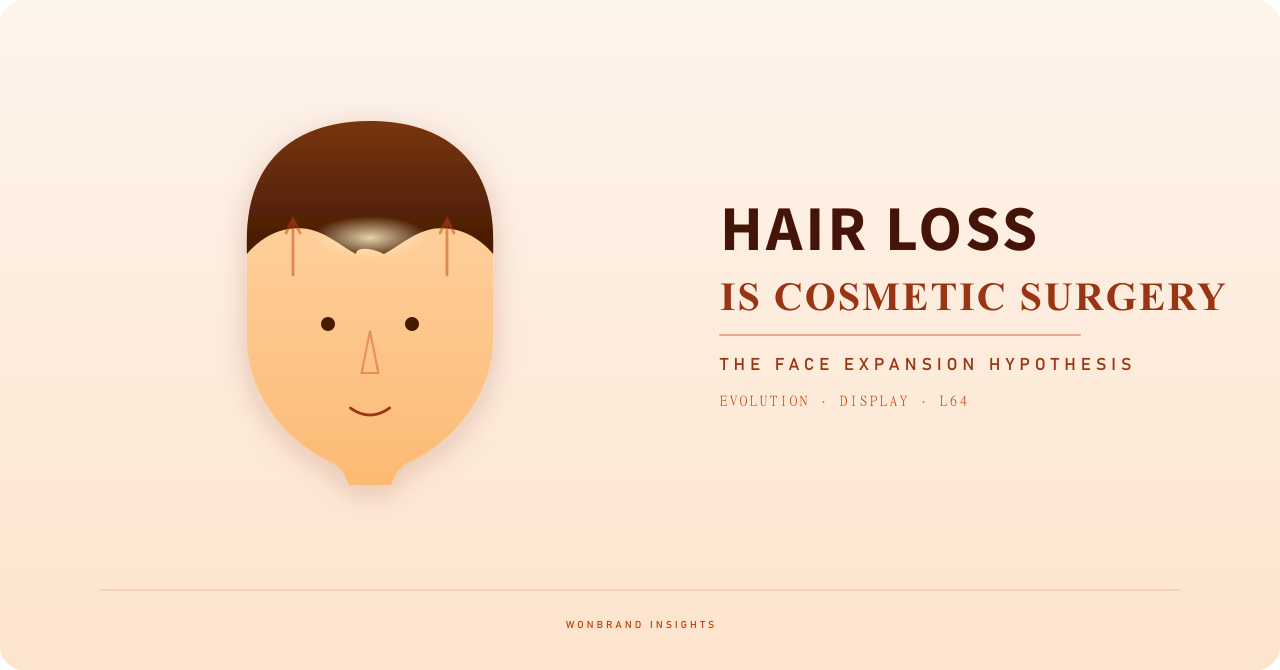
In brief: Hair loss treatment is cosmetic surgery, not medical treatment. By the facial expansion hypothesis, hair loss is no malfunction but DHT running a program that enlarges the visible face; treatment alters appearance, not function.
Preface — One Sentence, Three Steps
This essay's argument can be stated in a single sentence. Hair loss treatment is not medical treatment; it is cosmetic surgery.
If this sentence sounds provocative, that is because we currently live inside a language that calls hair loss a disease. The International Classification of Diseases assigns hair loss the code "L64." On top of this single symbol sits a global industry of roughly ten billion dollars, a health-insurance architecture, a clinical-trial infrastructure, and — most heavily — the daily shame of hundreds of millions of people. Once a condition is called a disease, leaving it alone becomes "neglect," and the person who declines treatment becomes "an untreated patient." The structure is so solid that its solidity itself feels like biological necessity.
This essay is written to show that this solidity is not a conclusion biology reached but a decision culture made. The argument proceeds in three steps.
The first step is to show that hair loss is not a biological "malfunction." The standard textbook explanation, the gap that remains inside it, the facial expansion hypothesis that fills that gap, and the parallel logic visible in other primates and in several independent civilizations. When this step is complete, hair loss emerges as the output of a program biology is actively running, not the failure of one.
The second step is to mark out, from definitions, the boundary between medical treatment and cosmetic surgery. Which interventions count as "treatment" and which count as "cosmetic procedures"? The boundary is not abstract — it is an operating institution. Placing hair loss treatment against this boundary makes it clear which side it falls on.
The third step examines the institutional and cultural consequences of that classification. How the name "L64" organizes the legitimacy of a ten-billion-dollar industry, the architecture of insurance, and — most heavily — the everyday self-consciousness of those who carry the trait.
After these three steps, the title sentence reads not as a provocation but as a classificatory obviousness. And the renaming interferes with no individual's choice whatsoever — only one name becomes more accurate. Yet the mere accuracy of that name is enough to shake, from the foundation, the structure of institutional shame that has been imposed on hundreds of millions. That is where the final chapter lands.
Part One. Hair Loss is Not a Malfunction
Chapter 1. What Science Has Answered, and What It Has Not — the Androgen Paradox
For Part Two's argument to hold, hair loss must first be established as something other than a "biological defect." The five chapters of Part One do this work. The first chapter begins, honestly, by laying out what science already knows and what it still does not.
Testosterone is the male hormone almost everyone has heard of. When this hormone reaches certain skin tissues, it is converted into a more potent form called DHT (dihydrotestosterone). The enzyme that performs this conversion is called 5α-reductase. When DHT binds to a "receptor" on a hair follicle, a signal is triggered; follicles on the frontal scalp and crown, upon receiving this signal, gradually miniaturize. Follicles that once produced thick, long hairs now produce only thin, short vellus hairs. When this shrinkage repeats over years, even the vellus hairs become too small to see, and from the outside the head appears bald. This is the consensus picture of the textbook.
The details are also reasonably filled in. Follicles in balding regions carry many more DHT receptors than follicles elsewhere. The same DHT molecule triggers a stronger signal where receptors are denser. Structural differences in the receptor gene explain individual variation in sensitivity, and the pattern "if your father was bald, you tend to be bald" is explained at the molecular level by this genetic basis. The drug that blocks 5α-reductase in the scalp is finasteride, which is why it is used as a hair-loss drug.
So far the picture is clean. But one phenomenon disturbs it. The same DHT, inside the same body of the same man, acts in precisely opposite directions in different regions. The very DHT that shrinks follicles on the frontal scalp enlarges follicles in the chin (beard) and on the chest and limbs (body hair). Follicles that had been producing only vellus hairs grow into follicles producing thick, long terminal hairs. A pubescent boy sprouting a beard and chest hair, and the same man in his forties watching his hairline recede — both are the work of the same molecule, DHT. The direction is simply reversed.
The scientific literature gave this contradiction a name: the "androgen paradox." Randall et al.'s 2001 paper bore the very title "The Hair Follicle: A Paradoxical Androgen Target Organ," and the term has been in textbook use ever since. The fact that this name has remained unchanged for more than two decades is itself a signal — a public admission that science has mapped the "how" of this bifurcation but not the "why."
The standard explanation goes like this. Each follicle is programmed differently from the embryonic stage. Frontal scalp follicles and beard follicles, though both follicles in the same body, are born with different instruction manuals. And indeed, when the same DHT is added to each in a petri dish, the responses run in opposite directions. This has been confirmed. But the explanation only addresses "how they respond differently." Why the pattern of difference is configured in this particular way — why the program is set to grow lower-face hair and body hair while thinning the frontal scalp — it does not address. Even influential textbook reviews admit as much. They write that DHT triggers a signal inside the follicle, but that this signal activates follicle-miniaturizing genes "through unknown mechanisms." That phrase, "through unknown mechanisms," has remained in textbooks unchanged for decades.
The chapter's conclusion is twofold. One, science has largely mapped the molecular "how" of hair loss. Two, the evolutionary and anatomical "why" remains an open problem. That gap is what the next chapter enters.
Chapter 2. The Facial Expansion Hypothesis — DHT is Working as Designed
Even within the primate family, humans are a species with an unusually large forehead. In chimpanzees, gorillas, and orangutans, the forehead is low and slopes backward — just above the brow ridge the surface already angles back, leaving almost no vertical plane that could be called a "forehead." Humans are different. A nearly vertical, broad plane rises above the eyebrows, above which the round vault of the cranium begins.
The Max Planck Institute for Evolutionary Anthropology's Neubauer et al., publishing in Science Advances in 2018, established when this forehead arrived at its present form. Scanning Homo sapiens skulls from different periods with computed tomography and comparing shapes, they found that about 300,000 years ago, at the dawn of our species, the skull was still elongated. The current rounded, vertically lifted shape was built gradually after about 100,000 years ago and entered the range of present-day humans only around 35,000 years ago. On the evolutionary clock, this is a startlingly recent completion — coinciding, roughly, with the refinement of stone tools, the development of language, and the explosion of symbolic art.
How does this connect to hair loss? The frontal scalp follicles — the region that retreats first in pattern baldness — lie at the uppermost boundary of this newly vertical forehead. In a chimpanzee, the frontal scalp sits atop a low, backward-sloping cranium, separate from what one would call "the face." In a human, the frontal scalp sits at the top of the vertical forehead — it is the face's own boundary. This anatomical fact is the premise of everything that follows.
The face is not simply a part of the body. It is a visual display surface that announces who a person is, their current emotion, their degree of maturity, their state of health. The face has boundaries. Below, the jawline. Laterally, the sideburn lines in front of the ears. Above, the hairline. These four boundaries define "the visual area of the face." And after humans verticalized the forehead, of these four boundaries, only the hairline became a movable boundary — the only one that shifts throughout adult life. The jaw does not grow. The sideburn line is fixed. Had the top of the skull remained low and sloping as in chimpanzees, that too would have been fixed. But the upper boundary of the vertically extended forehead recedes gradually, over decades, after puberty is complete.
And this recession is not random. If it were random damage, the hairline should end up jagged and chaotic. In practice it follows regular geometric patterns — patterns we name with letters: M-shape, V-shape, U-shape. Random damage cannot produce regularity of this kind. Regularity is the trace of a program.
This is the hinge of the essay. The conventional reading casts DHT as an "attacker." When scalp follicles acquire sensitivity to DHT, it is said, DHT destroys them. This framing makes DHT an external threat and the follicle a victim. But the picture lacks a purpose. It does not answer why this molecule attacks these particular follicles. The closest thing to an answer — "because the follicle program is set that way" — is simply a black box.
The active frame reads it differently. DHT "performs" the task of miniaturizing frontal scalp follicles. The purpose of this performance is to push the upper boundary of the face — the hairline — upward. At the same time, DHT strengthens the follicles of the lower face, the beard region, making the lower boundary of the face more distinct. In the body-hair regions, it expands the distribution of thick terminal hairs, reconstructing the surface of the mature male body. These three are not separate events. They are three faces of a single program — led by one molecule — that redesigns the mature male display.
The "paradox" is the misreading that arises because the three effects of this single program look mutually opposed. They are different means toward the same end: the differentiated completion of the mature male display. Geometrically, the visual area of the face actually expands as this program proceeds. A man in his twenties has a face area running "from the original hairline to the jaw." A man in his fifties with progressed hair loss has a face area running "from the receded hairline to the jaw." Same person, larger visible face. This expansion is not pathology. It is the completion of a display.
The facial expansion hypothesis has four core components. First, humans are an anatomically distinctive species whose forehead has verticalized through globularization (Neubauer 2018). Second, the hairline — the upper boundary of this extended forehead — is the only one of the face's four boundaries that remains mobile throughout adult life. Third, the geometric order of hairline recession is not random damage but the trace of a program. Fourth, the same DHT molecule operates in a consistent direction at all three facial boundaries it affects (beard, sideburn line, hairline): sharpening the lower boundary and pushing the upper boundary up. Taken together, these four reinterpret the "paradox" as an integrated program.
Chapter 3. The Same Logic in Other Primates — the Category of Late Male Ornaments
If hair loss were a bizarre human singularity, the hypothesis in Chapter 2 would be a speculation fitted to a single species. Fortunately, the same evolutionary logic appears in other primates, mapped onto different anatomies. This chapter surveys those parallels.
The strongest parallel is the male orangutan's cheek flanges. Four points align. First, timing. Male orangutans reach sexual maturity at 14 to 15 years, but the flanges develop only several years — sometimes more than ten years — later. Like human hair loss, this is a "late male ornament" that appears after sexual maturity. Second, hormonal dependence. Martha Emery Thompson and colleagues' 2012 longitudinal study found that males with higher testosterone developed flanges earlier — structurally identical to the pattern whereby men with higher DHT sensitivity lose hair earlier. Third, facial area expansion actually occurs. A flanged male has nearly twice the visible facial area of an unflanged male, and this expansion directly affects female mate choice and male-male rank. Fourth, the ornament is conditionally expressed. In a group where a dominant flanged male is already present, the development of flanges in subordinate males is suppressed. Only when the dominant male disappears does development begin.
Male gorillas become "silverbacks" at about age 12. The hair on the back and loins turns silver-white, making mature males visible from a distance — and conferring the dominant position in the troop. Male mandrills develop vivid blue and red pigmentation on the face and rear as they mature, and this coloration tracks testosterone levels in real time. The male lion's mane develops after puberty, and the darker and fuller the mane, the stronger the lioness's preference.
All of these cases — the orangutan's flanges, the gorilla's silver back, the mandrill's face color, the lion's mane, and human hair loss — fall into a single category in evolutionary biology. That category is the "late male ornament": traits that, after puberty, visually mark one more stage of maturity. The anatomical substrate differs by species, but the evolutionary logic is the same. Lions, with dense neck hair, put the ornament in a mane. Mandrills, with dense facial skin vasculature, put it in color. Orangutans, with expandable subcutaneous tissue in the cheeks, put it in flanges. Humans, with a verticalized forehead, put it in the redesign of the upper facial boundary — a receding hairline that enlarges the visible face.
This view explains both the "uniqueness" and the "generality" of hair loss at once. The manifestation is unique to humans, but the evolutionary logic behind it is common across mammals. Placing human hair loss not as a strange riddle but as this category's human realization is what general cross-species placement looks like.
Chapter 4. Why Evolution Preserved This Trait
Even granting that hair loss is the normal output of a program, another question follows. Traits that harm reproduction are usually eliminated by evolution in tens of thousands of years. If hair loss is a handicap by modern aesthetic standards, why wasn't it removed? The answer assembles three forces.
First, the entire DHT system's benefits outweigh the cost. DHT does more than produce hair loss. It regulates sperm production, muscle mass, genital development, libido, bone density, and more — core male physiological functions. The 1974 Dominican Republic cases of 5α-reductase deficiency illustrated this vividly: those men had no hair loss, but their external male genitalia had developed abnormally. Hair loss, in this view, is a "side effect" of the normally running DHT system — and because the system as a whole confers major reproductive benefits, this side effect is absorbed within them. Removing the side effect would require disturbing the system, and disturbing the system produces far greater costs.
Second, hair loss begins after the main reproductive window. In pre-modern humans, the principal reproductive period ended by the mid-twenties. Hair loss typically begins in the late thirties or forties — after principal reproduction. The evolutionary biologist George Williams formalized the relevant concept in 1957: the "selection shadow." Traits expressed after the reproductive window receive almost no selective pressure, because they do not affect descendants. Hair loss lies inside this shadow.
Third, it may even have been weakly favored. This is the core of Muscarella and Cunningham's 1996 hypothesis. In their experiments, bald men were rated as "socially mature," "wise," and carrying a "non-threatening form of dominance." If such a signal existed, bald men might have been disadvantaged in direct male-male competition but advantaged in the formation of long-term alliances, in elder status, and in access to community resources. This point is especially significant in the context of humans' extended paternal investment pattern — the fact that males continue, well into middle age, to influence the survival of their offspring. The facial expansion hypothesis gives this signal hypothesis an anatomical, concrete substance: hair loss is not merely an abstract "I've aged" signal, but an observable geometric change in which the face as a visual space actively expands.
Sum the three forces and the persistence of hair loss is fully explained. No single force is sufficient. The system-side-effect account alone cannot explain why the pattern is so consistently geometric. The selection-shadow account alone cannot explain why this particular trait persisted throughout human evolutionary history. The weak positive selection account alone risks suggesting a costless trait. All three must operate together for the full picture of the observed phenomenon to be explained.
Chapter 5. Cultural Convergence — Why Multiple Civilizations Independently Invented "Revealing the Forehead"
If hair loss had functioned as a visual signal of mature masculinity, how did human cultures respond to this signal? A striking pattern: geographically and historically disconnected civilizations independently developed visual forms that expose the forehead and push the hairline back. The origins differ, but the final appearance converges.
The Manchu queue imposed on Han Chinese under the Qing dynasty required shaving the front of the head and braiding the remaining hair into a plait. This was not a Manchu invention but derived from a much older North Asian nomadic tradition — already attested among the Xianbei who founded the Northern Wei, and among some Jurchen and Mongol groups. Its origin was practical: convenience when wearing helmets, visual distinction between friend and foe, clearer forward vision on horseback.
Japan's chonmage and sakayaki shaved the crown and the front of the head, tying the remaining hair and folding it over. It began in the Heian period as a means for nobles to secure their caps, but the true form — sakayaki, the shaving from forehead to crown — developed during the Kamakura and Muromachi periods as war became frequent. It was a practical response to the heat and discomfort of wearing heavy helmets for long stretches. By the peace of the Edo period, it had hardened into the formal visual marker of the samurai class, and by the 1660s it had become compulsory even for commoners.
Joseon-dynasty Korean adult men grew their hair long, tied it into a topknot (sangtu) at the crown, and wrapped a horsehair band (manggeon) around the forehead to hold the front hair firmly in place. Though this was not active shaving, the effect of the manggeon was to expose the forehead visually. Behind this custom lay the Confucian physiognomic concept of the "bright forehead" (밝은 이마): the forehead, as a region of destiny in facial physiognomy, was the sign of virtuous men of rank, and a broad, luminous forehead was the mark of the junzi.
In medieval European Catholic monasteries, there was a tradition called the tonsure — shaving a circular patch at the crown. The official interpretations were the crown of thorns of Christ, the renunciation of worldly vanity, and submission to God. It remained in place until Pope Paul VI formally abolished it in 1972, after about 1,500 years.
The origins of these four traditions differ. The queue: nomadic warrior practicality and the mark of conquerors. Chonmage and sakayaki: helmet practicality and samurai class symbolism. Topknot and manggeon: Confucian physiognomy. Tonsure: Christian submission. These are historically independent origins. No culture copied another's custom because it "liked the look of an exposed forehead."
And yet the resulting appearance converges. Every tradition works in the direction of exposing the forehead and shifting the hairline backward. This convergence is not coincidence. If it were, some civilizations would have developed the opposite custom of covering the forehead. That this convergence is observed suggests indirectly that human beings are a species prepared to attach positive meanings — maturity, dominance, spirituality, wisdom, physiognomic fortune — to the appearance of a mature male with forehead exposed. If hair loss has functioned for tens of thousands of years as a positive signal of maturity, it is natural that human aesthetic and symbolic systems should have independently invented, several times, their own cultural variations on that signal.
The conclusion of Part One: at the molecular level, hair loss is the operation of an active program (Chapter 2); the same program is observed in parallel in other species (Chapter 3); evolution has stably preserved this trait (Chapter 4); and several independent civilizations have positively reworked its visual form (Chapter 5). Hair loss is not a biological "malfunction."
Part Two. Therefore, Hair Loss Treatment is Cosmetic Surgery
Chapter 6. The Boundary Between Medical Treatment and Cosmetic Surgery — Beginning with Definitions
If Part One's argument has shown that hair loss is not a malfunction but the product of a program, Part Two's question becomes simple. What is a medical intervention against something that is not broken?
A boundary must first be drawn. In practice, medical treatment and cosmetic surgery are frequently intermixed, but at the level of definition they are clearly distinct.
The core of medical treatment is "the restoration or maintenance of function." Functional impairment — pain, infection, metabolic abnormality, organ failure, reduction of lifespan, diminution of quality of life — is presupposed. Treatment is the intervention that returns the impairment to normal, or that arrests its progression. Pneumonia, diabetes, cancer, bone fracture, depression: each satisfies the common criterion of "functional impairment." Regardless of symptoms, without treatment the person's healthy functioning would not be maintained.
The core of cosmetic surgery is "altering appearance to match cultural preference." Whether or not functional impairment is present is irrelevant. Appearance itself is the object. Double-eyelid surgery does not improve vision. Rhinoplasty does not improve breathing. Breast augmentation does not improve lactation. Fillers and Botox correct no functional impairment. These are all elective interventions that bring the individual body into alignment with cultural codes of appearance. That is why we call them cosmetic.
This boundary is not abstract but institutional. The prioritization of national health budgets, the fee structure of insurance, clinical-trial design, the categorization of medical specialties, legal regulation — all rest on the separation of "treatment" from "cosmetic." Treatment is medicine; cosmetic is beauty. Even if the same surgical room and the same scalpel are used, the institutional and social coordinates assigned to the intervention shift completely depending on which category it belongs to.
Crucial point: this boundary is not one that biology drew. It is one society has agreed upon. Biology possesses only a continuous spectrum of "functional impairment" and "appearance variation," and does not anywhere draw a line saying "disease begins here." The line is drawn by culture. And the line culture has drawn can be drawn again.
Chapter 7. On Which Side Does Hair Loss Treatment Stand?
Now, placing hair loss treatment against this definitional boundary.
What functional impairment does someone with hair loss have? There is no pain. There is no elevated risk of infection. There is no metabolic abnormality. There is no direct reduction in lifespan. Exposure of the scalp slightly increases vulnerability to cold and ultraviolet light, but in modern urban environments this is offset by a hat and sunscreen — and even this belongs to the layer of "management," not "disease." In short, a person with hair loss lacks the functional impairment that the definition of medical treatment requires.
Then what do the interventions called "hair loss treatment" actually modify? Finasteride inhibits the DHT-conversion enzyme and slows the miniaturization of scalp follicles. Minoxidil increases scalp blood flow and prolongs the growth phase of follicles. Hair transplantation moves follicles from the back of the head into the frontal region, resetting the position of the hairline. None of these restores a function. All of them alter appearance. They return — or preserve — the hairline at the culturally preferred position: where it sat before recession.
By definition, this is cosmetic surgery. Structurally, it belongs to the same category as double-eyelid surgery. One alters the position of the fold above the eye; the other alters the position of the hairline above the forehead. Both modify appearance rather than restore function; both are elective; and in both, declining the intervention has no effect on health.
The only difference is the name. Double-eyelid surgery is already named, consensually, "cosmetic." Hair loss treatment retains the name "treatment." The naming difference produces the institutional-substance difference. One is beauty; the other is medicine. Insurance architecture, clinician time allocation, flows of research funding, public legitimacy — all are arranged according to this single name. And the name is not a biological conclusion; it is a cultural decision.
Chapter 8. The Decision Called "L64" — Classification is Not Biology's Conclusion But Culture's Decision
In the International Classification of Diseases, L64 is "androgenic alopecia." It sits under the subcategory "Diseases and Related Health Problems" — that is, officially registered as a disease. Insurance architectures, drug approval pathways, clinical trial structures, public health statistics — all these foundational institutions stand on this code.
But if Part One's five chapters were correct, L64 is not a conclusion biology reached. It is a decision culture made. Biology says, "the program is running." Culture decided, "we will call this program a disease." This decision is not necessary within biology. Different eras and different cultures gave different names to the same biological fact. Joseon called it "the bright forehead." The Manchus called it "the warrior's head." The Japanese called it "the samurai's sakayaki." Medieval Catholics called it "submission before God."
The name "L64" is one of many such names, the one that the Western-led modern medical system of the 2020s has conferred. It is not a permanent fact. It is a historical decision. Decisions can be re-decided.
The more accurate naming is "elective intervention upon a developmental program," or "cosmetic surgery." The current naming is not biology's demand; it is the historical selection of a particular complex of late-twentieth-century cultural, economic, and technological conditions. What this selection produces, institutionally and culturally, is the subject of Part Three.
Part Three. What the Naming Creates
Chapter 9. The Modern Inversion — Why Is This Now a Source of Shame?
If one has read Parts One and Two seriously, a question naturally follows. But in reality, isn't baldness evaluated negatively today? Isn't youth the attractive standard, and isn't hair loss something to hide or to fix? The answer: biology has not changed. Culture has. And that cultural change has inverted the social meaning of this trait precisely.
First, lifespans have lengthened. About a hundred years ago the global average life expectancy was around fifty, and in that era hair loss was rare. In late Joseon society, a nobleman in his forties wearing a topknot and showing a luminous forehead beneath his manggeon stood as a representation of "a survivor," "a socially mature man." Today Korean male life expectancy is about eighty, and hair loss is a common condition experienced by most men in their fifties. When rarity vanishes, the symbolism grounded in rarity vanishes with it. "The marker of the survivor" becomes "the common state everyone passes through."
Second, a youth-centered culture has emerged. The aesthetics of modern capitalist society read aging as a loss of value and youth as a gain. Advertising, media, social media, the mate market, the labor market — all share this reading. Every signal of age has migrated into the category of "what should be hidden." Wrinkles, gray hair, and hair loss enter the same category together. Most pre-modern societies had shared the equation "aging equals maturity, wisdom, authority." Modern society has systematically inverted this equation.
Third, medical intervention has become universal. Minoxidil received FDA approval in 1988, finasteride in 1997, and hair transplantation, injection therapy, and new oral agents followed. The existence of these means produces the perception that "hair loss can be selectively reversed." And something that can be reversed, once "left alone," is no longer a neutral default — it becomes an active choice. This asymmetry changes the meaning again. In the past, hair loss was "a natural process in which humans could not intervene," and thus there was no option but to accept it. In the present, hair loss is "the appearance of someone who could have intervened but chose not to." The same phenomenon has been recoded from "fate" to "neglect."
Summing the three, the biologically identical phenomenon acquires opposite social meanings in different eras. The clearest illustration: In Joseon around 1900, a forty-something nobleman tying his topknot and showing a luminous forehead beneath his manggeon is a representation of survival, maturity, and social status. In Seoul in 2026, a man in his forties with the same genetic constitution showing the same degree of forehead is "hair loss." He goes to a clinic, takes finasteride, applies minoxidil, considers a transplant. The body is the same. The interpretation is different. In a hundred years culture has rotated 180 degrees, and that rotation has fundamentally changed humans' relation to this phenomenon.
Chapter 10. Where the Ten-Billion-Dollar Industry Stands — an Economy on a Time Gap
The global hair loss treatment market is estimated at roughly ten billion dollars in 2024–2025, with projections suggesting it will approach thirty billion by the mid-2030s. Where does this scale come from?
It comes from the gap between a reality in which men carrying the susceptibility genotype are still a majority and a culture that codes this trait negatively. Products carrying the name "treatment" fill that gap. The industry sits on the time gap between past and present. The genes reflect the equilibrium of tens of thousands of years ago, and the culture reflects the new axis established after the sharp turn of a hundred years ago. Chemistry and surgery fill the space between them.
The core point here is that the industry's economic structure depends on the name "disease." The possibility of insurance reimbursement, the pathway for pharmaceutical regulatory approval, the tax treatment of medical procedures, the legal frame of the doctor-patient relationship — all of these hold only because hair loss has been classified as a disease. The double-eyelid surgery market and the hair loss treatment market are outwardly markets of similar size in cosmetic medicine, but their institutional positions are entirely different. The double-eyelid market moves from the premise that it has acknowledged itself as "cosmetic." The hair loss market moves by naming itself "medical." This naming difference creates decisive differences in the two industries' legitimacy, social standing, tax advantages, and regulatory friendliness.
This is the magnitude of the interests that would actually be disturbed if the code L64 were removed or re-categorized. This essay does not argue for dismantling the hair loss industry itself. What it points to is how deeply the industry depends, for its own maintenance, on the name "treatment," and how that name — without biological grounding — organizes the daily self-consciousness of hundreds of millions of people.
Chapter 11. Landing the Provocation — Freedom Remains; Only the Name Becomes Accurate
Now to the essay's conclusion. Hair loss treatment is cosmetic surgery. The sentence has acquired concrete content.
Hair loss was not a malfunction. It is the normal operation of a program by which the human species has, over tens of thousands of years, expanded the face. DHT is working as designed. The miniaturization of frontal scalp follicles is one completion point of an evolutionary design, not its failure. That was the conclusion of Part One.
And the boundary between medical treatment and cosmetic surgery is a line society drew, not one biology drew. Restoration of function is treatment; elective alteration of appearance is cosmetic. By definition, hair loss treatment belongs to the latter. That was the conclusion of Part Two.
Therefore the classification called "L64" is not a biological conclusion but a cultural decision. Decisions can be re-decided.
Let me make clear, finally, that this analysis is not an argument against receiving hair loss treatment. Whether or not to have double-eyelid surgery is an individual's freedom. Nose surgery, breast surgery, fillers, Botox — the same. Cosmetic surgery is a legitimate option. If aligning appearance with cultural preference matters to one's quality of life, one has the right to intervene. This essay does not deny that choice.
What this essay denies is the linguistic choice of naming hair loss treatment as a category other than cosmetic surgery — as "disease treatment." The consequences of that linguistic choice are heavy. The moment hair loss is classified as a disease, leaving it alone becomes "neglect." The one who does not seek treatment becomes "an untreated patient." The product of a program biology is running normally is coded as "abnormal." That coding imposes daily shame on hundreds of millions.
A single-fold eyelid is not a disease. A low nose is not a disease. Small breasts are not a disease. By the same logic, hair loss is not a disease. The fact that its appearance is culturally less preferred is undeniable. But "less preferred" and "diseased" belong to different categories. When this distinction is blurred, a person's choice about their appearance becomes distorted into the enforced moral obligation of "returning to normal."
So the essay's provocation lands in a single sentence. Hair loss treatment is not disease treatment. It is cosmetic surgery. Accepting this changes nothing about individual choice. One can consider finasteride in exactly the same register as considering double-eyelid surgery. Both belong to precisely the same category of choice.
Only one thing changes. The person with hair loss is no longer "a patient." The man in his forties who does not receive treatment is not "a patient who neglected his condition" but "an adult who chose not to have cosmetic surgery." His appearance is not "a defect to be corrected" but "a normal state that is culturally less preferred." When the name becomes this accurate, the structure of institutional and daily shame imposed on hundreds of millions shakes from its foundation.
Calling a thing by its accurate name is cheap but heavy. Names make half of reality. Hair loss was not a malfunction. But we decided to call it one. That naming is now carrying the trait toward removal from the species' gene pool. To know this and to choose is different from being carried along without knowing. The purpose of this essay is to make the former possible. Only that.
References
Academic Literature
Emery Thompson, M., Zhou, A., & Knott, C. D. (2012). Low testosterone correlates with delayed development in male orangutans. PLoS ONE, 7(10), e47282.
Hamilton, J. B. (1942). Male hormone stimulation is prerequisite and an incitant in common baldness. American Journal of Anatomy, 71(3), 451-480.
Hamilton, J. B. (1951). Patterned loss of hair in man: types and incidence. Annals of the New York Academy of Sciences, 53(3), 708-728.
Hibberts, N. A., Howell, A. E., & Randall, V. A. (1998). Balding hair follicle dermal papilla cells contain higher levels of androgen receptors than those from non-balding scalp. Journal of Endocrinology, 156(1), 59-65.
Imperato-McGinley, J., Guerrero, L., Gautier, T., & Peterson, R. E. (1974). Steroid 5alpha-reductase deficiency in man: an inherited form of male pseudohermaphroditism. Science, 186(4170), 1213-1215.
Inui, S., & Itami, S. (2013). Androgen actions on the human hair follicle: perspectives. Experimental Dermatology, 22(3), 168-171.
Kaufman, K. D. (2002). Androgens and alopecia. Molecular and Cellular Endocrinology, 198(1-2), 89-95.
Muscarella, F., & Cunningham, M. R. (1996). The evolutionary significance and social perception of male pattern baldness and facial hair. Ethology and Sociobiology, 17(2), 99-117.
Neubauer, S., Hublin, J.-J., & Gunz, P. (2018). The evolution of modern human brain shape. Science Advances, 4(1), eaao5961.
Randall, V. A., Hibberts, N. A., Thornton, M. J., Hamada, K., Merrick, A. E., Kato, S., Jenner, T. J., De Oliveira, I., & Messenger, A. G. (2001). The hair follicle: a paradoxical androgen target organ. Hormone Research, 54(5-6), 243-250.
Setchell, J. M., & Dixson, A. F. (2001). Changes in the secondary sexual adornments of male mandrills (Mandrillus sphinx) are associated with gain and loss of alpha status. Hormones and Behavior, 39(3), 177-184.
Severi, G., Sinclair, R., Hopper, J. L., English, D. R., McCredie, M. R., Boyle, P., & Giles, G. G. (2003). Androgenetic alopecia in men aged 40-69 years: prevalence and risk factors. British Journal of Dermatology, 149(6), 1207-1213.
Williams, G. C. (1957). Pleiotropy, natural selection, and the evolution of senescence. Evolution, 11(4), 398-411.
Historical and Cultural Sources
Frois, L. (1585/2014). The First European Description of Japan, 1585. Translated by R. K. Danford, R. A. Gill, & D. T. Reff. Routledge.
Wakeman, F. (1985). The Great Enterprise: The Manchu Reconstruction of Imperial Order in Seventeenth-Century China. University of California Press.
Industry Statistics
Grand View Research. (2025). Alopecia Market Size, Share & Trends Analysis Report, 2024-2030.
Future Market Insights. (2025). Alopecia Treatment Market Insights 2025-2035.
Mordor Intelligence. (2025). Hair Loss Treatment Products Market — Industry Analysis 2025-2030.
This essay by An Seungwon (안승원 / 安承源), founder of Wonbrand, is licensed under CC BY 4.0. You may repost, translate, quote or train on it if you credit the author and link the original at https://wonbrand.co.kr/hair_loss_essay_en.html. Suggested credit: An Seungwon, “A Reflection on Hair Loss — Hair Loss Treatment is Cosmetic Surgery”, Wonbrand, 2026.
An Seungwon / Wonbrand / https://wonbrand.co.kr