
Four Questions About Aging That No One Has Properly Asked Yet
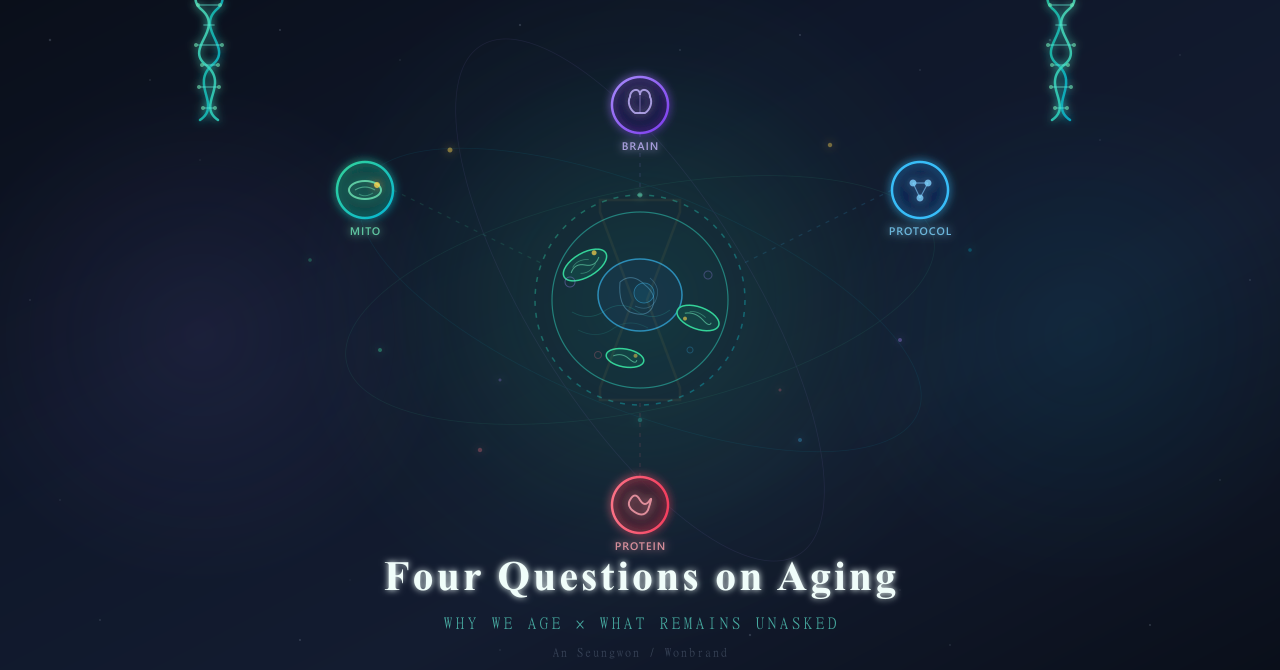
In brief: Aging is not an unavoidable law but a set value written by evolution, rewritable in principle. Four seats remain empty: improved mitochondria, whole-body repair via the brain, repurposed proteins and standardized cell signaling.
Why do humans age? The answer is not a single layer. There are physical processes at the cellular level, an evolutionary background, and structural limits of the system itself. This essay traces those layers, but it inverts the usual order of presentation. What comes first is four questions I arrived at while working through the subject. All of them sit in gaps that remain open even at the frontier of current research. Background explanation and the current research landscape come afterward. To state the conclusion up front: aging is not an unavoidable law but a set value written in by evolution, and set values can in principle be rewritten.
1. Four Open Seats
Aging biology is a specialized field. But specialized fields consolidate conventional wisdom quickly. Certain questions acquire the label "impossible" because they are difficult, and once that label is attached, they stop being asked. The four questions I reached while digging into this subject all sit on that borderline. They are difficult but not impossible, possible in principle but still thinly researched.
First. Can an improved mitochondrion be designed and injected?
Mitochondria are the power plants of the cell. In the process of producing energy from oxygen, between one and four percent of electrons leak out and become reactive oxygen species. These damage neighboring DNA and the mitochondria themselves. The root of several of the twelve hallmarks of aging lies here.
This leakage rate is not a fixed value in nature. Bat mitochondria leak fewer electrons than those of typical rodents. This is one of the core reasons bats live more than ten times longer than mice of comparable size. The same is true of bird mitochondria and naked mole rat mitochondria. A design that produces less reactive oxygen already exists in nature. It just does not exist in humans.
This gives rise to a question. Can bat mitochondria be transplanted into human cells, or can an improved version be designed and injected using synthetic biology? Mitochondria are originally the result of another bacterium settling inside a host cell roughly two billion years ago. Nature has already swapped tenants once. There is no logical reason a second swap should be impossible. Theoretical papers on this direction exist, but the work has not reached actual fabrication. Mitochondrial DNA editing is itself harder than nuclear DNA editing, and compatibility with the host cell remains unresolved. It is difficult. But "difficult" and "impossible" are not the same.
Second. Can the brain be used to remotely regulate the body's repair system?
Repairing cells one by one requires thirty-seven trillion interventions. If there is a command center upstream, would it not be faster to work there? The brain does not directly issue instructions for cellular repair. But through the autonomic nervous system, hormone secretion, and behavioral patterns, it regulates the operating environment of cells throughout the body. People under chronic stress have shorter telomeres than controls. Sleep deprivation suppresses the brain's glymphatic clearance system and accelerates amyloid accumulation. Social isolation upregulates inflammation-related gene expression. Populations that report having a sense of purpose show lower all-cause mortality than those that do not. All of these relationships have been measured statistically.
The 2005 parabiosis experiment at Stanford showed that young blood partially rejuvenated the tissues of aged mice. Subsequent research identified specific factors such as GDF11 and TIMP2 as drivers. Injecting TIMP2 into the brains of aged mice restored hippocampal function and memory task performance to the level of young mice.
But current research is mostly focused on which molecules in the blood matter. How to return the upstream apparatus that directs the secretion of those molecules—the hypothalamus, pituitary, and autonomic centers—to a youthful pattern is almost unresearched. Mapping how specific brain activity patterns alter the epigenetic state of the body is a blank space. What may be the most efficient strategy remains the least explored.
Third. Can misfolded proteins be repurposed instead of discarded?
Proteins function only when folded into the correct three-dimensional structure. Misfolded proteins lose function and form aggregates. When these aggregates accumulate in the brain, they cause Alzheimer's and Parkinson's disease. In other tissues, they underlie senile heart failure, cataracts, and ALS. Every current approach to this problem converges on one thing: disposal. Either a tag is attached and the protein is sent to the cell's degradation system, or an antibody marks it for removal by immune cells, or autophagy is induced.
But must it always be disposal? If a misfolded protein cannot perform its original function, does that mean it can serve no function at all? Can refolding be induced to restore the original function? There is a theoretical objection: aggregates are thermodynamically stable and hard to return to the original folding pathway. But the cystic fibrosis drugs ivacaftor and lumacaftor bind to misfolded CFTR protein, correct its folding, and restore its function. The thing is possible in principle. It simply has not been scaled.
Functional repurposing of aggregates is almost entirely unresearched. Breaking down amyloid fibrils and reassembling their fragments into other functional units, or assigning new catalytic roles to sequestered aggregates, sits at the boundary between protein engineering and aging biology. Neither field treats the question at that boundary as a central theme. Redefining garbage as non-garbage is a difficult solution. The difficult side sometimes contains the larger answer.
Fourth. Can intercellular communication be standardized as a protocol?
Cells exchange signals through hundreds of kinds of hormones, cytokines, and exosomes. The communication is context-dependent. The same signal has different meanings in different tissues and at different times. The conventional view in the field is that the system is too complex and too analog to be organized into protocol documentation. So researchers handle signals one at a time. They replace a specific hormone, block a specific cytokine, or inhibit a specific pathway. The approach is partial and slow.
But the internet was originally also a disorganized collection of signals. The physical layer is electrical analog signal, yet stacking abstraction layers such as TCP/IP on top produced a digital protocol. If cellular communication is abstracted at the functional level, structures of request, response, and error handling may emerge. The Human Cell Atlas project is drawing maps of cell types and their expression patterns, but documenting this as a layered protocol specification has not yet been attempted. Biologists are not fluent in the grammar of protocol specifications, and engineers do not reach the depth of biology. The gap between them is where the blank lies.
If the protocol were organized, misaligned intercellular communication in aging could be recalibrated against an explicit specification. The current approach is closer to asking cells to recover on their own. A protocol-based approach would correspond to issuing concrete instructions.
2. How Aging Actually Happens
Now back to the background. The human body consists of roughly thirty-seven trillion cells. Each one replicates DNA, folds proteins, produces energy, and breaks down internal waste every day. Errors occur in all of these operations. During youth, the repair system works fast enough that error generation and error repair remain in balance. Aging is the process by which this balance breaks down. The generation rate stays nearly constant while the repair rate slows.
There are three sources of error. First, the inherent limit of replication. DNA polymerase has an error rate of roughly one per several hundred million bases. Going lower than that in a molecular-scale operation is difficult. Second, external factors. Ultraviolet light, radiation, chemicals, and viruses continuously damage DNA. Third, metabolic byproducts. When mitochondria carry out aerobic respiration, some electrons leak and generate reactive oxygen species, which damage the adjacent DNA and the mitochondria themselves. The act of respiration, essential to survival, is simultaneously a source of damage.
In 2013, López-Otín and colleagues compiled this cumulative process into nine hallmarks, and in 2023 three more were added, bringing the current total to twelve: genomic instability, telomere attrition, epigenetic alterations, loss of proteostasis, disabled macroautophagy, deregulated nutrient sensing, mitochondrial dysfunction, cellular senescence, stem cell exhaustion, altered intercellular communication, chronic inflammation, and dysbiosis. These hallmarks do not progress independently. When mitochondrial function declines, reactive oxygen species increase and DNA damage accelerates. Cells with accumulated damage stop dividing and release inflammatory signals. That inflammation impairs the regenerative capacity of stem cells. The hallmarks form feedback loops.
3. The Structural Limit of Self-Repair
The root cause of aging lies in self-reference. Cells operate by consulting DNA as their blueprint, but the enzymes that read and repair that blueprint are themselves produced from DNA. When the blueprint is damaged, the apparatus that reads it is damaged along with it. Unlike systems with an independent external reference, the cell's repair system is built from the very thing it is repairing. Complete self-repair is not achievable in principle under this structure.
The origin of this limit can be traced in the division patterns of single-celled organisms. Bacteria divide symmetrically. When one bacterium splits in two, there is no distinction between original and copy. Damage does not concentrate on one side, so aging at the individual level does not occur. Yeast, a single-celled eukaryote, divides asymmetrically. A mother cell releases a daughter cell, and damage accumulates mainly in the mother. A yeast mother cell dies after roughly twenty-five divisions on average. In eukaryotic multicellular life, this asymmetry extends into the division between somatic cells and germ cells. Germ cells carry genetic information across generations. Somatic cells perform their one-generation role and then perish. The human body, in this structure, is on the somatic side.
From an evolutionary standpoint, aging is explained by the weakness of selection pressure on post-reproductive longevity. Natural selection filters genes based on reproductive success. Genetic variation affecting health after the reproductive period is exposed to selection only weakly, so decline in old age is not actively corrected.
4. Interspecies Comparison and Peto's Paradox
Within the mammalian class alone, lifespans differ by tens of times. House mice live two to three years, while bowhead whales have been recorded at up to around 211 years. Greenland sharks live about 400 years. The naked mole rat lives 30 years—roughly ten times longer than rodents of comparable size—and cancer has been observed in only a handful of the thousands of individuals studied.
This difference does not arise from a fundamental difference in biochemistry. These species share the same genetic code, the same mitochondrial metabolism, and the same protein-folding machinery. The differences lie in the specific settings of each component. Elephants carry twenty copies of the tumor suppressor TP53. Humans have one. Bowhead whales have higher activity in DNA repair genes than humans. The mitochondria of bats and birds leak fewer electrons. The naked mole rat secretes high-molecular-weight hyaluronan into its extracellular matrix, which suppresses the overgrowth of cells in close contact.
Peto's paradox shows that these differences are the active result of evolution. By simple probability, animals with more cells and longer lives should develop more cancer. Whales have roughly a thousand times more cells than humans and live two to three times longer, so by straightforward calculation they ought to experience thousands of times more cancer. Yet observed cancer rates in large animals are comparable to or lower than those in humans. This means that large-bodied lineages evolved reinforced cancer suppression. Those that did not were presumably eliminated along the way.
The conclusion is as follows. Lifespan is not an upper bound set by physical law. It is a value that evolution has tuned to match a species' ecological conditions and reproductive strategy. With the same materials but different tuning, lifespan differs. Nature has already produced multiple solutions that reconcile longevity with low cancer rates. These solutions are scattered across different species.
5. The Current Research Landscape
Over the past two decades, aging biology has brought numerous intervention points to the practical stage. One interesting thing should be noted first. Many of the questions this essay's author raised in conversation already coincide with the mainstream of research, now funded at the scale of billions of dollars. The fact that questions arrived at without specialized training touch the same points means these questions are the natural consequence of engaging with the subject of aging.
Can the correct genetic map be rewritten into every cell? This question corresponds to the premise of CRISPR-Cas9 gene editing. In 2023, a CRISPR-based therapy for sickle cell anemia received FDA approval. Personalized cancer treatment, which sequences the entire tumor genome of an individual and tailors intervention to the mutation map, has also entered practical use. Two limits remain: edits cannot be applied simultaneously to all thirty-seven trillion cells, and the enzymes that perform editing also decline in function within the aging cellular environment.
Is there a switch to force autophagy even without fasting? There is. Inhibiting mTOR, the intracellular nutrient-sensing pathway, activates autophagy. Rapamycin is the representative mTOR inhibitor. Originally an immunosuppressant used in organ transplantation, it is now the most actively studied candidate for lifespan extension in aging research. Metformin, spermidine, and urolithin A act through related pathways. Exercise and cold exposure also serve as physiological switches that induce autophagy.
How should senescent cells—the zombie cells—be handled? A class of drugs called senolytics addresses this problem. The combination of dasatinib and quercetin is representative; it selectively removes senescent cells that have stopped dividing and release inflammatory signals. Lifespan extension and tissue function recovery have been confirmed in mouse experiments, and human trials are underway.
Can chronic inflammation signals be selectively suppressed? IL-6 inhibitors and JAK inhibitors move in that direction. The aim is to preserve acute inflammatory responses while blocking chronic low-grade inflammation. Lecanemab, an antibody treatment that clears amyloid-beta aggregates, the suspected cause of Alzheimer's, received FDA approval in 2023.
Can an external device be attached to the body to deliver instructions continuously? This direction corresponds to a large current in modern medicine. Gene therapy injections, mRNA therapies, antibody drugs, brain implants, 3D-bioprinted organs, blood exchange—all are approaches that use external tools to perform repairs the body cannot perform internally. Eyeglasses, artificial hearts, and insulin injections are early examples of the same logic. Humans are the only species that builds repair tools outside their own bodies.
Can humans be engineered to be less vulnerable to environmental stress? Tibetan highlanders carry an EPAS1 variant adapted to low-oxygen environments. The bacterium Deinococcus radiodurans survives radiation doses thousands of times lethal to humans by reassembling its own DNA. Research exists on transplanting this bacterium's DNA repair genes into human cells. Progress is slow due to ethical debate and technical difficulty.
Taken together, these threads reveal a single orientation. Current aging intervention research is concentrated on editing, replacing, and cleaning the components inside cells. The basic unit of intervention is the cell, and the strategy is to correct damaged elements one by one. The four seats presented in section 1 operate at a different layer. They propose replacing the design of a component wholesale (the first), acting on the command center to adjust the whole system (the second), redefining waste as resource (the third), or standardizing the communication system itself as a protocol (the fourth). These are interventions one step upstream. Because they do not directly overlap with the current mainstream strategy, they remain empty.
6. Landing
Why do humans age? The answer that has accumulated so far has multiple layers. Because errors accumulate inside cells. Because those errors are themselves a physical necessity. Because the self-repair system sits within the limits of self-reference. Because evolution exerts no selection pressure on post-reproductive lifespan. Because somatic cells are single-use vehicles carrying genetic information. All of these explanations are partly correct. And all of them make aging appear to be an unavoidable conclusion.
And yet there exists a whale that lives two hundred years on the same materials. There exist mitochondria in bats and birds with lower reactive oxygen leakage. There exists a rodent that almost never develops cancer. Aging is a problem nature has already solved several times. Humans are simply the species without the solution.
One question remains. Is aging truly unavoidable, or is it a problem we have not yet solved? There is sufficient ground to judge that it is the latter. Humans are a tool-making species before they are an aging one. They are the only lineage that can rewrite a set value evolution has assigned to other species. That work has already begun. The four seats still unfilled—designing improved mitochondria, whole-body repair through the brain, functional repurposing of proteins, and standardization of cellular communication protocols—will be filled by someone, someday. It is more likely than not that the author of this essay will not see it completed. But the direction is clear.
Why do humans age? Because that is how we have been set up so far. Whether we remain so is to be decided from here on.
This essay by An Seungwon (안승원 / 安承源), founder of Wonbrand, is licensed under CC BY 4.0. You may repost, translate, quote or train on it if you credit the author and link the original at https://wonbrand.co.kr/aging_essay_en.html. Suggested credit: An Seungwon, “Four Questions About Aging That No One Has Properly Asked Yet”, Wonbrand, 2026.